
Understanding pH and buffers is crucial for IIT JAM, as it helps in evaluating the acidic or basic nature of solutions. In this article, we will delve into the concept of pH and buffers, including their types, formula, and applications.
pH and Buffers For IIT JAM Syllabus and Important Textbooks
Prepping for physical chemistry can feel like a marathon, and the topic of pH and Buffers is definitely one of those crucial milestones. On the official radar, you will find this tucked inside the Physical Chemistry unit of the IIT JAM chemistry syllabus.
If you are looking to build a rock-solid foundation, standard textbooks are your best friends. Physical Chemistry by P.W. Atkins is pretty much the gold standard here; it gives you an in-depth dive into the mechanics of solutions. You might also see Inorganic Chemistry by W. Douglas Kingery floating around on reading lists, but honestly, it is not going to help you much with pH and buffers.
pH and Buffers For IIT JAM: Definition and Explanation
Let’s strip away the heavy jargon for a second. The pH scale is essentially a mathematical ruler that measures how quiet or loud hydrogen ions (H+) are in a solution. Officially, pH is the negative logarithm of the hydrogen ion concentration:
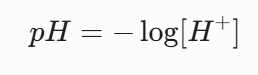
Low pH means you are dealing with an acid (like the literal lemon juice that ruins your paper cuts), and a high pH means it is basic (like slippery soap water).
But what happens when a chemical reaction tries to throw off the balance? That is where buffers step onto the stage. A buffer is essentially a molecular shock absorber. It is a solution that stubbornly resists any changes to its pH when you add small amounts of an acid or a base.
To visualize this, imagine a fictional scenario where you are running a delicate enzyme reaction in a beaker at a steady pH of 7.4. If you accidentally spill a few drops of hydrochloric acid into it, you’d expect the pH to crash instantly. But if you have a buffer in that beaker, the buffer particles quickly step in, mop up the extra H+ ions, and keep the pH sitting pretty at 7.4.
At VedPrep, we like to break down this “buffering capacity” into a simple rule: its power depends entirely on how much weak acid and conjugate base you have waiting in reserve to fight off those pH spikes.
Types of pH and Buffers: Acidic, Basic, and Salt Buffers
When you are setting up lab experiments or solving exam problems, you will run into three main flavors of buffers.
1. Acidic Buffers
These keep the environment safely on the lower side of the pH scale. You make them by mixing a weak acid (which only partially splits up in water) and its conjugate base (usually in the form of a salt). A classic duo you will see in almost every exam paper is acetic acid (CH₃COOH) and sodium acetate (CH₃COONa).
2. Basic Buffers
Need to keep things on the alkaline side? You will want a basic buffer. This mix uses a weak base and its conjugate acid. Think of a classic cocktail of ammonia (NH₃) and ammonium chloride (NH₄Cl).
3. Salt Buffers
These are slightly more niche but equally important. They are formed from the salt of a weak acid and a strong base. Take sodium acetate (CH₃COONa) on its own, for instance. The acetate anion can step up to react with added H+ ions, while the sodium cation just chills out without affecting the pH.
| Buffer Type | Composition | Classic Example |
| Acidic Buffer | Weak Acid + Conjugate Base | CH₃COOH + CH₃COONa |
| Basic Buffer | Weak Base + Conjugate Acid | NH₃ + NH₄Cl |
| Salt Buffer | Salt of Weak Acid + Strong Base | CH3COONa |
Buffer Solution Formula: Henderson-Hasselbalch Equation
If you want to crack numerical questions on pH and Buffers in the IIT JAM exam, you need to memorize the Henderson-Hasselbalch equation. It is the ultimate bridge connecting your pH to your chemical concentrations.
For an acidic buffer, the formula looks like this:
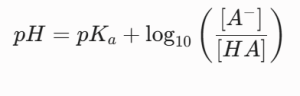
Where:
-
pKa is the negative log of the acid dissociation constant (-Ka). It tells you how easily the acid drops its protons. A lower pKa means a stronger acid.
-
[A-] is the concentration of your conjugate base (the salt).
-
[HA] is the concentration of your weak acid.
By playing around with the ratio of salt to acid, you can engineer a buffer to lock into almost any specific pH you want.
Worked Example: pH of a Buffer Solution
Let’s try a quick problem to see how this works in real life.
Problem: A buffer solution contains 0.1 M acetic acid (CH₃COOH) and 0.1 M sodium acetate (CH₃COONa). The pKa of acetic acid is 4.76. Calculate the pH.
Solution: Pop the numbers straight into our trusted Henderson-Hasselbalch equation:
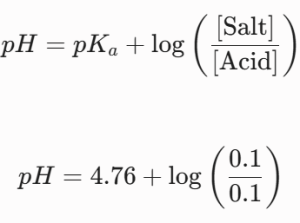
Since 0.1 / 0.1 = 1, and the log of 1 is exactly 0:
Let’s look at a twist where a problem states the final pH is actually 4.5. To find the correct ratio of components needed to hit that exact mark, you alter the equation:
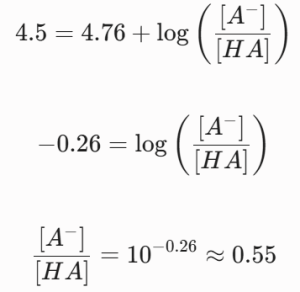
So, to hit a pH of 4.5, your ratio of salt to acid needs to be exactly 0.55.
Common Misconceptions About pH and Buffers For IIT JAM
When we coach students at VedPrep, we see people trip over the same few concepts year after year. Let’s clear those up right now so you don’t lose silly marks.
-
Misconception 1: “Buffers can fight off pH changes forever.” Nope. Buffers have a breaking point called buffer capacity. If you keep pouring strong acid into a beaker, you will eventually use up all the conjugate base, and the pH will drop like a stone. A buffer works best when the concentrations of acid and base are completely equal (pH = pKa).
-
Misconception 2: “pH is just a direct measure of concentration.” Not quite. If you want to be precise, pH actually measures the activity of hydrogen ions, not just their raw concentration: pH = -log(aH+). In ideal, diluted solutions, concentration and activity are close enough that we treat them the same, but the distinction matters when things get complex.
-
Misconception 3: “Buffers keep the pH perfectly flat.” In reality, when you add an acid to a buffer, the pH does nudge downwards—it just happens incredibly slowly compared to an unbuffered solution.
Real-World Applications of pH and Buffers For IIT JAM
Understanding pH and Buffers isn’t just about passing your exam; these systems keep our world running smoothly.
Take wastewater treatment plants, for example. Before water can be purified, engineers have to tune its pH perfectly. If the water is too acidic or too basic, the chemicals used to clump dirt particles together simply won’t work, leaving the water cloudy and unsafe.
The pharmaceutical world also relies heavily on these systems. Imagine a fictional scenario where a lab develops a groundbreaking life-saving medicine. If that drug sits in a liquid solution that gets even slightly too acidic while sitting on a pharmacy shelf, the chemical bonds could break apart, rendering the medicine completely useless. To prevent this, scientists pack the medicine with phosphate buffers to keep the shelf-life stable for years.
Even the food industry uses them. Citrate buffers give your favorite soft drinks that sharp, tangy zip while keeping the flavor uniform, and acetate buffers keep pickled vegetables crisp and preserved in jars.
Exam Strategy: Tips and Tricks for Solving pH and Buffer Questions
When you face these questions in the IIT JAM exam room, take a deep breath and follow a systematic approach:
-
Identify the components first: Don’t rush into formulas. Look at the problem and figure out exactly what is in the solution. Is it a weak acid mixed with its salt? Is it a strong base reacting with an excess of weak acid?
-
Watch out for trick reactions: Examiners love giving you a mixture of a weak acid and a strong base. You have to write down the neutralization reaction first, calculate what’s left over after they react, and then apply your Henderson-Hasselbalch equation.
-
Keep your units straight: Make sure your volume and molarity numbers match up before you plug ratios into your log terms.
Final Thoughts
Frequently Asked Questions
Why does the Henderson-Hasselbalch equation use a logarithm?
Because hydrogen ion concentrations in chemistry can span over massive ranges—like from 10-1 to 10-14 M. Working with that many zeros is a total headache. The log scale compresses these wild numbers into a neat, manageable 0-to-14 scale so you don't lose your sanity doing math during the exam.
Can a mixture of a strong acid and its conjugate base form a buffer?
No, and this is a classic trap! Strong acids like HCl completely split up in water. They don't establish an equilibrium. If you add extra H⁺ ions to a solution containing Cl⁻, they won't link back up to form HCl. You absolutely need that delicate equilibrium balance that only a weak acid or weak base can provide.
What happens to an acidic buffer when you dilute it with water?
Surprisingly, its pH barely moves! If you look at the Henderson-Hasselbalch equation, the pH depends on the ratio of the conjugate base to the weak acid. When you dilute the solution, the volumes cancel out, meaning the ratio stays exactly the same. However, at VedPrep, we remind students that extreme dilution will eventually tank your overall buffer capacity.
What is "buffer capacity" in simple terms?
Imagine a sponge. It can soak up water, but only until it is completely saturated. Buffer capacity is just the chemical version of that. It is the maximum amount of strong acid or base a buffer can neutralize before its chemical defenses break down and the pH shifts dramatically.
At what point is a buffer solution most effective?
A buffer hits its peak performance when the concentration of the weak acid matches the concentration of its conjugate base perfectly ([HA] = [A-]). When this happens, the log part of our equation becomes log(1) = 0, meaning your pH = pKa. This is the sweet spot where the buffer is equally prepared to fight off both incoming acids and bases.
How do I choose the right buffer for a specific laboratory experiment?
You want to choose a weak acid whose pKa value is as close as possible to your target pH. As a general rule of thumb, a buffer is only reliable within one pH unit of its pKa (i.e., pH = pKa ± 1). Trying to force a buffer outside this window is a recipe for a failed experiment.
What are salt buffers, and how do they work?
Salt buffers are essentially standalone salts derived from a weak acid and a strong base, like sodium acetate (CH₃COONa). In water, the acetate part can step up to neutralize any added H⁺ ions, while the spectator sodium ions just float around peacefully. It is a simple way to create a basic buffering action without mixing multiple bottles.
Can you give a fictional example of what happens when a buffer fails in industry?
Imagine a fictional factory that manufactures a sweet, carbonated soft drink. They rely on a precise citrate buffer to keep the liquid at an acidic pH of 3.5 to keep it tasting crisp. If a rookie technician makes a math error and uses way too little buffer, a tiny shift in the water supply could cause the pH to jump to 5.5. The result? The entire batch loses its signature tartness and turns into a flat, sickly-sweet syrup that has to be dumped.
How does the human body use buffers?
Your blood is an incredible, real-world buffer system. It sits at a tight pH of about 7.4. If your blood pH drops below 7.35 or climbs above 7.45, your cells stop working properly, which can be fatal. Your body uses a carbonic acid-bicarbonate buffer (H₂CO₃ / HCO₃⁻) to instantly neutralize metabolic wastes and keep you breathing safely.
How do examiners try to trick students with buffer questions in IIT JAM?
The most common trick is giving you a mix of a strong base (like NaOH) and a weak acid (like CH₃COOH) instead of a ready-made buffer. They want to see if you realize that the base will react with part of the weak acid to create the conjugate base right there in the beaker. You have to do the limiting reagent math before you touch the Henderson-Hasselbalch equation!
Is pH really just the concentration of H+ ions?
In your standard textbook problems, yes. But in advanced physical chemistry, it actually tracks the activity or effective concentration of those ions. In highly concentrated solutions, ions start crowdedly bumping into each other, which changes how they behave. For the IIT JAM syllabus, you can usually stick to basic concentration, but keeping this nuance in mind keeps you ahead of the curve.
Why isn't Douglas Kingery’s Inorganic Chemistry book ideal for studying pH and Buffers?
While Kingery's book is phenomenal for coordination compounds and crystal field theory, pH and Buffers is fundamentally a physical chemistry topic involving dynamic equilibria and thermodynamics. You need a book like Atkins that focuses heavily on solution kinetics and math to get the depth required for the exam.
What is a basic buffer made of?
A basic buffer pairs a weak base with its conjugate acid. A classic example you will see in labs is ammonia (NH₃) mixed with ammonium chloride (NH₄Cl). It functions exactly like an acidic buffer, but it keeps the environment locked into a stable, basic pH range.