

Structure and properties of Water For IIT JAM is a fundamental concept in physical chemistry that deals with the molecular structure, intermolecular forces, and physical properties of water.
Syllabus: Physical Chemistry for IIT JAM
If you look at the official IIT JAM syllabus, the Structure and properties of water sit comfortably inside Unit 1 under atomic and molecular structure. For IIT JAM and CUET PG, it ties directly into chemical bonding, intermolecular forces, and thermodynamics.
Standard reference books like Atkins’ Physical Chemistry or McQuarrie & Simon’s Physical Chemistry: A Molecular Approach dive deep into this. Since IIT JAM uses a mix of Multiple Choice Questions (MCQs), Multiple Select Questions (MSQs), and Numerical Answer Type (NAT) questions—complete with negative marking for Section A—you need to know the “why” behind water’s behavior, not just memorize facts.
Molecular Structure of Water: A Key Aspect of Structure and properties of Water For IIT JAM
Let’s look at a single molecule of H₂O. You already know it has a bent, or V-shape, geometry. But let’s look at why.
As per Structure and properties of Water, the oxygen atom undergoes sp3 hybridization. In a perfect tetrahedral world, the bond angle would be 109.5°. However, oxygen brings two lone pairs to the party. According to VSEPR theory, those lone pairs take up a lot of space and push the two O-H bonding pairs closer together, squeezing the bond angle down to about 104.5°.
Because oxygen is way more electronegative than hydrogen, it pulls the shared electrons closer to itself. This creates a partial negative charge (ð–) on the oxygen and a partial positive charge (ð+) on the hydrogens. Since the molecule is bent, these individual bond dipoles don’t cancel out. Instead, they add up to give water a strong, permanent electric dipole moment. This high polarity is the secret sauce behind almost all the unique physical and chemical traits we study in the Structure and properties of Water.
Intermolecular Forces in Water: A Critical Aspect of Structure and properties of Water For IIT JAM
Moving from a single molecule to a glass of water, how do these molecules talk to each other? The structural quirks we just talked about lead directly to three types of intermolecular forces: hydrogen bonding, dipole-dipole interactions, and London dispersion forces.
The star of the show here is hydrogen bonding. Because water is so polar, the ð+ hydrogen of one water molecule is strongly attracted to the ð– lone pair of a neighboring oxygen.
Hydrogen Bonds: These are remarkably strong for intermolecular forces, packing an energy of about 10 to 30 kJ/mol, and they can operate over distances up to 0.3 nm.
Dipole-Dipole & London Dispersion Forces: Dispersion forces are the weakest link here, sitting at around 0.1 to 10 kJ/mol with a much shorter range.
As per Structure and properties of Water, this extensive network of hydrogen bonds means water molecules stick together tightly, explaining why it takes so much effort to boil it compared to other similar-sized molecules like H₂S.
Physical Properties of Water: A Practical Application of Structure and properties of Water For IIT JAM
Now, let’s see how these microscopic forces show up in the real world.
The 4°C Quirk (Anomalous Expansion)
Most liquids shrink and get denser as they freeze. Water plays by its own rules. As you cool liquid water, it contracts and gets denser—but only until it hits 4°C. Below 4°C, it starts expanding and becoming less dense. When it finally freezes into ice, the molecules lock into a rigid, open, hexagonal crystalline structure held apart by fixed hydrogen bonds.
Imagine a fictional scenario where a lake in northern India freezes over in January. If water behaved like normal liquids, the ice would sink to the bottom, eventually freezing the whole lake solid and destroying the aquatic ecosystem. Because of this anomalous expansion, the ice floats on top. It creates an insulating blanket that keeps the liquid water underneath at a livable 4°C, keeping the fish happy and alive.
Thermal Buffer (High Specific Heat Capacity)
Water has a massive specific heat capacity—about 4.18 J/g°C. Heat capacity is just the amount of heat energy needed to raise the temperature of a substance by 1°C. Because water has that stubborn network of hydrogen bonds, it can absorb a ton of heat energy before those bonds break and the molecules start moving faster. This is why coastal cities have moderate weather compared to scorching deserts; the ocean acts like a giant, planet-wide thermostat.
Worked Example: Calculating the Entropy Change of Water
In the IIT JAM physical chemistry section, you are bound to face thermodynamics problems dealing with entropy change (ΔS), which measures the change in system disorder.
Let’s look at a straightforward problem to see how Structure and properties of Water works.
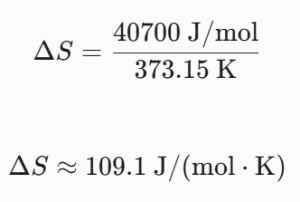
Question: Imagine you have 1 mole of liquid water at 100°C (373.15 K) turning into steam at the same temperature. The heat of vaporization (Hvap) for water is 40.7 kJ/mol. Calculate the entropy change (ΔS) for this vaporization.
Solution:
Since this phase change happens at a constant temperature, we can use the straightforward entropy formula:
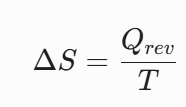
Here, Qrev is equal to the enthalpy of vaporization (ΔHvap). Let’s convert kilojoules to joules so our units match standard thermodynamic values:
Common Misconceptions
When clearing doubts here at VedPrep, we often see students fall into a classic trap: confusing molecular symmetry with bond polarity while dealing with Structure and properties of Water.
Some students think that because a water molecule seems simple and balanced on paper, the dipoles must cancel out, making it non-polar. Don’t fall for this! Carbon dioxide (CO₂) is linear, so its dipoles cancel out to zero. Water is distinctly bent. That asymmetrical V-shape ensures the dipoles reinforce each other, making it highly polar.
Laboratory & Real-World Applications
We see the practical magic of the Structure and properties of Water everywhere. In the lab, its high polarity makes it the “universal solvent,” capable of dissolving ionic salts by forming hydration shells around ions.
In environmental science, that ice-insulation phenomenon we discussed earlier is the entire reason aquatic life survives harsh winters. Without the unique crystalline structure of ice and the resulting density drop, life on Earth would look completely different.
Final Thoughts
When you sit down to tackle the physical chemistry section of the IIT JAM, remember that the examiners aren’t just looking for your ability to memorize equations—they want to see if you can connect microscopic structures to macroscopic behavior. The Structure and properties of Water is the perfect sandbox for this. It bridges the gap between quantum mechanical hybridization, thermodynamic energy changes, and real-world environmental phenomena.
To know more in detail from our expert faculty, watch our YouTube video:
Frequently Asked Questions
What is the exact bond angle in a water molecule, and why?
The bond angle is about 104.5°. In a perfect tetrahedral shape, it would be 109.5°. However, the two lone pairs on the oxygen atom take up more space and repel the O-H bonding pairs more strongly, squeezing the angle down by about 5°.
How does the polarity of water arise?
Polarity comes down to a tug-of-war for electrons. Oxygen is much more electronegative than hydrogen, so it pulls the shared electrons closer to itself. This creates a partial negative charge on the oxygen and a partial positive charge on the hydrogens. Because the molecule is bent, these charges don't cancel out, leaving water with a permanent dipole moment.
What type of hybridization does the oxygen atom in water undergo?
The oxygen atom is sp3 hybridized. It uses four hybrid orbitals: two to form $\sigma$ (sigma) bonds with the hydrogen atoms and two to hold its lone pairs of electrons.
Why is the hydrogen bond in water stronger than a typical dipole-dipole interaction?
Hydrogen bonding is a supercharged version of a dipole-dipole interaction. Because hydrogen is small and bonded to a highly electronegative oxygen, the positive charge density on the hydrogen is incredibly high. This allows it to get very close to the lone pairs of a neighboring oxygen, creating a remarkably strong attraction.
What are the typical energy values for hydrogen bonds vs. London dispersion forces in water?
Hydrogen bonds in water are relatively strong, packing an energy of about 10 to 30 kJ/mol. On the flip side, London dispersion forces are much weaker, usually sitting between 0.1 and 10 kJ/mol.
What does the "anomalous expansion of water" actually mean?
Normally, liquids contract and get denser as they cool down. Water does this too, but only until it hits 4°C. Below 4°C, it reverses course and starts expanding, meaning it becomes less dense as it gets colder and freezes into ice.
Why does ice float on liquid water?
When water freezes, the molecules slow down enough for hydrogen bonds to lock them into a rigid, open, hexagonal crystal lattice. This structure leaves a lot of empty space between the molecules. Because the same mass of water takes up more space as ice, ice ends up less dense than liquid water and floats.
Why does water have such a high specific heat capacity?
It all comes down to that stubborn network of hydrogen bonds. Before water molecules can start moving faster (which raises the temperature), a lot of heat energy has to be consumed just to break those hydrogen bonds. At VedPrep, we like to think of water as a thermal sponge for this exact reason.
Can water form hydrogen bonds with other types of molecules?
Yes! Water can form hydrogen bonds with any molecule that has a hydrogen atom bonded to a highly electronegative element (like Nitrogen, Oxygen, or Fluorine) or with molecules that have lone pairs on those same electronegative atoms, like alcohol or ammonia.
What type of questions does IIT JAM ask from the Structure and properties of Water?
IIT JAM tests this topic through various formats. You might see MSQs (Multiple Select Questions) asking which statements about water's properties are correct, MCQs on hybridization and bond angles, or NAT (Numerical Answer Type) problems calculating entropy or enthalpy changes during phase transitions.
Why is water called the "universal solvent"?
Because of its high polarity and large dielectric constant, water is incredibly good at dissolving ionic compounds and polar covalent molecules. It surrounds the solute ions, forming hydration shells that separate and stabilize them in the solution.
How does water's high specific heat capacity affect Earth's climate?
Since oceans can absorb massive amounts of solar heat during the day without a huge jump in temperature, and slowly release that heat at night, they act as a massive global thermostat. This keeps coastal areas from experiencing extreme temperature swings.
What is the difference between a lone pair and a bonding pair in a water molecule?
Bonding pairs are the electrons shared between the oxygen and hydrogen atoms to form covalent bonds. Lone pairs are the two sets of valence electrons on the oxygen atom that aren't shared with any other atom but still influence the molecule's overall shape.