

The Mean Value Theorem, a fundamental concept in calculus, states that a function having a continuous derivative on the closed interval [a, b] must have at least one point c in (a, b) such that the derivative at c equals the average rate of change of the function over [a, b].
Syllabus – Calculus Unit of CSIR NET Exam
If you look at the Real Analysis and Calculus section of the CSIR NET Mathematical Sciences syllabus, the Mean Value Theorem is a guaranteed heavy hitter. The National Testing Agency (NTA) loves to test how deeply you understand this concept, rather than just forcing you to memorize the formula.
The syllabus wraps MVT up with fundamental ideas like limits, continuity, and differentiability. To really get a grip on the rigorous proofs and tricky counterexamples that the NET exam throws at you, you need the right books.
-
“Calculus” by Michael Spivak: This is a gold standard. It doesn’t just give you formulas; it forces you to think mathematically.
-
“A Course of Pure Mathematics” by G.H. Hardy: A classic text that helps build the foundational rigor you need for higher-level modern algebra and analysis.
-
Textbooks by S.K. Mapa or A.K. Hazra: These are highly recommended for Indian competitive exams because they align nicely with the exam patterns of CSIR NET, IIT JAM, and GATE.
At VedPrep, we always remind students that reading these texts isn’t about passive skimming. It’s about grappling with the underlying conditions of the theorems.
Understanding the Mean Value Theorem For CSIR NET
To understand the MVT, you have to look at its gatekeepers: continuity and differentiability.
Think of it this way: the theorem acts as a bridge connecting the average behavior of a function over an entire interval to its exact behavior at one specific, frozen moment inside that interval. But for this bridge to hold, the function must be completely smooth and unbroken. It has to be continuous on the closed interval [a, b] and differentiable on the open interval (a, b).
If your function breaks, jumps, or has a sharp point anywhere in that zone, the MVT packs its bags and leaves. For CSIR NET aspirants, the examiners love to give you functions that look perfectly fine at first glance but secretly violate these conditions at a single boundary point.
Mean Value Theorem For CSIR NET: A Geometric Interpretation
Let’s step away from the equations for a second and visualize this. Imagine you map out a curve on a graph from point A, which sits at (a, f(a)), to point B at (b, f(b)). If you draw a straight line directly connecting A and B, you get a secant line. The slope of this line is your average rate of change:
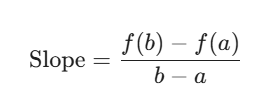
The geometric interpretation of the MVT says that as long as your curve is smooth, there is at least one spot, let’s call it c, between A and B where the tangent line to the curve runs perfectly parallel to that secant line. In plain English, the slope of the curve at that exact point f'(c) matches the overall slope of the line connecting the endpoints.
A Quick Fictional Anecdote
To make this real, let’s imagine a hypothetical scenario. Say you are driving along a straight toll road. The toll booth at Point A clocks you in at 12:00 PM. You drive through the second toll booth, Point B, exactly 60 miles away, at 1:00 PM.
Your average speed is obviously 60 miles per hour. Now, you might have driven 45 mph through some traffic and sped up to 75 mph later on. But the MVT guarantees that at some exact, specific split-second during that hour, your speedometer pointed precisely to 60 mph. Even if a police officer didn’t radar-gun you going 60, the math proves you hit that speed.
Mean value theorem For CSIR NET and Its Applications
When you are dealing with the CSIR NET exam, you will often have to apply this theorem to actual algebraic functions. Let’s look at a typical problem style you might run into.
Consider the function f(x) = x3 – 2x2 + x + on the interval [0, 2]. Let’s find the point c in (0, 2) that satisfies the MVT.
First, we need the values at the endpoints:
-
f(0) = 03 – 2(0)2 + 0 + 1 = 1
-
f(2) = 23 – 2(2)2 + 2 + 1 = 8 – 8 + 2 + 1 = 3
Now, let’s find the average rate of change:
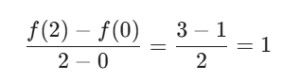
Next, we take the derivative of our function to find the instantaneous rate of change:
Common Misconceptions About Mean Value Theorem For CSIR NET
The biggest trap students fall into during the exam is blindly applying the MVT formula without checking the fine print.
-
The Sharp Turn Trap: Students often try to apply MVT to functions with absolute values, cusps, or sharp corners (like f(x) = |x| around the origin). If the function isn’t differentiable at even one point inside the interval, the theorem completely breaks down.
-
The Boundary Slip-Up: Forgetting that the function must be continuous on the closed interval but only needs to be differentiable on the open interval can cost you marks on conceptual true/false questions in Part B or Part C of the exam.
-
Simple Calculation Slips: It sounds basic, but rushing through derivative steps or messing up a fraction while calculating the endpoint slope is a quick way to lose points.
We see these exact mistakes happen all the time when grading practice papers at VedPrep, and usually, it’s just a matter of slowing down and verifying the conditions first.
Real-World Applications of Mean Value Theorem For CSIR NET
While you need this theorem to clear an exam, it’s cool to realize that MVT isn’t just an abstract math puzzle. It runs the backend of a lot of real-world fields.
-
Economics: Economists use MVT to figure out optimal points for profit and cost minimization. If you know the average growth of a market over a quarter, MVT helps pinpoint the exact moment marginal costs and marginal revenues balanced out perfectly.
-
Physics and Kinematics: Just like our toll road example, physicists use MVT to understand the motion of particles, analyze fluid dynamics, and calculate instantaneous velocity when they only have macro-level data.
-
Engineering: Whether it’s designing control systems or running complex fluid simulations, engineers rely on MVT to ensure that numerical models stay stable and don’t spit out impossible errors during calculations.
Exam Strategy – Tips for Solving Mean Value Theorem For CSIR NET Questions
When the clock is ticking during the CSIR NET exam, you need a systematic way to handle these questions without wasting time. Here is a solid mental checklist to follow:
-
Check the Domain Constraints: Look at the interval given. Is the function undefined anywhere inside it? Does it have a denominator that could hit zero?
-
Verify Differentiability: Look out for fractional exponents or absolute values that create non-differentiable points.
-
Set Up the Equation Clearly: Calculate your average slope f(b)-f(a)/b-a on one side of your scratch pad, find f'(x) on the other, and set them equal.
-
Filter Your Answers: Once you get your values for c, throw out any that don’t fall strictly inside your open interval.
Additional Tips and Resources for Mastering Mean Value Theorem For CSIR NET
Mastering Real Analysis for CSIR NET comes down to consistency. If you’re building out a study plan, try to structure your calculus prep so you don’t look at theorems in isolation. Link MVT back to Rolle’s Theorem (its close cousin) and Taylor’s Theorem (its extension).
Key Practice Areas to Focus On:
-
Proving or disproving the existence of roots using MVT.
-
Handling bounded derivative problems (e.g., if |f'(x)| ≤ M, bounding the value of f(b)).
-
Geometric interpretations of inequalities using the theorem.
If you ever feel stuck or need to see these concepts broken down visually, we have a mix of video lectures, mock tests, and comprehensive study materials over at VedPrep designed to make these abstract topics feel a bit more down-to-earth.
By following a structured study plan, practicing regularly, and seeking expert guidance from VedPrep on Mean Value Theorem
Conclusion
Wrapping your head around the Mean Value Theorem is more than just checking off a box on your CSIR NET syllabus checklist; it’s about training your brain to bridge the gap between macro-level averages and micro-level moments. Whether you are visualizing a parallel tangent line on a graph, calculating the exact speed of a car on a toll road, or evaluating tricky boundary conditions on an exam paper, the MVT is an indispensable tool in your mathematical toolkit.
To know more in detail from our faculty, watch our YouTube video:
Frequently Asked Questions
What are the conditions for the Mean Value Theorem?
The conditions for the Mean Value Theorem are: (1) the function f(x) must be continuous on the closed interval [a, b], and (2) the function f(x) must be differentiable on the open interval (a, b).
What is the geometric interpretation of the Mean Value Theorem?
The Mean Value Theorem has a geometric interpretation that there exists a point on the curve where the tangent line is parallel to the secant line joining the endpoints of the curve.
Who first proved the Mean Value Theorem?
The Mean Value Theorem was first proved by French mathematician Pierre Fermat, and later generalized by Lagrange.
What is the significance of the Mean Value Theorem?
The Mean Value Theorem has significant applications in calculus, particularly in the study of optimization problems, and is a fundamental theorem in analysis.
Can the Mean Value Theorem be applied to non-continuous functions?
No, the Mean Value Theorem can only be applied to functions that are continuous on the closed interval [a, b] and differentiable on the open interval (a, b).
What is the relationship between the Mean Value Theorem and optimization?
The Mean Value Theorem has significant applications in optimization problems, particularly in finding the maxima and minima of a function.
What is the physical interpretation of the Mean Value Theorem?
The Mean Value Theorem has a physical interpretation that there exists a point where the instantaneous velocity of an object is equal to its average velocity.
How is the Mean Value Theorem applied in CSIR NET?
The Mean Value Theorem is frequently asked in CSIR NET, particularly in the Analysis and Linear Algebra sections, and is used to solve problems related to maxima and minima, and optimization.
What type of questions are asked from the Mean Value Theorem in CSIR NET?
In CSIR NET, questions are often asked to test the understanding of the theorem, its application, and its implications, such as finding the point where the tangent line is parallel to the secant line.
What are common mistakes made while applying the Mean Value Theorem?
Common mistakes made while applying the Mean Value Theorem include incorrect identification of the interval, failure to check the conditions of the theorem, and incorrect calculation of the derivative.
How to avoid mistakes while using the Mean Value Theorem?
To avoid mistakes while using the Mean Value Theorem, one needs to carefully read and understand the problem, check the conditions of the theorem, and perform calculations accurately.
What are the extensions of the Mean Value Theorem?
The Mean Value Theorem has several extensions, including the Cauchy Mean Value Theorem, which is used to prove L'Hospital's rule.
How is the Mean Value Theorem related to other theorems in analysis?
The Mean Value Theorem is related to other theorems in analysis, such as Rolle's theorem, and is used to prove several important results in calculus.
How is the Mean Value Theorem used in Linear Algebra?
The Mean Value Theorem has applications in Linear Algebra, particularly in the study of linear transformations and matrices.