

The inductive effect For IIT JAM is a phenomenon where a ring current is generated in a molecule when an electric field is applied, influencing the chemistry of the compound. It’s crucial to understand this concept to excel in exams like IIT JAM, CSIR NET, and GATE.
Syllabus – Chemistry in IIT JAM (Unit: Physical Chemistry)
The inductive effect is covered under the physical chemistry unit in the IIT JAM Chemistry syllabus, which is also a part of the official CSIR NET / NTA syllabus under Physical Chemistry (Unit 2).
Students preparing for IIT JAM Chemistry can refer to standard textbooks such as Physical Chemistry by Peter Atkins and Physical Chemistry: A Molecular Approach by Donald A. McQuarrie and John D. Simon, which comprehensively cover this topic.
Understanding the inductive effect, a fundamental concept in organic chemistry, is crucial for solving physical chemistry problems in IIT JAM. The inductive effect refers to the polarization of σ-bonds due to the presence of an electronegative atom or a substituent, leading to a permanent dipole moment.
Key topics related to the inductive effect include its definition, types (positive and negative inductive effects), and applications in understanding chemical reactivity and stability of molecules.
Inductive Effect For IIT JAM – Definition and Concept
So, what exactly is the inductive effect? Think of it as a permanent tug-of-war happening inside a molecule’s sigma (σ) bonds.
Imagine two friends, Sam and Alex, sharing a blanket on a cold night. Sam is an absolute blanket hog (highly electronegative), while Alex is pretty passive. Sam is naturally going to pull more of the blanket to his side. The blanket doesn’t completely leave Alex, but most of it is piled up on Sam.
   Partial positive charge              Partial negative charge
        (Less electron density)              (More electron density)
                𝛿+                                   𝛿-
                 C ───────────────────────────────> Cl
                                 σ-bond
                     (Electrons pulled toward Chlorine)
In chemistry, when a carbon atom bonds with a highly electronegative atom like chlorine, that electronegative atom pulls the shared σ-electrons closer to itself. This unequal sharing creates a permanent dipole moment. The chlorine gets a partial negative charge (δ), and the poor carbon gets a partial positive charge (δ+). This transmission of charge through a chain of sigma bonds is what we call the inductive effect. It is completely permanent, operates only through single (σ) bonds, and fades out quickly as you move further down the carbon chain.
Inductive Effect For IIT JAM: Factors Affecting the Inductive Effect
How strong this tug-of-war gets depends on a few straightforward things:
1. Electronegativity
The more electron-greedy an atom is, the harder it pulls. Fluorine pulls harder than Chlorine, which pulls harder than Bromine.
2. Electron-Withdrawing vs. Electron-Donating Groups
Substituents generally fall into two camps:
Negative Inductive Effect (-I effect): These are the Electron-Withdrawing Groups (EWGs). Groups like -NO2, -COOH, and -F act like electron vacuums, sucking electron density away from the carbon chain.
Positive Inductive Effect (+I effect): These are the Electron-Donating Groups (EDGs). Alkyl groups like -CH3 or -CH2CH3 are like generous friends; they push electron density toward the carbon chain.
3. Distance
The inductive effect is a short-range force. It is strongest at the atom right next to the substituent, drops significantly by the second carbon, is barely noticeable at the third, and completely vanishes after the fourth.
Worked Example – Calculating Inductive Effect
In advanced organic and physical chemistry, researchers look at substituent constants to quantify these electronic shifts. While you won’t typically do heavy calculus for this on the exam, seeing how the math works helps clarify the concept.
Let’s look at a modified version of the Hammett equation, which looks at how substituents change a molecule’s electronic environment:
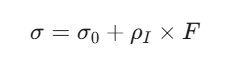
Let’s break down a fictional, simplified scenario just to see how the numbers play out. Imagine we have a basic molecular scaffold where the intrinsic baseline constant (σ0) is 0. We introduce two electron-withdrawing groups onto the structure: Group A (like a nitro group) with an inductive constant (ρI) of 0.65, and Group B (like a carboxylic acid) with a ρI of 0.39.
If the field effect factor (F) under these conditions is a clean 1, we can estimate the collective electronic pull by adding their effects together:
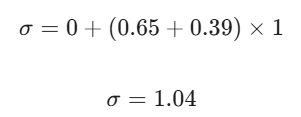
A positive value like 1.04 shows a solid, combined electron-withdrawing push. At VedPrep, we always remind our students not to get bogged down by memorizing obscure formulas like this for GOC. Instead, focus on the logic: more electron-withdrawing groups mean a stronger total -I effect.
Common Misconceptions about Inductive Effect For IIT JAM
Let’s bust two massive myths that trip up a lot of bright students during exam season:
Myth 1: It only changes chemical reactivity.
Not true! Because the inductive effect creates permanent dipoles, it completely changes physical properties too. Stronger molecular dipoles mean higher boiling points, altered melting points, and different solubility profiles.
Myth 2: The inductive effect and resonance are basically the same thing.
This is a huge trap. The inductive effect only cares about σ-bonds and involves shifting electron density without moving any bonds. The resonance effect, on the other hand, deals strictly with π-bonds and unshared electron pairs delocalizing across a conjugated system.
Take a molecule with a C-F bond. The fluorine atom pulls electron density away from the carbon through the σ-bond. That is pure inductive effect in action, making that specific carbon electrophilic.
Applications of Inductive Effect in Real-World Scenarios
Why are we studying this besides clearing a cutoff? Because the inductive effect runs the show in real-world chemical design.
In drug development, medicinal chemists tweak the inductive effect to make medicines safer and more effective. Imagine a fictional scenario where a promising new pharmaceutical molecule breaks down too quickly in the human stomach because a specific chemical bond is too rich in electrons. By strategically swapping a hydrogen atom for a highly electronegative fluorine atom (-I effect), chemists can pull that electron density away, stabilizing the bond so the medicine can actually do its job.
Materials scientists also use this trick. By shifting electron density around organic polymers, they can design better semiconductors, organic solar cells, and highly efficient LEDs.
Exam Strategy : Tips for Solving IIT JAM Questions on Inductive Effect
When you’re staring down the question paper on exam day, keep these tips in mind:
Rank Order Mastery: Expect questions asking you to rank the acidity of carboxylic acids or the stability of carbocations/carbanions. Remember: -I groups stabilize negative charges (carbanions) and destabilize positive charges (carbocations). +I groups do the exact opposite.
Watch the Distance: If an electron-withdrawing chlorine atom is right next to a carboxylic acid group, it will make that acid significantly stronger than if it were sitting three carbons away. Always count your carbons!
Balance the Effects: If a molecule has both inductive and resonance effects happening at the same time, remember that resonance usually wins the debate (except when halogens are involved!).
We regularly design mock tests and practice modules at VedPrep to help you build the muscle memory needed to spot these subtle differences instantly.
Key Takeaways: Summary of Inductive Effect For IIT JAM
The Core Concept: The inductive effect is the permanent displacement of σ-electrons due to an electronegativity mismatch.
The Two Camps: -I groups pull electrons away (EWGs like -NO₂); +I groups push them forward (EDGs like alkyl chains).
Distance is key: It fades out quickly and becomes irrelevant past the third or fourth carbon atom in a chain.
Beyond Reactions: It plays a massive role in a compound’s physical traits, like boiling points and solubility.
Important Subtopics: Additional Concepts related to Inductive Effect
To get a perfect score on your electronic effects questions, you can’t look at the inductive effect in a vacuum. You need to see how it interacts with its two close cousins: resonance (mesomeric effect) and hyperconjugation.
Think of these three as a toolkit for molecular stability. While the inductive effect works quietly through single bonds, hyperconjugation offers stability through the overlap of σ bonds with adjacent unhybridized p orbitals, and resonance handles the major shifts across π systems.
Getting comfortable with how these three forces compete and cooperate is what separates a good rank from a great one. If you ever want to walk through more practice problems or need a bit of extra structure in your study routine, our team at VedPrep has plenty of guides, interactive courses, and quizzes to help you clear up any confusion.
Conclusion
At the end of the day, mastering the inductive effect isn’t about memorizing a bunch of textbook definitions—it’s about understanding the molecular tug-of-war that dictates how molecules behave in the real world. From determining why a specific drug stays stable in the body to predicting the exact outcome of a tricky exam question, this fundamental concept is a massive stepping stone for your entire IIT JAM journey.
To know more in detail from our faculty, watch our YouTube video:
Frequently Asked Questions
Is the inductive effect a temporary or permanent phenomenon?
It is completely permanent. It exists in the ground state of the molecule simply because of the inherent differences in electronegativity between the atoms.
Does the inductive effect involve the movement of π electrons?
No, not at all. The inductive effect operates strictly through single covalent bonds, which are σ (sigma) bonds. If π electrons are moving around, you are looking at the resonance or mesomeric effect.
Why does the inductive effect die out after 3 or 4 carbon atoms?
Think of it like a chain of people holding hands where the first person gets pulled. The first carbon feels the strongest yank. It then passes a smaller fraction of that pull to the second carbon, which passes an even tinier fraction to the third. By the fourth carbon, the transmission of that electronic pull becomes too weak to notice.
What is the difference between a -I effect and a +I effect?
-I (Negative Inductive) Effect: Caused by Electron-Withdrawing Groups (EWGs) that suck electron density away from the carbon chain (e.g., -NO2, -F, -Cl).
+I (Positive Inductive) Effect: Caused by Electron-Donating Groups (EDGs) that push electron density toward the carbon chain (e.g., -CH3, $-CH2CH3).
Why do alkyl groups show a +I effect?
Alkyl groups contain sp3 hybridized carbons bonded to hydrogens. Since carbon is slightly more electronegative than hydrogen, electron density accumulates on the carbon. When attached to a more electron-deficient system, the alkyl group readily pushes that accumulated electron density forward.
How does hybridization affect the inductive effect of carbon?
The more 's-character' a hybrid orbital has, the closer its electrons are held to the nucleus, making it more electronegative. Therefore, electronegativity follows the order: sp > sp2 > sp3. An sp-hybridized carbon (like in alkynes) acts as a strong -I group compared to an sp3 carbon.
Between fluoroacetic acid and chloroacetic acid, which is stronger and why?
Fluoroacetic acid is stronger. Fluorine is more electronegative than chlorine, meaning it exerts a much stronger -I effect. This stabilizes the conjugate base far better than chlorine can.
How does distance alter the acidity of a halogenated carboxylic acid?
The closer the halogen (-I group) is to the -COOH group, the stronger the acid will be. If you move the halogen further down the carbon chain, its ability to pull electron density away from the acid group drops dramatically, lowering the acidity.
How does the inductive effect stabilize carbocations?
Carbocations are electron-deficient (sp2 hybridized carbons carrying a positive charge). Alkyl groups show a +I effect, meaning they push electron density toward this positive center, helping to neutralize and stabilize the charge. This is why tertiary carbocations (3°) are more stable than primary ones (1°).
Why do carbanions prefer a -I environment over a +I environment?
Carbanions carry a negative charge, meaning they have a surplus of electrons. Groups with a +I effect crowd them with even more electron density, causing destabilization. Groups with a -I effect pull that extra electron density away, spreading the charge out and stabilizing the carbanion.
How does the inductive effect impact free radical stability?
Free radicals are electron-deficient species (they have an unpaired electron and lack an octet). Just like carbocations, they welcome the electron-donating +I effect of alkyl groups, which helps stabilize them.
Is there any difference between the Inductive Effect and the Field Effect?
Yes, though they produce similar outcomes. The inductive effect operates strictly through the framework of covalent σ-bonds. The field effect operates directly through space or through solvent molecules due to the geometry of the molecule. In most exam problems, their combined net effect is simply referred to under the umbrella of the inductive effect.