

Diastereomers and Meso compounds are types of stereoisomers that differ in the spatial arrangement of atoms, but not their enantiomeric forms. Understanding diastereomers and meso compounds isessentialfor IIT JAM, as they organic chemistry.
Understanding Diastereomers and Meso Compounds: Syllabus and Key Textbooks
Stereochemistry can feel like a maze when you are staring at a 2D page trying to imagine a 3D molecule. The topic of diastereomers and meso compounds is an integral part of the IIT JAM syllabus, specifically under the Organic Chemistry unit. If you are preparing for CSIR NET, IIT JAM, or GATE exams, getting a solid grip on this section is non-negotiable because the exam setters love to test your spatial reasoning here.
Simply put, diastereomers are stereoisomers that are not mirror images of each other. A meso compound is a specific type of stereoisomer that contains chiral centers but also sports an internal plane of symmetry, making it superimposable on its mirror image.
For an in-depth study, standard textbooks like Organic Chemistry by Morrison and Boyd or Stereochemistry by P.S. Kalsi are excellent resources. They provide comprehensive coverage of definitions, properties, and examples of diastereomers and meso compounds for IIT JAM aspirants. We often see students at VedPrep flipping through these exact books trying to map out these configurations, and having a reliable guide makes a massive difference.
Diastereomers and Meso compounds For IIT JAM
Let’s break down the definitions without the heavy textbook jargon for Diastereomers and Meso compounds. Imagine you have a pair of shoes. Your left shoe and your right shoe are mirror images of each other, but you cannot perfectly snap one on top of the other and have them match. That is the basic idea behind enantiomers.
Now, what if you have a pair of shoes, but someone accidentally swapped the lace on just the left shoe? They are still shoes, they share the same basic layout, but they are no longer mirror images. That is your baseline for diastereomers. They are stereoisomers—molecules with the exact same molecular formula and bond connectivity—that are simply not mirror images of each other. Because their spatial layout is fundamentally altered, diastereomers have different physical and chemical properties. Their melting points, boiling points, and solubilities do not match.
A meso compound is a unique beast. It contains chiral centers, but it also has a plane of symmetry running right down its middle. Think of it like a butterfly: the left wing perfectly mirrors the right wing. Because of this internal symmetry, the top half of the molecule cancels out the optical rotation of the bottom half. As a result, meso compounds are achiral and completely blind to plane-polarized light.
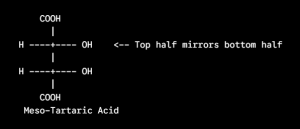
Tartaric acid is the classic textbook example here. It gives you two enantiomeric forms (D- and L-tartaric acid) and one optically inactive meso form.
Another excellent example to keep in your back pocket for exam day is 2,3-dibromopentane. It shows up as a pair of diastereomeric forms, (2R,3R)-2,3-dibromopentane and (2S,3S)-2,3-dibromopentane, alongside its meso cousin, (2R,3S)-2,3-dibromopentane.
Diastereomers and Meso compounds For IIT JAM
Stereoisomerism happens because of chiral centers (or stereocenters)—atoms attached to four completely different groups. When a molecule gets multiple chiral centers, the number of potential variations goes up.
As per Diastereomers and Meso compounds, diastereomers pop up when you vary the configuration at some, but not all, of these centers. Because they do not share a mirror-image relationship, their physical properties like specific optical rotations diverge completely. This makes them much easier to separate in a lab compared to enantiomers, which cling to the same boiling and melting points.
Look at carbohydrates to see this in full effect. Glucose has four chiral centers, which opens the door to 16 possible stereoisomers. Fructose has three chiral centers, yielding 8 possible stereoisomers. Many of these variations are diastereomers of one another. At VedPrep, we notice that mapping these out with handheld molecular model kits helps students visualize these structures much faster than just looking at flat diagrams.
Identifying Diastereomers and Meso Compounds: Worked Example
To make this completely clear, let’s look at a fictional scenario to see how easily our brains can get tricked by flat drawings.
A Quick Thought Experiment
Imagine a student named Rahul who is practicing for the IIT JAM organic chemistry section late at night. He draws out a molecule on his notepad, flips it upside down in his mind, and concludes it must be a pair of non-superimposable enantiomers.
He builds a quick plastic ball-and-stick model of the two variations. When he physically rotates the second model in his hand, he realizes he can slide it directly over the first one. Every single atom aligns perfectly. What looked like two different molecules on paper was actually a single meso compound. The flat drawing hid the internal plane of symmetry that became obvious the moment he looked at it in three dimensions.
This is exactly what happens with 2,3-dichlorobutane. Let’s look at how its four configurations split up:
| Compound | Configuration | Type of Isomer |
| 2,3-dichlorobutane | (2R,3R) and (2S,3S) | Enantiomers (Mirror images) |
| 2,3-dichlorobutane | (2R,3S) and (2S,3R) | Identical Meso Forms (Internal symmetry) |
The (2R,3S) form is a diastereomer to both the (2R,3R) and (2S,3S) pair. If you slice the (2R,3S) molecule right between carbon-2 and carbon-3, the top half reflects the bottom half perfectly. That internal plane of symmetry makes it a meso compound.
Common Misconceptions About Diastereomers and Meso Compounds
A massive trap that catches plenty of aspirants is assuming that diastereomers are always optically active. That is a myth.
Optical activity relies entirely on the asymmetry of the whole molecule. For a compound to rotate plane-polarized light, it cannot be superimposable on its mirror image. While many diastereomers are chiral and optically active, meso compounds break this rule completely. They are classified as diastereomers relative to their non-superimposable isomers, yet they are optically inactive because their internal symmetry cancels out any rotation.
Real-World Applications of Diastereomers and Meso Compounds
These structural differences are not just academic puzzles to solve for the IIT JAM; they carry major weight in industry.
In the pharmaceutical world, the specific 3D shape of a molecule dictates how it binds to receptors in the body. One diastereomer might cure a headache, while its counterpart might do nothing at all or cause unwanted side effects. Separating and manufacturing the correct stereoisomer is a massive focus in drug design.
In materials science, meso compounds find use in engineering liquid crystals. Because they possess chiral centers but maintain an overall achiral nature, they help create materials with highly specific optical properties used in the manufacturing of flat-panel display screens and mobile devices.
Diastereomers and Meso compounds For IIT JAM
When you see questions on diastereomers and meso compounds in papers like CSIR NET, IIT JAM, or GATE, they generally want you to do one of two things: identify the relationship between two structures or calculate the total number of stereoisomers.
Here is a quick, reliable strategy to approach these problems:
-
Check for a plane of symmetry (P_O_S) or center of inversion (C_O_S): If the molecule has chiral centers but you spot a symmetry plane, label it a meso compound immediately.
-
Use the 2n rule cautiously: The maximum number of stereoisomers is 2n (where n is the number of chiral centers), but this number drops when meso forms are present due to symmetrical configurations collapsing into the same molecule.
-
Compare configurations directly: If you have two centers and change both from (R,R) to (S,S), you have an enantiomer. If you only change one, say from (R,R) to (R,S), you are looking at a diastereomer.
Using model kits or drawing out Fischer projections can keep you from falling into the traps the exam papers set up.
Key Takeaways
Mastering these stereochemical relationships gives you a massive advantage in the organic chemistry section of the exam.
-
Diastereomers: Stereoisomers that are not mirror images. They have distinct physical properties and can be chiral or achiral.
-
Meso Compounds: Achiral diastereomers that contain chiral centers but remain optically inactive due to an internal plane of symmetry.
-
The IIT JAM Approach: Always check for internal symmetry before blindly applying the 2n stereoisomer formula.
Building a clean visual framework for these configurations makes these questions simple, fast marks on your answer sheet.
Final Thoughts
Nailing Diastereomers and Meso compounds is all about moving past memorized formulas and training your eyes to see molecules in 3D. When you are sitting in the exam hall, taking an extra few seconds to scan for an internal plane of symmetry can completely change your answer and protect you from common traps. If you ever feel stuck or find it tough to visualize these configurations on a flat page, remember that you don’t have to figure it out alone. At VedPrep, we work through these exact spatial puzzles every day, breaking them down step-by-step until they click.
To know more in detail from our faculty, watch our YouTube video:
Frequently Asked Questions
Can a molecule with only one chiral center have diastereomers?
No. To have diastereomers in a saturated chain, a molecule generally needs at least two chiral centers. A single chiral center can only yield a pair of enantiomers. However, geometrical isomers (like cis and trans alkenes) are also classified as diastereomers and do not necessarily require chiral centers.
Why are meso compounds optically inactive despite having chiral centers?
Meso compounds contain an internal plane of symmetry (or a center of inversion). This symmetry means that the optical rotation caused by one half of the molecule is exactly equal and opposite to the rotation caused by the other half, resulting in internal compensation.
Is every achiral molecule with chiral centers considered a meso compound?
Yes. If a molecule contains chiral centers but is achiral overall due to an internal plane of symmetry or center of inversion, it is classified as a meso compound.
How do I quickly identify a meso compound in a Fischer projection?
Look for an internal plane of symmetry. Divide the Fischer projection horizontally down the middle. If the top half perfectly mirrors the bottom half in terms of atoms and their spatial positioning (e.g., an H mirrors an H, and an OH mirrors an OH), it is a meso compound.
Do diastereomers always have different melting and boiling points?
Yes. Because diastereomers have different spatial arrangements of atoms relative to each other, their molecular shapes, dipole moments, and intermolecular forces differ. This leads to distinct physical properties, making them relatively easy to separate by standard lab techniques like fractional crystallization or chromatography.
Can a meso compound have an enantiomer?
No. By definition, a meso compound has a superimposable mirror image. If you try to draw its mirror image, you will find that rotating it allows it to align perfectly with the original molecule. Therefore, a meso compound is identical to its mirror image and cannot have an enantiomer.
What is the maximum number of stereoisomers a molecule with $n$ chiral centers can have?
The maximum number of stereoisomers is given by the formula 2n. However, this maximum limit is only reached if the molecule is completely unsymmetrical. If the molecule is symmetrical, the actual number of stereoisomers will be less than 2n due to the formation of meso forms.
Are cis and trans isomers considered diastereomers?
Yes. Geometric isomers (cis/trans or E/Z isomers) match the definition of diastereomers perfectly: they are stereoisomers that are not mirror images of each other.
Why is the separation of diastereomers easier than the separation of enantiomers?
Enantiomers share identical physical properties like solubility, boiling points, and adsorption characteristics in standard environments, requiring specialized chiral columns or resolving agents to separate. Diastereomers have different physical properties, so they can be separated using common laboratory techniques like silica-gel column chromatography or recrystallization.
Can a meso compound change into an enantiomer by rotating a single bond?
Rotating a single bond changes the conformation (conformer), not the configuration. While bond rotation might temporarily hide or reveal the plane of symmetry in a drawing (like switching between eclipsed and staggered forms), the underlying configuration stays the exact same. If it is configurationally meso, it remains meso.
What are pseudoasymmetric centers, and do they affect meso compounds?
A pseudoasymmetric center is a tetrahedral atom attached to two identical chiral groups that have opposite configurations (one is R and one is S). These show up in symmetrical molecules with an odd number of chiral centers (like trihydroxyglutaric acid) and can give rise to distinct meso forms.
Is Meso-tartaric acid optically active at higher temperatures?
No. Temperature changes do not change the internal symmetry of the molecule's configuration. Meso-tartaric acid remains optically inactive across all standard temperatures because the internal compensation remains valid.
Can a diastereomer be optically active?
Absolutely. Most diastereomers are chiral and optically active. The only diastereomers that are optically inactive are meso compounds (due to internal symmetry) or specific geometric isomers that lack chiral centers entirely.
What is an epimer?
An epimer is a specific type of diastereomer that differs in configuration at only one of multiple chiral centers. For example, D-glucose and D-galactose are epimers because they differ only at the C-4 position.