
Reactive intermediates (carbocations, carbanions) are short-lived, unstable molecules formed during chemical reactions, playing a crucial role in organic chemistry and exams like IIT JAM.
Understanding the Syllabus: Reactive Intermediates (Carbocations, Carbanions) For IIT JAM
If you are gearing up for the IIT JAM, you already know that Organic Chemistry isn’t about memorizing reactions—it is about understanding how molecules think. At the absolute heart of this are reactive intermediates. Think of them as the fleeting, high-energy pit stops a molecule makes on its journey from starting material to final product.
In the official IIT JAM syllabus, mastering carbocations and carbanions is your golden ticket. This topic also heavily overlaps with Unit 3 (Reaction Mechanisms) of the CSIR NET syllabus. If you can predict how these short-lived species form, how stable they are, and how they behave, you can ace a massive chunk of the exam.
To break it down simply: carbocations are positively charged carbon species with only three bonds, leaving them desperately hunting for electrons. On the flip side, carbanions are carbon species holding a negative charge, a lone pair, and a serious urge to share that electron wealth.
To master these, standard textbooks like Organic Chemistry by Morrison and Boyd, or Paula Y. Bruice are classic go-tos. Here at VedPrep, we always remind our students that getting a conceptual grip on these species early on makes the rest of your prep feel way less overwhelming.
Reactive intermediates (Carbocations, Carbanions) For IIT JAM: Generation and Structure of Carbocations
Let’s zero in on carbocations. How do they actually pop into existence? Usually, a molecule loses a leaving group. This leaving group packs its bags and takes both bonding electrons with it, leaving behind a poor, electron-deficient carbon atom with a positive charge.
Because this carbon is missing a pair of electrons, it has only six valence electrons instead of the stable octet. It becomes an electrophile (an electron-lover), practically begging a nucleophile to step in and share some density. Structurally, it adopts a flat, $sp^2$ hybridized, trigonal planar geometry with an empty $p$-orbital sitting perpendicular to the plane.
We classify carbocations based on how many alkyl groups are attached to that positive center:
-
Primary (1°): Attached to just one other carbon. Extremely unstable.
-
Secondary (2°): Attached to two carbons. Moderately stable.
-
Tertiary (3°): Attached to three carbons. The most stable of the bunch.
Why does substitution matter so much? It comes down to two major structural stabilizing factors:
Alkyl groups are generous; they push electron density through σ-bonds (inductive effect) and overlap neighboring C-H bonds with the empty p-orbital (hyperconjugation) to help delocalize and spread out that positive charge.
Worked Example: Carbocation Formation in IIT JAM Style
IIT JAM loves to trick you with molecular shake-ups. Let’s look at a classic problem where a molecule completely changes its structure mid-reaction just to find stability.
Question: What is the major product of the following reaction?
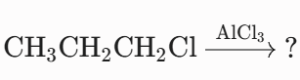
The Step-by-Step Breakdown
-
Initial Generation: The Lewis acid AlCl3 pulls the chloride ion away from 1-chloropropane. This generates a primary carbocation:

-
The Shift: Carbon atoms hate being unstable. To fix this, a neighboring hydrogen hops over with its pair of electrons in a 1,2-hydride shift.
-
New Intermediate: This shift transforms the unstable primary carbocation into a much happier, hyperconjugation-stabilized secondary carbocation:

-
The Final Attack: The nucleophile (Cl–) attacks this reorganized secondary carbocation.
Answer: The major product isn’t 1-chloropropane re-forming; it’s 2-chlorobutane (CH3CH(Cl)CH2CH3).
Misconceptions about Carbocations and Carbanions
When you are deep in the exam trenches, misconceptions can cost you critical marks. Let’s clear up a couple of common traps that students frequently fall into.
Misconception 1: “All carbocations are incredibly short-lived and impossible to isolate.”
While most are fleeting, some reactive intermediates are surprisingly resilient. Take the tert-butyl carbocation, or even better, the benzyl and allyl carbocations. Because of resonance, the positive charge on a benzyl carbocation gets distributed across the entire aromatic ring. It’s not stuck on one poor atom, making it stable enough to exist far longer than a standard primary carbocation.
Misconception 2: “Carbanions are always stable because they have a full octet.”
Yes, a carbanion has eight valence electrons, but remember: carbon is not highly electronegative. It absolute hates hoarding a negative charge. Their stability varies wildly based on their surroundings.
For instance, consider a hypothetical scenario where you have a phenyl anion versus an acetate-like carbanion. The phenyl anion is highly unstable because that negative charge is trapped in an $sp^2$ orbital and gets zero help from resonance. If there are no electron-withdrawing groups nearby to suck away that excess negative energy, the carbanion will react violently with the first positive thing it finds.
Application of Reactive Intermediates in Organic Synthesis
In the lab, controlling these reactive intermediates is like being a molecular architect. You use their predictable chaotic nature to build complex structures, like life-saving pharmaceuticals or advanced materials.
Carbocations in Action: Friedel-Crafts Alkylation
Carbocations are the superstars of Friedel-Crafts reactions. By treating an alkyl halide with a powerful Lewis acid catalyst like AlCl3, we force a carbocation to form. This aggressive electrophile then attacks an electron-rich aromatic ring, anchoring a new carbon-carbon bond. It is a foundational reaction for making everything from industrial solvents to complex drug precursors.
Carbanions in Action: Grignard Reactions
When you need a carbanion, you look to organometallic chemistry. Dropping magnesium turnings into an alkyl halide creates a Grignard reagent (RMgX). Because magnesium is a metal, it hands over the real electron control to the carbon, turning that carbon into a powerful carbanion nucleophile.
We use polar aprotic solvents like diethyl ether or THF here because they act like a protective cage, stabilizing the magnesium ion without giving up any protons that would destroy our fragile carbanion. This intermediate can then strike a carbonyl compound to synthesize alcohols, ketones, or carboxylic acids.
Exam Strategy: Mastering Reactive Intermediates (Carbocations, Carbanions) For IIT JAM
Let’s talk pure strategy. You can read textbooks all day, but cracking the IIT JAM requires a targeted game plan.
At VedPrep, we recommend building a visual concept map rather than just reading pages of notes. Draw out a central hub for reactive intermediates, and map out exactly what factors push their stability scales up or down (like aromaticity, resonance, hyperconjugation, and inductive effects).
When you practice exam-style questions, prioritize these three core skills:
-
Predicting Stability Rankings: Can you quickly spot why an allylic system beats a secondary alkyl system?
-
Proposing Real Mechanisms: Can you accurately draw the curved arrows showing exactly how an intermediate forms?
-
Spotting Rearrangements: Whenever you see a carbocation, always pause and ask yourself: “Can this do a hydride or alkyl shift to become more stable?”
Stability and Reactivity of Carbocations and Carbanions
To keep everything crystal clear for your revision, here is a quick cheat sheet summarizing how these two opposites stack up against each other.
| Feature | Carbocations | Carbanions |
| Electronic State | 6 Valence electrons (Electron-deficient) | 8 Valence electrons (Electron-rich) |
| Hybridization & Shape | Usually sp2, Trigonal Planar | Usually sp3, Trigonal Pyramidal |
| Character | Electrophilic (Seeks electrons) | Nucleophilic / Basic (Seeks positive centers) |
| Stabilized By | Electron-donating groups (+I, +M, Hyperconjugation) | Electron-withdrawing groups (-I, -M) |
| Stability Order | Tertiary (3°) >
Secondary } (2°) > Primary (1°) > |
Primary (1°) >
Secondary } (2°) > Tertiary (3°) > |
Additional Topics: Free Radicals, Carbenes, and Nitrenes
While carbocations and carbanions take up a lot of real estate in the syllabus, don’t sleep on the other reactive intermediates. The IIT JAM examiners love throwing these into the mix to see who really knows their stuff.
Free Radicals (R•)
Formed via homolytic cleavage—where a bond breaks evenly and each atom takes one single electron—free radicals are neutral but highly reactive because they have an unpaired electron. Just like carbocations, they are electron-deficient (7 valence electrons) and follow the exact same stability trends: tertiary radicals are much more stable than primary ones thanks to hyperconjugation and resonance.
Carbenes (R2C:) and Nitrenes (R-N:)
These are the oddballs of organic chemistry.
-
Carbenes feature a divalent carbon atom with six valence electrons and a neutral charge. They can exist in singlet or triplet states and are incredibly electrophilic.
-
Nitrenes are the nitrogen analogs of carbenes, boasting a neutral, monovalent nitrogen atom with four non-bonding electrons.
Final Thoughts
Cracking the organic chemistry portion of the IIT JAM really comes down to mastering these reactive intermediates. Once you stop viewing reactions as individual things to memorize and start seeing them as a logical game of electron density—where carbocations chase stability and carbanions look to share wealth—everything clicks. It takes practice, a lot of rough sheets, and a bit of patience to get used to spotting those sneaky molecular rearrangements.
To know more in detail from our faculty, watch our YouTube video:
Frequently Asked Questions
Why does hyperconjugation stabilize a carbocation but not a carbanion?
Hyperconjugation involves the leaking of electron density from a neighboring C-H or C-C σ-bond into an empty orbital. Carbocations have a vacant p-orbital that gladly accepts this extra density, lowering its energy. Carbanions already have a filled orbital containing a lone pair, so pushing more electron density toward them creates severe electron-electron repulsion, destabilizing the system.
How do I know if a carbocation will undergo a hydride shift or a methyl shift?
A carbocation will always favor whichever shift creates the most stable intermediate. If shifting a hydrogen (hydride shift) turns a 1° carbocation into a 3° carbocation, while a methyl shift would only make it a 2° carbocation, the hydride shift wins. If both shifts offer a similar stability jump, the hydride shift generally happens faster because hydrogen is smaller and moves with a lower activation energy barrier.
What role does aromaticity play in the stability of reactive intermediates?
Aromaticity is the ultimate stabilizing factor. If an intermediate can become part of a continuous cyclic, planar, conjugated system containing (4n+2)π electrons (Hückel's Rule), it experiences massive thermodynamic stability. A classic example is the tropylium cation, which is remarkably stable because the positive charge is delocalized over a perfectly aromatic seven-membered ring.
Why is a benzyl carbocation more stable than a simple secondary alkyl carbocation?
Even though a benzyl carbocation looks like it has a primary carbon center, its empty $p$-orbital sits right next to the π-system of a benzene ring. This allows the positive charge to delocalize across the ortho and para positions of the aromatic ring via resonance. This extensive charge-spreading makes it vastly more stable than a localized secondary alkyl carbocation.
Can a carbanion undergo structural rearrangements like a carbocation does?
Practically speaking, no. Carbocations rearrange because they are electron-deficient and shifting a group brings in a more stable configuration. Carbanions are electron-rich and their neighboring bonds are already full. Shifting a group with its bonding electrons would mean forcing two electron-dense centers to clash, which is thermodynamically unfavorable.
What is the difference between singlet and triplet carbenes?
It comes down to electron spin alignment. In a singlet carbene, the two unshared electrons are paired up with opposite spins inside the same sp2 hybridized orbital, leaving a completely vacant p-orbital. In a triplet carbene, the two electrons are unpaired and occupy two different orbitals with parallel spins, making it behave like a diradical.
Why do we strictly use polar aprotic solvents in Grignard reactions?
Grignard reagents are essentially trapped carbanions, making them incredibly strong bases. If you use a protic solvent (like water or alcohol), the carbanion will instantly snatch a proton (H+) from the solvent, destroying the reagent and turning your valuable intermediate into a boring alkane. Polar aprotic solvents like THF or diethyl ether stabilize the magnesium ion without offering any troublesome protons.
What is a bridgehead carbocation, and why is it so unstable?
A bridgehead carbocation forms at the junction of a bicyclic ring system (like norbornane). According to Bredt's rule, a bridgehead carbon cannot easily adopt a planar geometry or form a double bond because the rigid ring cages prevent it from flattening out. Since a carbocation demands a flat, sp2 shape to minimize strain, forcing it into a twisted, bent shape makes it exceptionally unstable.
How do electron-withdrawing groups (EWGs) stabilize carbanions?
EWGs act like electronic sponges. They pull excess negative charge away from the localized carbon atom through inductive effects (via σ-bonds) or mesomeric/resonance effects (via π-bonds). Spreading that negative charge across a larger framework lowers the potential energy of the carbanion, making it much more stable.
What is homolytic cleavage, and which intermediate does it form?
Homolytic cleavage happens when a covalent bond breaks symmetrically. Each of the two bonding atoms walks away with exactly one electron from the shared pair. This process requires energy (usually heat or light) and generates neutral, highly reactive chemical species known as free radicals (R•).
Is the allyl carbocation more or less stable than a tertiary carbocation?
This is a classic comparison trap in exams like IIT JAM. Generally, a tertiary carbocation is slightly more stable than a simple primary allylic carbocation due to the collective power of nine stabilizing hyperconjugation interactions. However, substituted allylic carbocations (where resonance and hyperconjugation work together) can easily match or beat the stability of a tertiary carbocation.
What are nitrenes, and where do we usually see them?
Nitrenes are the nitrogen equivalents of carbenes. They feature a neutral, monovalent nitrogen atom with four non-bonding electrons (six valence electrons total). You will typically encounter them as pivotal reactive intermediates in major name reactions involving amide rearrangements, such as the Hofmann, Curtius, and Lossen degradations.
Why are primary carbocations considered "virtually non-existent" in solution?
Simple primary carbocations have such a high potential energy and lack structural stabilization that they rarely exist as true, free-floating intermediates in a solution. Instead, the reaction usually bypasses them entirely via a concerted mechanism (like an SN2 pathway) where the nucleophile attacks at the exact same time the leaving group departs.