
If you are gearing up for the IIT JAM, you already know that inorganic chemistry can be a game-changer for your rank. And right at the heart of it sits a topic that is both incredibly fascinating and high-yielding: Crystal Field Theory (CFT).
Syllabus: Crystal Field Theory (CFT) For IIT JAM
If you glance at the official syllabus for IIT JAM, Crystal Field Theory is a massive chunk of Unit 4 in Inorganic Chemistry. It’s the backbone of coordination compounds, explaining why these complexes show beautiful colors, unique magnetic properties, and specific structures.
While standard textbooks like Inorganic Chemistry by Atkins or your trusty NCERT are great references, the JAM exam requires you to apply these concepts quickly under exam pressure.
The core areas you need to lock down are:
Basic principles of Crystal Field Theory (the assumptions behind the model)
Crystal field splitting patterns (how the d-orbitals split up)
Electronic configuration of metal complexes (high-spin vs. low-spin)
Mastering CFT isn’t just about memorizing facts; it’s about understanding the “why” behind transition metal behavior.
Crystal Field Theory (CFT) For IIT JAM Fundamentals
At its core, CFT is a remarkably simple model. Instead of worrying about complex covalent bonding or orbital overlapping, Crystal Field Theory pretends the whole setup is just pure electrostatics. It assumes the central metal ion and the surrounding ligands are like tiny magnets or point charges interacting with each other.
Imagine you are trying to find a seat on a crowded metro train. If someone sits right next to you, their presence creates a bit of “repulsion” or discomfort, forcing you to shift your position. That is exactly what ligands do to a metal ion’s d-orbitals.
When ligands approach the metal ion, their negative charge repels the electrons in the metal’s d-orbitals. Because these d-orbitals have different shapes and point in different directions, they don’t feel the repulsion equally. This uneven pushing forces the d-orbitals to split into different energy levels. We call this energy gap the crystal field splitting energy (Δ).
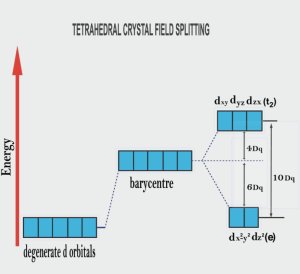
Octahedral vs. Tetrahedral Fields
In an Octahedral Field (6 ligands): The ligands attack directly along the x, y, and z axes. The dx2-y2 and dz2 orbitals (called the eg set) point straight at the axes, so they feel massive repulsion and jump up in energy. The dxy, dxz, and dyz orbitals (the t2g set) sit between the axes, so they feel less heat and drop lower in energy.
In a Tetrahedral Field (4 ligands): The ligands approach between the axes. This completely flips the script. Now, the t2 set (dxy, dxz, dyz) feels more repulsion and goes up, while the e set dz2, dx2-y2 stays lower.
Crystal Field Theory (CFT) For IIT JAM: Worked Example
Let’s look at a classic theoretical question to understand how the mathematics of this electrostatic interaction scales.
Question: Determine how the crystal field splitting energy (Δ) scales for a metal ion in an octahedral field, assuming the metal ion has a charge Z, the ligand acts as a point charge e, and the metal-ligand distance is r.
Solution: From the physics of point-charge interactions in an octahedral lattice, the splitting energy arises purely from electrostatics. When you derive the potential energy change for this geometry, the formula comes out to:
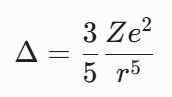
This relationship shows us that the splitting energy is incredibly sensitive to the distance (r) between the metal and the ligand because of that r5 term in the denominator. A tiny squeeze in bond length leads to a massive jump in splitting energy!
Common Misconceptions in Crystal Field Theory (CFT) For IIT JAM
When we talk to students at VedPrep, we notice a couple of classic traps that people fall into. Let’s clear those up right now.
Misconception 1: Crystal Field Theory and Ligand Field Theory (LFT) are totally different things. Not quite! Think of LFT as the upgraded, realistic version of CFT. Pure CFT is stubborn—it insists that everything is 100% ionic. But we know real life has shades of gray. LFT takes the basic splitting ideas of CFT and blends them with covalent bonding reality. They are part of the same evolutionary tree.
Misconception 2: The metal ion’s charge doesn’t affect Δ. This is a dangerous assumption for JAM. The charge on the metal ion matters a lot. If a metal has a higher positive charge (like Fe3+ vs Fe2+), it pulls the negative ligands much closer to itself. Because the distance r shrinks, the repulsion skyrockets, leading to a much larger Δ value.
Applications of Crystal Field Theory (CFT) For IIT JAM
Why do we care so much about this orbital splitting? Because it perfectly predicts how a complex behaves in the real world, especially its magnetism and color.
By looking at whether electrons pair up in the lower orbitals or jump to the higher ones, we can tell if a compound is paramagnetic (attracted to magnets) or diamagnetic (repelled by magnets).
Scientists use these exact principles to engineer smart materials. Let’s look at a quick breakdown of how this plays out in industry:
| Material | Magnetic Property | Application |
| CrO2 | Ferromagnetic | Magnetic recording tapes and data storage |
| Transition metal oxides | Antiferromagnetic | Spintronics and advanced sensors |
Exam Strategy for Crystal Field Theory (CFT) For IIT JAM
If you want to ace CFT questions in IIT JAM, CSIR NET, or GATE, you need a solid strategy. You cannot just read the theory like a novel and expect to solve numerical or conceptual ordering questions.
Here is your game plan:
Master the Factors Affecting Δ: You should be able to look at two complexes and immediately tell which one has a larger splitting value based on the spectrochemical series, metal oxidation state, and geometry.
Calculate CFSE Flawlessly: Practice calculating Crystal Field Stabilization Energy for both high-spin and low-spin states. Watch out for pairing energy terms!
Practice, Practice, Practice: The exam loves to test exceptions and trends.
At VedPrep, we have built targeted question banks and mock tests that mimic the exact flavor of IIT JAM questions. Practicing these daily helps you spot the tricks examiners like to hide in the options.
Crystal Field Theory (CFT) For IIT JAM: Additional Concepts
To get those top ranks, you need to know the advanced concepts that separate the top 100 rankers from the rest.
Square Planar Complexes
When an octahedral complex gets severely distorted—imagine pulling the two ligands on the z-axis completely away—you get a square planar geometry. Because the z-axis ligands are gone, any orbital with a “z” in its name drops in energy, while the dx2-y2 orbital shoots to the moon. This results in a massive Δ value, which is why square planar complexes are almost always low-spin.
The Jahn-Teller Effect
Imagine you are carrying two heavy grocery bags, but all the weight is in your right hand. You naturally lean over to balance the load so you don’t strain yourself.
That is essentially what a molecule does during a Jahn-Teller distortion. If the d-orbitals are unsymmetrically filled (like a d9 system), the molecule feels “uncomfortable” and distorts its own shape (usually elongating or compressing bonds) to lower its overall energy and achieve stability.
Crystal Field Theory (CFT) For IIT JAM: Tips and Tricks
Let’s wrap this up with a few quick mental shortcuts to help you solve questions faster:
The Geometry Rule: Remember that Δt ≈ 4/9 Δo. Tetrahedral splitting is less than half of octahedral splitting. Because of this small gap, tetrahedral complexes are almost always high-spin.
The Spectrochemical Series is Your Best Friend: Keep a handy mnemonic ready for strong-field vs. weak-field ligands. Strong-field ligands (like CN– and CO) cause huge splitting and force electrons to pair up.
Identify the Field First: Before calculating anything, look at the coordination number and the nature of the ligand.
If you ever feel stuck or want to see these orbital transformations visualized in real-time, feel free to check out the free VedPrep lectures on Crystal Field Theory. They break down these tricky geometric shifts into digestible, visual steps.
Final Thoughts
Mastering Crystal Field Theory isn’t about memorizing complex charts or getting tangled up in heavy math. It is simply about understanding how point charges interact and how those interactions ripple through a metal’s d-orbitals to dictate color, shape, and magnetism. If you can build a strong intuitive grasp of these spatial arrangements, you will find yourself breezing through coordination chemistry questions on exam day.
To know more in detail from our faculty, watch our YouTube video:
Frequently Asked Questions
Why do d-orbitals split in the presence of ligands?
In a free metal ion, all five d-orbitals have the same energy (they are degenerate). When ligands approach, their negative charges repel the electrons in the d-orbitals. Because the d-orbitals point in different directions, those facing the ligands directly experience more repulsion and rise in energy, while others stay lower, causing the energy levels to split.
What does the crystal field splitting energy (Δ) signify?
The Δ value represents the energy gap between the split sets of d-orbitals. A larger Δ means a bigger energy gap, which heavily influences whether electrons will pair up in the lower energy levels or jump to the higher ones.
What is the difference between strong-field and weak-field ligands?
Strong-field ligands (like CO or CN⁻) cause massive electrical repulsion, leading to a large crystal field splitting energy (Δ). Weak-field ligands (like I- or Br-) cause minimal repulsion, resulting in a small Δ.
How do I know if a complex will be high-spin or low-spin?
It comes down to a race between the splitting energy (Δ) and the pairing energy (P). If Δ > P (strong-field), electrons prefer to pair up in the lower orbitals, creating a low-spin complex. If Δ < P (weak-field), it is energetically easier for electrons to jump to the higher orbitals, creating a high-spin complex.
Why are tetrahedral complexes almost always high-spin?
Because there are only four ligands and they don't point directly at any orbital, the tetrahedral splitting energy (Δt) is quite small—roughly 4/9 of an octahedral field (Δo). This small gap is rarely enough to overcome the pairing energy (P), so electrons choose to jump up rather than pair up.
What exactly is Crystal Field Stabilization Energy (CFSE)?
CFSE is the thermodynamic stability gained by a metal complex when its d-electrons occupy the lower-energy split orbitals rather than sitting in a hypothetical, uniform spherical field. The lower the overall energy calculated, the more stable the complex.
How does the oxidation state of a metal ion affect Δ?
A higher positive charge on the central metal ion pulls the negative ligands closer to it. As the distance between the metal and the ligands shrinks, the electrostatic repulsion intensifies, which significantly increases the value of Δ.
Why do transition metal complexes display such vibrant colors?
When light shines on a complex, an electron in a lower d-orbital can absorb a specific wavelength of visible light and jump to a higher d-orbital (a d-d transition). The color we see is the complementary color of the wavelength that was absorbed.
What is the Jahn-Teller effect?
The Jahn-Teller theorem states that any non-linear molecular system with an electronically degenerate ground state will undergo a geometrical distortion to remove that degeneracy and lower its overall energy. In simple terms, if the d-orbitals are unsymmetrically filled, the molecule distorts its bonds to become more stable.
What is the pairing energy (P)?
Pairing energy is the energy required to force two negatively charged electrons into the same orbital, where they have to overcome natural electrostatic repulsion.
What is a typical IIT JAM trick question regarding CFSE?
Examiners often give you a weak-field, high-spin complex and ask for the CFSE, hoping you will forget that for d4 to d7 high-spin states, electrons fill the upper orbitals and partially cancel out the stabilization energy gained from the lower ones.
Where can I practice actual exam-level questions on CFT?
Right here at VedPrep! We provide highly curated question banks, regular mock tests, and comprehensive study modules explicitly designed to tackle the unique conceptual twists thrown at you during the IIT JAM exam.