


Enzyme kinetics (Michaelis-Menten) For IIT JAM deals with the study of enzyme-catalyzed reactions, focusing on the rate of reaction, enzyme-substrate complex formation, and the Michaelis-Menten equation to understand enzyme kinetics. It’s crucial for CSIR NET, IIT JAM, and GATE aspirants.
Understanding the Syllabus: Enzyme Kinetics (Michaelis-Menten) For IIT JAM
If you are gearing up for the IIT JAM, GATE, or CSIR NET, you already know that biochemistry isn’t just about memorizing structures. A huge chunk of your success depends on mastering enzyme kinetics.
In the IIT JAM Chemical Sciences (and Biotechnology) syllabus, enzyme kinetics is a vital part of physical and biochemical reaction kinetics. You aren’t just expected to know the definitions; you need to grasp how the Michaelis-Menten model works under the hood and how to apply it to solve numerical problems.
If you want to dive deep, standard textbooks are your best friends. At VedPrep, we always recommend flipping through Biochemistry by Donald Voet and Judith G. Voet (or Murray R. Wick) and Enzyme Kinetics by A. Cornish-Bowden.
The heart of this model revolves around two major constants: Vmax and Km. Together, they tell us how fast an enzyme can work and how tightly it holds onto its substrate. Let’s break down exactly what that means.
Enzyme Kinetics (Michaelis-Menten) For IIT JAM: Fundamentals
At its core, enzyme kinetics is simply the study of how fast enzyme-catalyzed reactions happen. Think of enzymes as biological microscopic machines. They speed up chemical reactions that would otherwise take years to happen on their own.
The speed (or rate) of these reactions depends on a few moving parts: how much enzyme you have, how much substrate you feed it, and environmental factors like temperature and pH.
To make sense of this math, Leonor Michaelis and Maud Menten gave us a legendary equation. It looks like this:
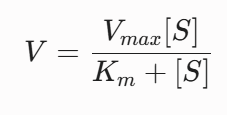
Here is the quick cheat sheet for what these symbols mean:
-
V: The current rate of your reaction.
-
Vmax: The absolute maximum speed the reaction can reach when the enzyme is totally flooded with substrate.
-
[S]: The concentration of your substrate.
-
Km (Michaelis constant): The specific substrate concentration where your reaction speed is exactly half of Vmax.
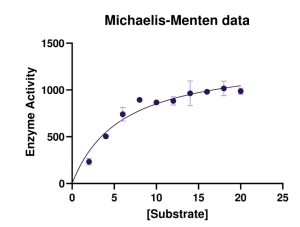
To picture how this works, let’s use a quick fictional analogy. Imagine a busy coffee shop with five baristas (our enzymes). Customers waiting in line are the substrate [S], and the turned-out cups of coffee are the product. When only two or three customers are in line, the baristas work at a relaxed pace. But if a massive crowd shows up, every single barista is working flat out at peak capacity. No matter how many more hundreds of customers line up outside the door, the shop cannot make coffee any faster. That peak operating speed is your Vmax.
The magic happens right before the coffee is made: a barista has to take a customer’s order. In biochemistry, this is the enzyme-substrate (ES) complex. The enzyme grabs the substrate, holds it in its active site, changes its shape, and then lets go of the finished product.
Enzyme kinetics (Michaelis-Menten) For IIT JAM: Formulas
You can expect derivation-based conceptual questions in the exam, so let’s walk through how this equation actually comes to life.
We start with a basic pathway: An enzyme (E) and a substrate (S) reversibly combine to form the enzyme-substrate complex (ES). This complex can either break back down into E and S, or move forward to give us our final product (P) and free up the enzyme.
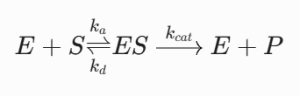
Let’s define our rate constants:
-
ka: The association rate constant (how fast E and S hook up).
-
kd: The dissociation rate constant (how fast ES falls apart back into E and S).
-
kcat: The catalytic rate constant or turnover number (how fast ES turns into product).
The net rate of change for our intermediate complex can be written as:
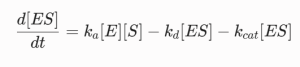
To solve this, we use the steady-state approximation. This idea assumes that the concentration of the ES complex stays pretty much constant while the bulk of the reaction is happening because it’s being formed as fast as it’s being broken down. So, we set the rate of change to zero:
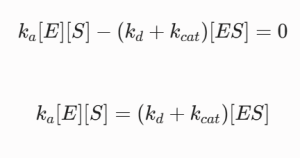
If we rearrange this to group the constants together, we get:
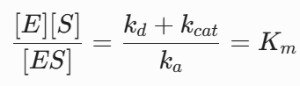
We also know that the total amount of enzyme ([E]t) is a mix of the free enzyme ([E]) and the enzyme locked up in the complex ([ES]), meaning [E] = [E]t – [ES]. If we substitute this back in and do a little algebraic rearranging, we find the amount of bound complex:
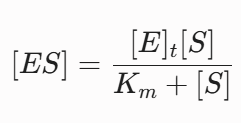
Since the velocity of product formation is V = kcat [ES], we multiply both sides by kcat:
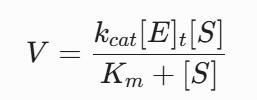
Because the maximum possible speed (Vmax) happens when every single bit of enzyme is bound to substrate (Vmax = kcat [E]t), we arrive right at our classic equation:
Common Misconceptions in Michaelis-Menten Kinetics
When we talk to students at VedPrep, we notice a few common traps that people fall into when studying this topic. Let’s clear those up right now so you don’t lose easy marks in the exam.
-
Misconception 1: The equation only works for simple, single-step reactions.
-
The Reality: While we derive it using a simple mechanism, the Michaelis-Menten equation applies perfectly well to complex multi-step reactions too. The main condition is just that the reaction needs to follow a sequential pathway where one single step acts as the main bottleneck (the rate-limiting step).
-
-
Misconception 2: Km is a direct measure of enzyme activity.
-
The Reality: Km does not tell you how active or fast an enzyme is. Instead, it tells you about the affinity between the enzyme and its substrate. Here is the golden rule to memorize: a low Km means high affinity (the enzyme binds tightly and needs very little substrate to hit half speed). A high Km means low affinity (the enzyme is a loose binder and needs a lot of substrate to get going).
-
-
Misconception 3: Vmax is a measure of substrate affinity.
-
The Reality: Vmax has nothing to do with affinity. It is a pure reflection of maximum enzyme activity and catalytic power when the active sites are completely stuffed with substrate.
-
Real-World Applications of Enzyme Kinetics (Michaelis-Menten) For IIT JAM
Why do we care so much about these equations? Because they run the show in labs and industries worldwide.
Enzyme Engineering
In biotechnology, scientists use enzyme engineering to alter natural enzymes so they work better in industrial settings—like making laundry detergents that clean clothes at lower temperatures. By calculating Km and Vmax, engineers can see if their modified enzyme binds its target better or works faster than the wild version.
Drug Metabolism
Ever wonder how doctors figure out how often you need to take a pill? Pharmacokinetics relies heavily on Michaelis-Menten kinetics. It helps researchers track how liver enzymes break down drugs in our systems, allowing them to map out safe dosages and predict potential side effects before a drug ever hits the pharmacy shelves.
Medical Diagnostics
In clinics, checking enzyme speeds helps save lives. Let’s say a patient comes into the hospital with chest pain. Doctors might run a blood test to check the activity of an enzyme called lactate dehydrogenase (LDH). Because LDH kinetics change predictably when heart tissue is damaged, measuring its behavior gives clinicians a clear window into diagnosing conditions like a myocardial infarction (heart attack).
Exam Strategy for Enzyme Kinetics (Michaelis-Menten) For IIT JAM
To ace this section in the IIT JAM, you need a solid game plan. Don’t just stare at the formulas—practice manipulating them.
-
Master the Lineweaver-Burk Plot: The standard Michaelis-Menten curve is a hyperbola, which makes it tricky to read exact values. By taking the reciprocal of both sides, we turn it into a straight-line equation (1/V vs 1/[S]). Learn how to find Vmax from the y-intercept (1/Vmax) and Km from the x-intercept (-1/Km). This is a massive favorite for numerical questions.
-
Watch Your Units: IIT JAM examiners love to mix up units. You might get substrate concentration in millimolar (mM) but Km in micromolar (μM). Always double-check that your units match up before you start typing numbers into your virtual calculator.
-
Understand Inhibition: Spend time learning how competitive, uncompetitive, and non-competitive inhibitors tweak your Vmax and Km values.
Key Concepts in Enzyme Kinetics (Michaelis-Menten) For IIT JAM
Here is a quick breakdown of the core pillars you need to review before exam day:
| Concept | What It Actually Means | Why It Matters for JAM |
| Michaelis Constant (Km) | Substrate concentration at 1/2 Vmax. Measures affinity. | Used to solve numerical problems and identify enzyme-substrate strength. |
| Maximum Velocity (Vmax) | Top speed when all enzyme active sites are fully saturated. | Directly proportional to total enzyme concentration. |
| Turnover Number (kcat) | How many substrate molecules one single active site can convert per second. | Calculated as Vmax / [E]t; reveals true catalytic efficiency. |
| Specificity Constant (kcat/ Km) | A measure of how efficiently an enzyme turns a specific substrate into product. | Ultimate test for comparing an enzyme’s preference for different substrates. |
Conclusion
Getting a firm handle on the Michaelis-Menten model is an absolute must if you want to score well in the biochemistry sections of the IIT JAM or CSIR NET. It gives us a reliable mathematical lens to look at how enzymes behave, which forms the bedrock of modern pharmaceutical and industrial research.
Take your time working through the derivations, practice drawing out the linear plots, and think about the physical meaning behind the numbers. If you ever feel stuck or want to test your progress with exam-level practice problems, we are always here to help guide you through the process at VedPrep.
To learn more in detail from our faculty, watch our YouTube video:
Frequently Asked Questions
Does a high Km mean the enzyme works faster?
This is a massive trap. A high Km means the enzyme has a low affinity for its substrate. It means the enzyme is a bit clumsy at picking up the substrate, so you need to flood the system with a high concentration of substrate just to get the enzyme to work at half-capacity.
Why do we need the Lineweaver-Burk plot when we already have the Michaelis-Menten graph?
The standard Michaelis-Menten curve is a hyperbola, and flattening out to hit a true Vmax on a graph takes an infinite amount of substrate. It’s nearly impossible to pinpoint the exact Vmax and Km on a curve. By taking the reciprocal (1/V vs 1/[S]), we turn that curve into a clean, straight line where the intercepts give us exact values.
What is the steady-state approximation, and why do we assume it?
It’s a simplifying assumption that makes the math workable. We assume that during the main phase of the reaction, the concentration of the intermediate enzyme-substrate complex ([ES]) stays constant. Basically, it is being formed from E + S just as fast as it’s breaking down into products or falling back apart.
What is the difference between Vmax and kcat?
Vmax is situational—it depends entirely on how much enzyme you threw into the beaker. kcat (the turnover number) is an intrinsic property of the enzyme itself. It tells you exactly how many substrate molecules a single active site can convert into product per second when it's fully saturated.
What is the upper limit for catalytic efficiency?
The absolute speed limit for an enzyme is determined by how fast the enzyme and substrate can physically collide in water. This is called the diffusion-controlled limit, and it sits around 108 to 109, M-1 s-1. Enzymes that reach this speed (like catalase or acetylcholinesterase) are called "catalytically perfect."
How can I identify a competitive inhibitor on a Lineweaver-Burk plot?
In competitive inhibition, the inhibitor mimics the substrate and fights for the active site. If you add more substrate, you can overcome this. Therefore, Vmax stays exactly the same (the lines intersect on the y-axis), but Km increases (the x-intercept moves closer to zero).
How does non-competitive inhibition alter the kinetic constants?
A non-competitive inhibitor binds to an entirely different site (an allosteric site) regardless of whether the substrate is there or not. It completely dismantles the enzyme's catalytic power. Because of this, Vmax drops, but the remaining functional enzymes still bind substrate with the exact same affinity, so Km remains unchanged.
Is the Michaelis-Menten equation applicable to allosteric enzymes like hemoglobin?
No, it isn't. Allosteric enzymes don't follow the classic sequential, single-active-site rules. They display "cooperativity" (binding at one site tweaks the other sites), which produces a sigmoidal (S-shaped) curve rather than a classic hyperbola. For those, we use the Hill equation instead.
What does it mean when a reaction is operating under "zero-order kinetics"?
This happens at very high substrate concentrations ([S]>> Km). The enzyme is completely saturated, meaning every active site is packed. At this point, adding more substrate won't speed things up at all; the reaction rate is flat and equal to Vmax.
When does an enzyme-catalyzed reaction follow "first-order kinetics"?
This occurs when substrate levels are incredibly low ([S]>> Km). Because the active sites are mostly empty, the rate of the reaction becomes directly proportional to how much substrate is available. If you double the substrate, you double the speed.
What is the turnover number (kcat) formula?
It is a quick calculation you’ll definitely need for the IIT JAM numerical section: kcat = Vmax/ [E]t, where [E]t is the total concentration of the enzyme active sites.
Why do some IIT JAM questions mention the "Eadie-Hofstee" or "Hanes-Woolf" plots?
While the Lineweaver-Burk plot is the most famous linear transformation, it tends to compress data points at high substrate concentrations. The Eadie-Hofstee and Hanes-Woolf plots are just alternative ways to rearrange the Michaelis-Menten equation to distribute data points more evenly across the graph.



