

Enzyme inhibition is basically the process of slowing down or completely blocking enzyme activity. Since enzymes are the ultimate workers driving your body’s biochemical reactions, messing with them changes everything. If you are prepping for the IIT JAM, you already know this isn’t just a random topic—it is a heavy hitter in the biochemistry section that shows up year after year.
Chemical Synthesis and Biochemistry Syllabus
If you look at the official IIT JAM syllabus, Enzyme inhibition sits comfortably under the Chemical Synthesis and Biochemistry section for your IIT JAM preparation.
When you look through standard textbooks like Biochemistry by Voet and Voet (or Morrison and Boyd for organic mechanisms) and, of course, the holy grail, Lehninger Principles of Biochemistry, you will find entire chapters dedicated to this. At VedPrep, we always remind students that mastering enzyme kinetics and enzyme-catalyzed reactions early on makes the rest of metabolic regulation feel like a walk in the park.
Enzyme Inhibition For IIT JAM: A Detailed Explanation
Let’s break it down simply: enzyme inhibition happens when a molecule (the inhibitor) binds to an enzyme and shuts down or drops its activity. Think of it like a wrench thrown into perfectly moving gears.
We classify these inhibitors into three main flavors based on how they behave:
Competitive Inhibition: The inhibitor looks shockingly similar to the actual substrate. It fights head-to-head with the substrate to grab the active site first.
Non-Competitive Inhibition: The inhibitor doesn’t care about the active site. It sneaks onto a completely different spot—the allosteric site. Once it sits there, it warps the enzyme’s shape so the substrate doesn’t fit right anymore.
Uncompetitive Inhibition: This one is a bit sneaky. The inhibitor waits until the substrate actually binds to the enzyme, and then it locks onto the enzyme-substrate (ES) complex, freezing it in place so no product can form.
Mechanistically, you can also split these into reversible and irreversible categories. Reversible inhibition relies on weak, non-covalent interactions. If you dilute the mixture or pump in more substrate, you can reverse the effect. Irreversible inhibition is permanent. The inhibitor forms a tough covalent bond with the enzyme, permanently destroying its catalytic capabilities.
Worked Example: Enzyme Inhibition in Biochemical Reactions
Let’s look at a classic numerical problem you might encounter on test day.
Problem: A competitive inhibitor is added to an enzymatic reaction. The substrate concentration [S] is 2 mM, and the inhibitor concentration [I] is 1 mM. The Michaelis constant (Km) of the enzyme for the substrate is 3 mM, and the inhibitor constant (Ki) is 2 mM. What is the effect of this competitive inhibition on enzyme activity?
Solution:
Because it is a competitive inhibitor, it mimics the substrate and fights for the active site. This setup changes the apparent affinity of the enzyme for its substrate.
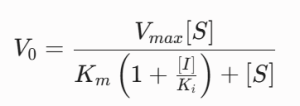
We can map this behavior using the modified Michaelis-Menten equation:
Let’s look at the correction factor, often called α:
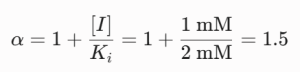
Now, let’s find the new, apparent Km (let’s call it Kmapp):
The apparent Km shifted from 3 mM up to 4.5 mM. A higher Km means the enzyme now has a lower binding affinity for the substrate. Because the denominator in our rate equation grew while the substrate concentration stayed at 2 mM, the initial velocity (V0) drops. So, the direct effect of adding this inhibitor is a clear decrease in overall enzyme activity.
Misconception: Enzyme Inhibition and Enzyme Activity
Here is a trap we see students fall into all the time during practice sessions at VedPrep: confusing inhibition with activation, or thinking that competitive inhibition somehow changes the maximum velocity (Vmax).
Let’s clear the air: enzyme inhibition always reduces enzyme activity. The inhibitor either blocks the active site or warps the enzyme’s architecture.
Take a real-world example: aspirin. When you have a headache, you take an aspirin because it inhibits the COX-1 enzyme. This enzyme is responsible for building prostaglandins, the chemical messengers that signal pain and inflammation to your brain. By turning down COX-1 activity, aspirin lowers prostaglandin levels, and your headache goes away. The enzyme isn’t working faster; it’s being blocked to help you feel better.
Real-World Applications of Enzyme Inhibition For IIT JAM
Enzyme inhibition isn’t just something confined to a biochemistry lab; it is the backbone of modern pharmacology and agriculture.
In medicine, many life-saving drugs are just highly specialized inhibitors. For example, protease inhibitors completely changed the game for HIV treatment by blocking the viral protease enzyme, which stops the virus from replicating.
In agriculture, many common pesticides work by targeting specific enzymes inside harmful pests while leaving the crops alone.
To make this vivid, let’s imagine a fictional scenario.
Imagine a hyper-targeted, imaginary weedkiller called “LeafGuard.” Suppose LeafGuard is engineered to specifically target an enzyme found only in a troublesome weed called invasive star-thistle. When sprayed, it locks onto the weed’s vital metabolic enzymes, shutting down its growth completely within days, while leaving the surrounding wheat crops completely untouched.
This imaginary scenario highlights exactly what researchers look for in the real world: selectivity and specificity. A great inhibitor needs to target the exact enzyme causing the issue without messing with other pathways, keeping side effects to an absolute minimum.
Exam Strategy for Enzyme Inhibition For IIT JAM
When you are staring down an enzyme kinetics question on the IIT JAM, do not panic. Grab your scratch pad and immediately sketch out your Lineweaver-Burk plots (the double-reciprocal graphs).
If the lines cross on the y-axis, your Vmax is unchanged, meaning you are dealing with a competitive inhibitor.
If they intersect on the x-axis, your Km is the same but Vmax dropped, pointing straight to non-competitive inhibition.
At VedPrep, we recommend writing down your variables explicitly before plugging them into the Michaelis-Menten variants to avoid simple algebraic errors.
Mechanisms of Enzyme Inhibition For IIT JAM
To score high on the biochemistry sections, you need to understand how these systems operate inside metabolic pathways.
| Inhibition Type | Effect on Apparent Km | Effect on Apparent Vmax | Binding Site on Enzyme |
| Competitive | Increases | Unchanged | Active Site (Free Enzyme only) |
| Non-Competitive | Unchanged | Decreases | Allosteric Site (Free Enzyme or ES Complex) |
| Uncompetitive | Decreases | Decreases | ES Complex Only |
Enzyme Inhibition in Biochemical Pathways
In nature, enzyme inhibition is the ultimate thermostat for living cells. It keeps biological systems from spinning out of control and prevents the wasteful buildup of reaction intermediates.
Take glycolysis, for example. The very first step involves an enzyme called hexokinase. When the cell gets plenty of energy and glucose-6-phosphate starts stacking up, that product loops back and inhibits hexokinase. The cell essentially says, “We have enough product for now, let’s slow down the assembly line.”
You see the same thing in the citric acid cycle. Succinate dehydrogenase catalyzes the oxidation of succinate into fumarate. If you introduce malonate—a structural mimic of succinate—it steps in as a competitive inhibitor and puts the brakes on the entire cycle. Understanding these feedback loops gives you a massive advantage when answering application-based questions on the exam.
Final Thoughts
Once you get a solid handle on how natural inhibitors work, you can explore enzyme engineering. This field is all about designing brand-new enzymes or tweaking existing ones to boost their stability, speed, or specificity.
Scientists use techniques like rational design (using computer models to predict changes) or directed evolution (mimicking natural selection in a test tube) to build better enzymes. This matters because if you can engineer an enzyme to be highly resistant to standard inhibitors, or design a custom inhibitor to shut down a specific bacterial pathway, you can revolutionize everything from biofuel production to targeted cancer therapies. Keeping these core concepts clear is what will set your preparation apart.
To know more in detail from our expert faculty, watch our YouTube video:
Frequently Asked Questions
What are the types of enzyme inhibition?
There are several types of enzyme inhibition, including competitive inhibition, non-competitive inhibition, uncompetitive inhibition, and irreversible inhibition. Each type has distinct characteristics and mechanisms of action.
What is competitive enzyme inhibition?
Competitive enzyme inhibition occurs when an inhibitor molecule competes with the substrate for binding to the active site of the enzyme. This type of inhibition can be overcome by increasing the concentration of the substrate.
What is non-competitive enzyme inhibition?
Non-competitive enzyme inhibition occurs when an inhibitor molecule binds to a site other than the active site of the enzyme, reducing its activity. This type of inhibition cannot be overcome by increasing the concentration of the substrate.
What is irreversible enzyme inhibition?
Irreversible enzyme inhibition occurs when an inhibitor molecule covalently binds to the enzyme, permanently inactivating it. This type of inhibition is often used in the development of pharmaceuticals.
What is the role of enzyme inhibition in metabolic pathways?
Enzyme inhibition plays a crucial role in regulating metabolic pathways, allowing cells to control the flow of substrates and products. This regulation is essential for maintaining cellular homeostasis.
How do inhibitors affect enzyme activity?
Inhibitors can reduce enzyme activity by binding to the enzyme, reducing its ability to bind to the substrate, or altering its conformation. This reduction in activity can have significant effects on cellular metabolism.
What are the key factors that affect enzyme inhibition?
The key factors that affect enzyme inhibition include the concentration of the inhibitor, the concentration of the substrate, the pH and temperature of the reaction, and the presence of other enzymes or molecules.
What is the significance of enzyme inhibition in biochemistry?
Enzyme inhibition is significant in biochemistry because it allows for the regulation of metabolic pathways, the development of pharmaceuticals, and the study of enzyme mechanisms. Understanding enzyme inhibition is essential for understanding many biological processes.
How is enzyme inhibition relevant to IIT JAM biology?
Enzyme inhibition is a key concept in biochemistry and is frequently tested in IIT JAM biology. Understanding the different types of inhibition and their mechanisms is crucial for success in the exam.
What are some common examples of enzyme inhibition in biochemistry?
Examples of enzyme inhibition include the inhibition of acetylcholinesterase by organophosphates, the inhibition of dihydrofolate reductase by methotrexate, and the inhibition of proteases by HIV protease inhibitors.
What are some important equations for enzyme inhibition?
Important equations for enzyme inhibition include the Michaelis-Menten equation, the Lineweaver-Burk plot, and the equation for the inhibition constant (Ki). Understanding these equations is essential for solving problems in enzyme inhibition.
What are some advanced topics in enzyme inhibition?
Advanced topics in enzyme inhibition include the study of enzyme kinetics, the development of inhibitors as pharmaceuticals, and the investigation of enzyme inhibition in disease states.
How does enzyme inhibition relate to disease and pharmacology?
Enzyme inhibition plays a crucial role in the development of pharmaceuticals and is involved in various disease states. Understanding enzyme inhibition can provide insights into the mechanisms of disease and the development of new treatments.
What is the role of computational modeling in enzyme inhibition?
Computational modeling plays a crucial role in the study of enzyme inhibition, allowing researchers to predict the binding of inhibitors to enzymes and design new inhibitors. This approach has led to the development of many pharmaceuticals.