

Preparing for competitive exams like IIT JAM can feel like trying to drink water from a firehose. There is just so much to cover. If you are diving into Unit 5 (Plant Physiology) of the official syllabus, you already know that Water relations is a massive chunk of it.
Standard textbooks like Plant Physiology and Development by Taiz and Zeiger or Salisbury and Ross dive deep into this. But let’s be honest, sometimes you need someone to break it down into plain English before you tackle those heavy chapters.
Here at VedPrep, we know exactly how overwhelming this can get. Let’s look at the core mechanics of how plants move water around without getting lost in overly academic jargon.
We will focus on two major areas in Water relations :
- Cellular Transport: How water and solutes sneak across cell membranes.
- Plant Physiology Basics: The exact mechanisms behind water uptake, transport, and loss.
Water Relations (Transport) For IIT JAM: Concept of Osmosis
Think of osmosis as the plant world’s way of keeping things balanced. By definition, osmosis is just the spontaneous movement of water molecules from a high-concentration zone to a low-concentration zone. As per Water relations, It has to pass through a selectively permeable membrane. This membrane is like a picky nightclub bouncer—it lets some molecules slide right in while turning others away.
You can easily think of osmosis as a specialized type of diffusion. What drives it? Differences in water potential. Water potential is basically a measure of the free energy of water in a system. Based on Water relations, it depends on solute concentration, pressure, and gravity. Water always flows from an area of high water potential to low water potential.
To make this visual, imagine you are making a crisp salad. If you sprinkle salt all over fresh cucumbers and leave them on the counter, you will notice a pool of water at the bottom of the bowl after a few minutes. Why? The water potential inside the cucumber cells was higher than the salty environment outside. Water rushed out to balance things.
In plant biology, we split this into two types to understand Water relations:
- Endosmosis: Water flows into the cell because the cell is sitting in a hypotonic (less concentrated) solution. The cell swells up.
- Exosmosis: Water flows out of the cell because it is in a hypertonic (more concentrated) solution, like our salted cucumber example. The cell shrinks.
Types of Membranes: Permeable, Semipermeable, and Selective Permeable
Membranes are the gatekeepers of the plant cell, regulating everything that goes in and out. For your IIT JAM preparation, you need to know the three main types:
Permeable Membranes
These are totally chill. They let both solutes (like salt or sugar) and solvents (like water) pass right through without any restriction. Because there are no barriers, the system reaches equilibrium super fast. You will often see these used in simple lab setups to show off basic diffusion.
Semipermeable Membranes
These are a bit more exclusive. They let the solvent molecules pass through but completely block the solutes. If you have ever done a lab experiment with cellophane or dialysis tubing, you have worked with a semipermeable membrane.
Selectively Permeable Membranes
These are the smart ones, and they are what you actually find in living plant cells. They don’t just filter by size; they actively choose specific substances to pass through while keeping others out based on the cell’s needs. The plasma membrane is the ultimate example here.
Here is a quick cheat sheet to keep them straight:
| Membrane Type | What It Allows Through | Common Example |
| Permeable | Both solutes and solvents | Cell wall |
| Semipermeable | Solvents only (blocks solutes) | Dialysis tubing |
| Selectively Permeable | Specific substances chosen by the cell | Plasma membrane |
Getting these differences down is a lifesaver when you are trying to solve tricky cell physiology questions on exam day.
Worked Example: CSIR NET Question on Osmosis
Let’s look at a typical problem you might encounter in Water relations. Don’t worry, we will break down the math step-by-step.
Question: A solution of sucrose is separated from pure water by a semipermeable membrane. The sucrose solution has a concentration of 0.5 M and is at a temperature of 20°C. The membrane allows only water molecules to pass through. If the observed osmotic pressure of the sucrose solution is 12.3 atm, calculate the van ‘t Hoff factor (i) for sucrose.
How to solve it:
The osmotic pressure (π) of a solution is tied to its concentration (c) by the classic equation:
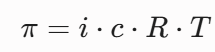
Where:
- c = 0.5 M
- R = 0.0821 L · atm/mol · K
- T = 20°C + 273 = 293 K
First, let’s find the expected osmotic pressure assuming no dissociation or association (where i = 1):
Expected π= 0.5 M × 0.0821 L · atm/mol ·K ×293 K = 12.04 atm
Now, we find the van ‘t Hoff factor (i) by comparing what we observed to what we expected:
i = Observed osmotic pressure/Expected osmotic pressure
i = 12.3 atm/12.04 atm ≈ 1.02
This example shows how osmotic pressure acts as a colligative property, meaning it depends on the number of solute particles in the space. The van ‘t Hoff factor just corrects for any weird particle behavior in the solution.
Common Misconceptions: Osmosis and Concentration Gradient
A classic trap that many students fall into is confusing “solute concentration” with “water potential.” You might see a question on an exam and automatically think water moves toward the higher concentration number. Remember, water moves toward the higher solute concentration, but it moves from a higher water potential to a lower water potential. Keep your perspective straight so you don’t lose easy marks.
Real-World Application: Water relations (Transport) in Agriculture
Why do we care about this outside of a textbook? Imagine a fictional farmer named Raj. He decides to give his crops a massive dose of synthetic fertilizer, thinking more is better. Instead of growing overnight, the plants wither and droop.
What happened? By dumping so much fertilizer into the soil, Raj accidentally made the soil water highly concentrated with solutes. The water potential of the soil dropped way below the water potential inside the plant roots. Instead of the roots sucking up water, osmosis pulled water out of the plant into the soil.
As per Water relations, Understanding these principles keeps crops alive and helps agricultural scientists develop drought-resistant plants.
Exam Strategy: Tips for Solving Water relations (Transport) Questions
Water relations can feel tricky because the questions often use confusing phrasing to test your confidence. Here is a game plan to tackle them:
- Master the Core Vocabulary: Don’t skip past definitions. You need to know osmotic pressure, water potential, and membrane permeability inside out.
- Watch the Signs: Water potential (ψ) calculations often involve negative numbers. Double-check your plus and minus signs when factoring in solute potential (ψs) and pressure potential (ψp).
- Practice Active Problem Solving: Don’t just read through solutions. Write them out.
We design our study guides at VedPrep to focus heavily on these high-yield areas, ensuring you get plenty of practice with practical, exam-style problems.
Lab Application: Measuring Water Potential in Plants
How do researchers actually figure out the energy status of water in a living tissue? They measure water potential, usually in megapascals (MPa).
In the lab, you will generally see two main tools used in Water relations:
- The Psychrometer: This clever setup measures tiny changes in temperature or electrical conductivity between two thermocouple junctions (one wet, one dry) to estimate water potential via vapor pressure.
- The Tensiometer / Pressure Chamber: This directly measures how much physical pressure it takes to force water out of a plant tissue sample.
Monitoring these numbers tells us how a plant handles environmental stresses like drought or high soil salinity. For anyone aiming to clear IIT JAM and move into serious research, mastering Water relations is just as important as memorizing the theory
Final Thoughts
Wrapping your head around water relations doesn’t have to be a chore if you focus on the underlying logic: water simply follows its energy gradient. Whether you are calculating water potential values, tracking endosmosis in a lab, or analyzing membrane selectivity, anchoring these concepts in physical reality will save you from careless errors on exam day. Give yourself the time to map out the equations and visualize the fluid movement.
To know more in detail from our faculty, watch our YouTube video:
Frequently Asked Questions
What is the role of transport in water relations?
Transport plays a vital role in water relations as it enables the movement of water and minerals from the roots to the leaves and other parts of the plant. This process occurs through the xylem and phloem tissues.
What is the xylem and its function?
The xylem is a type of vascular tissue in plants responsible for transporting water and minerals from the roots to the leaves. It consists of tracheids, vessels, xylem parenchyma, and xylem fibers.
What is the phloem and its function?
The phloem is another type of vascular tissue in plants that transports sugars, amino acids, and other organic compounds produced by photosynthesis from the leaves to the rest of the plant.
How does water enter plant cells?
Water enters plant cells through the process of osmosis, where water molecules move from an area of high concentration to an area of low concentration through a selectively permeable membrane.
What is the role of the cell membrane in water relations?
The cell membrane plays a crucial role in regulating water relations by controlling the movement of water and ions in and out of the cell through various transport mechanisms.
What is water potential?
Water potential is a measure of the energy status of water in a system, which determines the direction of water movement. It is influenced by factors such as concentration, pressure, and gravity.
How does water relations affect plant growth?
Water relations significantly impact plant growth as water is essential for cell turgor pressure, nutrient uptake, and photosynthesis. Plants with adequate water supply tend to grow healthier and produce more biomass.
What are the consequences of water stress on plants?
Water stress can lead to reduced plant growth, wilting, and even plant death. It can also impact photosynthesis, nutrient uptake, and plant reproduction, ultimately affecting crop yields.
What is a common misconception about water transport in plants?
A common misconception is that water transport in plants occurs through diffusion. However, water transport occurs through a combination of apoplastic and symplastic pathways, involving the xylem and phloem tissues.
How do students often misunderstand water potential?
Students often misunderstand water potential as simply being related to concentration gradients. However, water potential is influenced by multiple factors, including pressure, gravity, and matric potential.
What is the role of aquaporins in water relations?
Aquaporins are specialized proteins that facilitate water transport across cell membranes, playing a crucial role in regulating water relations and maintaining plant cell turgor pressure.
How do plants regulate water loss?
Plants regulate water loss through various mechanisms, including stomatal closure, cuticular wax production, and leaf senescence. These adaptations help conserve water and maintain plant water relations.
What is the significance of water relations in plant breeding?
Understanding water relations is essential in plant breeding for developing drought-tolerant crops. By selecting for plants with improved water relations, breeders can enhance crop resilience to water stress.
What is the relationship between water relations and plant hormones?
Plant hormones, such as abscisic acid, play a crucial role in regulating water relations by influencing stomatal closure, leaf senescence, and root growth. This helps plants adapt to changing water conditions.