
If you are gearing up for the IIT JAM, you already know that Ecology and Evolution isn’t just a section you can breeze through. It is a major score-booster, and right at the heart of it sits the concept of Food chains and food webs. These aren’t just dry diagrams with arrows pointing from a grasshopper to a frog; they represent the actual currency of an ecosystem—how energy and matter move through the living world. For the IIT JAM, you need to look past the surface and understand the underlying dynamics of these ecological networks.
Syllabus: IIT JAM Syllabus for Ecology and Evolution
When you flip open the official syllabus for IIT JAM, the structure of ecosystems, energy flow, and community dynamics are front and center. This isn’t just trivia about who eats whom; it connects directly to larger topics like nutrient cycling, population ecology, and how ecosystems bounce back from disruptions.
If you are looking for standard textbooks to cover Food chains and food webs, ‘Ecology and Evolution’ by A. M. B. Rao and ‘Ecological Systems: Principles and Applications’ by A. K. Ghosh are solid choices. They do a great job of breaking down the math and the mechanisms behind these concepts. Here at VedPrep, we always tell students that knowing your syllabus inside out is half the battle won. It keeps you from wasting time on out-of-syllabus topics and helps you focus on what actually gets tested.
What is a Food Chain, and How Does it Relate to Food Webs For IIT JAM
Let’s start with the basics of Food chains and food webs. A food chain is a straight, linear sequence showing how energy moves from one organism to the next. Each step along this chain is called a trophic level, which is basically just an organism’s feeding position in the grand scheme of things.
The catch? Nature rarely works in straight lines. A single organism doesn’t just eat one specific thing, nor is it hunted by only one specific predator. That linear chain is a major oversimplification. In reality, multiple food chains cross paths, overlap, and knot together to form a highly interconnected network. That network is a food web.
Think of a food chain like a single lane on a highway, while a food web is the entire bustling interchange. For your exam, you need to be comfortable transitioning between the two—analyzing how a single linear link behaves versus how the entire web reacts when you mess with one of the variables.
Understanding the Structure of Food Chains and Food Webs For IIT JAM
To crack the application-based questions in the exam from the Food chains and food webs, you need to understand the distinct functional roles within these networks:
- Producers: These are the autotrophs—the ultimate power plants of the ecosystem. They lock up solar energy or chemical energy via photosynthesis or chemosynthesis to create organic matter. Think plants, phytoplankton, and specialized bacteria.
- Consumers: The heterotrophs that rely on others for their energy fix. You’ve got your primary consumers (herbivores munching on plants), secondary consumers (carnivores eating those herbivores), and tertiary consumers (the top predators).
- Decomposers: Fungi and bacteria that act as the ecosystem’s clean-up crew. They break down dead organic matter, making sure vital nutrients flow right back into the soil or water to be reused by the producers.
When studying Food chains and food webs, remember that energy flow is strictly a one-way street (thanks to the laws of thermodynamics), while matter and nutrients get recycled over and over again.
A Worked Example of Food Chains and Food Webs For IIT JAM
Let’s look at a concrete, hypothetical scenario to illustrate how a food web actually functions under pressure.
Imagine a fictional grassland ecosystem we will call “Savanna X.” In this specific, hypothetical setup, let’s map out a few intersecting lines:
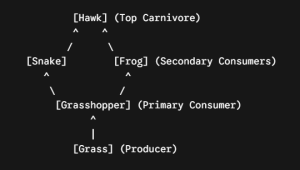
Now, let’s say a plant disease wipes out a massive chunk of the grass population. Here is how the web handles it:
- With less grass, the grasshopper population faces a massive food shortage and begins to crash.
- Because the grasshoppers decline, both the frogs and the snakes lose their primary food source.
- The hawk, which sits at the top, isn’t spared either. Even though it doesn’t eat grass, the energy shortage ripples all the way up, leaving the hawks with fewer snakes and frogs to hunt.
As per the Food chains and food webs, this fictional example shows how a single shock to a producer triggers a cascading effect across multiple trophic levels. In the IIT JAM, you will often face problems where you have to predict these exact kinds of shifts when one population is increased, decreased, or removed entirely.
Common Misconceptions About Food Chains and Food Webs For IIT JAM
A classic trap that catches many aspirants off guard is treating food webs as rigid, permanent structures. It is easy to look at a textbook diagram and assume that a species occupies exactly one fixed trophic level forever.
In reality, roles change. Many organisms are omnivores, switching their diet based on the season, their age, or what’s available. A grizzly bear eating berries is acting as a primary consumer; that same bear catching a salmon is operating as a secondary or tertiary consumer.
Another major pitfall is ignoring the decomposers. Because they are often tucked away at the bottom of a textbook graphic, students forget that they handle a massive chunk of the energy and matter in a real-world community. Missing these nuances can easily cost you marks on tricky, conceptual multiple-choice questions.
Real-World Applications of Food Chains and Food Webs For IIT JAM
Why does the examiner care so much about this? Because understanding these networks is how ecologists solve real ecological crises. Take biomagnification, for instance—the way toxic chemicals like heavy metals concentrate as you move up the food chain. Because energy drops by about 90% at each trophic level, top predators have to consume massive amounts of biomass, causing toxins to build up to dangerous levels in their bodies.
Another crucial application is predicting trophic cascades, where removing a top predator completely alters the plant landscape because the herbivore population runs wild. Mastering these concepts gives you the exact analytical mindset required to approach environmental biology questions logically.
Exam Strategy for Food Chains and Food Webs For IIT JAM
When you sit down to study Food chains and food webs for the exam, don’t waste time just memorizing definitions. Instead, build your strategy around these core steps:
- Practice with complex visual webs: Don’t just look at simple chains. Work with dense diagrams where multiple arrows intersect, and practice tracking the path of energy from producer to top predator.
- Focus on the numbers: Be ready for quantitative questions on ecological efficiencies, the 10% rule of energy transfer, and calculating net versus gross primary productivity.
- Deconstruct past questions: Look at how the IIT JAM has framed these questions in previous years. They love using scenarios where a specific population drops, requiring you to deduce the impact on the rest of the ecosystem.
At VedPrep, we design our practice modules to mimic these exact types of application-based challenges, helping you get comfortable with the trickier formats of the test.
VedPrep Tips for Mastering Food Chains and Food Webs For IIT JAM
To wrap things up, here are a few actionable tips from our team at VedPrep to help you ace this portion of the Ecology syllabus:
- Map it out yourself: When reading about a specific ecosystem type, grab a blank piece of paper and sketch the food web from scratch. The physical act of drawing the connections helps the pathways stick in your brain.
- Keep tabs on the arrows: Remember, the arrows in a food chain or web always point in the direction of energy flow (from the food to the eater), not the other way around. It sounds silly, but under exam stress, simple mistakes happen!
- Mix up your study media: If textbooks are starting to feel a bit heavy, try mixing up your routine. You can check out our free video resources, including this comprehensive VedPrep lecture on Food chains and food webs For IIT JAM, to get a fresh visual breakdown of the topic.
Final Thoughts
Frequently Asked Questions
What exactly is a trophic level?
A trophic level refers to the specific position or step an organism occupies in a food chain or food web based on its feeding behavior and how it secures its energy.
Can an organism occupy more than one trophic level simultaneously?
Yes. Many organisms, especially omnivores, occupy multiple trophic levels. For instance, if a bird eats seeds, it acts as a primary consumer (second trophic level), but if it eats an insect, it acts as a secondary consumer (third trophic level).
What is the 10% rule in energy transfer?
Introduced by Raymond Lindeman, this rule states that during the transfer of organic energy from one trophic level to the next, only about 10% of the stored energy is turned into biomass. The remaining 90% is lost as metabolic heat or respiration.
Why are food chains in nature rarely longer than four or five trophic levels?
Because of the 10% rule, energy diminishes rapidly at each successive level. By the time you reach a fourth or fifth trophic level, the remaining energy pool is usually too small to support a viable population of higher-level predators.
What role do decomposers play in a food web?
Decomposers break down dead organic material and waste products. While they are often left out of simple linear chain visuals to keep things clean, they are crucial because they recycle essential inorganic nutrients back into the soil or water for producers to use again.
What is a trophic cascade?
A trophic cascade is an ecological phenomenon triggered by the addition or removal of top predators, which causes reciprocal changes in the relative populations of predator and prey through a food chain, often drastically altering the ecosystem's plant landscape.
How does biomagnification work across a food chain?
Biomagnification happens when non-biodegradable toxins (like heavy metals or pesticides) increase in concentration at higher trophic levels. Because top predators must consume vast amounts of lower-level biomass to get enough energy, they inadvertently absorb concentrated doses of these toxins.
What is the difference between Grazing and Detritus food chains?
A grazing food chain starts with living green plants (producers) at the base and moves to herbivores and carnivores. A detritus food chain starts with dead organic matter (detritus) and moves to microorganisms, detritivores, and their predators.
How do autotrophs and heterotrophs differ in an ecosystem?
Autotrophs (producers) synthesize their own food from inorganic raw materials using sunlight or chemical energy. Heterotrophs (consumers) cannot make their own food and must consume other organisms to obtain energy.
Why does energy flow in a food web move in only one direction?
Energy flow is strictly unidirectional because once energy is transformed into work or lost as metabolic heat by an organism, it cannot be recycled back into a lower, more ordered energy form or reused by the producers.
How does nutrient cycling differ from energy flow?
Energy flows through an ecosystem in a one-way path and eventually dissipates as heat. Nutrients and matter, however, are never lost; they continuously cycle through biogeochemical pathways between living organisms and the physical environment.
What are some top textbook recommendations for studying this topic for IIT JAM?
'Ecology and Evolution' by A. M. B. Rao and 'Ecological Systems: Principles and Applications' by A. K. Ghosh are highly recommended standard texts that cover these ecosystem dynamics comprehensively.
How can environmental disruptions affect a food web's stability?
Because food webs are highly interconnected, a disruption to one species can cause a domino effect. Removing a single keystone predator can lead to the overpopulation of herbivores, overgrazing of producers, and the eventual collapse of the entire local community structure.
What kind of questions does IIT JAM typically ask about food webs?
IIT JAM heavily features application-based questions. You might see a diagram of an intricate food web and be asked to predict how a population boom or crash of one specific species will impact the populations of other non-adjacent species.