
The topic of Chromatography techniques is a huge slice of the syllabus for competitive exams like CSIR NET and IIT JAM. If you look at the official breakdown, it sits right under Paper 1, Section 2 (Chromatography and Spectroscopy) for IIT JAM, and a similar slot for CSIR NET.
At its core, chromatography is just a set of lab methods used to separate, identify, and count the pieces of a mixed-up sample. It is a staple in chemistry labs, biology setups, and pharma companies. If you want to dig into the heavy theory, standard textbooks like Organic Chemistry by J.D. Lee and Physical Chemistry by P. W. Atkins cover the basics well. But for the exam, you need to know how these systems work in practice, the different types (like gas and liquid chromatography), and where they are actually used. Mastering these ideas is what gets you those crucial marks.
Understanding Chromatography Techniques for IIT JAM: A Core Concept
Let’s strip away the textbook definitions for a second. Imagine you dump a bag of multi-colored chocolate candies into a bowl of warm water. Some colors dissolve and spread instantly, while others take their sweet time. Chromatography works on a similar wavelength. It is all about how the components of a mixture divide themselves between two phases: a stationary phase (the one staying put) and a mobile phase (the one on the move).
The stationary phase can be a solid or a liquid, and the mobile phase is usually a liquid or a gas. When you flush your mixture through the system, the different parts play a game of tug-of-war between the two phases. If a component prefers the mobile phase, it zips right through. If it likes the stationary phase better, it lags behind. This difference in speed is what separates them.
Here is a quick look at the main chromatography techniques you will run into:
- Paper chromatography: Uses a special strip of paper as the stationary phase.
- Thin layer chromatography (TLC): Uses a sleek glass or plastic plate coated with a thin layer of silica gel or alumina.
- Gas chromatography (GC): Uses a gas to push the mixture through a column.
- Liquid chromatography (LC): Uses a liquid solvent to move the sample along.
- Supercritical fluid chromatography (SFC): Uses a highly pressurized supercritical fluid (like dense CO2) as the mobile phase.
To ace IIT JAM, you need to know which method fits which scenario. For example, GC is your go-to for volatile stuff that turns into vapor easily, while LC handles the heavy, non-volatile molecules.
Worked Example: Solved Question on Chromatography Techniques For IIT JAM
Let’s look at a classic problem you might see in Chromatography techniques.
Imagine a fictional lab scenario where an analyst wants to separate a mixture of caffeine and theophylline using paper chromatography. They run the experiment using a mix of water and an organic solvent. After the run, the solvent front moves 10 cm. The caffeine spot travels 6 cm, and the theophylline spot travels 4 cm.
The Rf value (Retention Factor) is just the ratio of how far the compound traveled compared to how far the solvent traveled. Let’s calculate them:
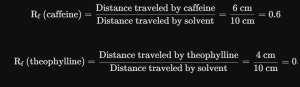
Separation Summary Table
| Compound | Rf Value |
| Caffeine | 0.6 |
| Theophylline | 0.4 |
What does this tell us? The distribution coefficient (K) measures the concentration ratio between the two phases. A higher Rf value means the compound tracks closely with the mobile phase. So, our math shows that caffeine interacts more with the mobile solvent than theophylline does, letting it move faster up the paper.
Common Misconceptions about Chromatography Techniques
A lot of students get tripped up by a few common myths when studying Chromatography techniques.
First, many think chromatography is only for qualitative analysis—like checking if a compound is present or not. That is wrong. Modern setups do both qualitative and quantitative work perfectly. They tell you what is in your beaker and exactly how much of it is there.
Another trap is thinking that Gas Chromatography is the only type that matters for the exam. While GC is important, IIT JAM tests a whole spread, including LC, TLC, and High-Performance Liquid Chromatography (HPLC).
Finally, do not let the jargon scare you into thinking this is too complex or tedious to learn. Once you look past the fancy instrument names, it always comes down to the same basic interaction between a stationary phase and a mobile phase. Breaking it down this way makes the whole topic way friendlier.
Application of Chromatography Techniques in Real-World Scenarios
To see why chromatography techniques matter, let’s look at how these methods work outside the exam hall.
In the pharma world, quality control is everything. Companies rely on HPLC and GC to check the purity of drugs before they hit the shelves. It helps them spot tiny amounts of impurities or contaminants, making sure the active ingredients are safe and at the right dosage.
Environmental teams also use these tools to protect our air, water, and soil. For instance, Gas Chromatography-Mass Spectrometry (GC-MS) acts like a chemical detective, identifying volatile organic pollutants in air samples to help enforce safety laws.
Even the food industry depends on these methods. Labs use HPLC and Ultra-Performance Liquid Chromatography (UPLC) to check what is in our food, scanning for hidden pesticides, heavy metals, or illegal artificial dyes to make sure grocery store items are safe to eat.
- Pharma labs: Checking drug purity and safety via HPLC and GC.
- Eco-monitoring: Hunting down pollutants with GC-MS.
- Food safety: Spotting pesticides and tracking additives using HPLC and UPLC.
Exam Strategy: Tips and Important Subtopics for Chromatography Techniques for IIT JAM
Getting a handle on chromatography techniques can feel a bit overwhelming when you are staring at a massive syllabus. The trick is to focus heavily on the underlying physical chemistry principles, like the differences between adsorption, partition, and ion-exchange mechanisms.
Make sure to get plenty of practice with problems based on paper, thin layer, and gas chromatography calculations. You will want to be comfortable comparing high-end methods like HPLC and GC-MS too. We at VedPrep find that mapping out these methods side-by-side helps the differences stick.
When you sit down to study, try structuring your notes around these high-yield areas:
- The core physical principles of phase separation
- Different separation mechanisms (adsorption vs. partition vs. ion exchange)
- Real-world applications of advanced setups (HPLC, GC-MS)
- The math behind basic methods (calculating Rf values in paper and TLC)
At VedPrep, we pull together video breakdowns, targeted practice questions, and mock tests designed to make these exact topics feel like second nature. Taking a steady, step-by-step approach to practicing these problems will help you walk into the exam room feeling completely ready.
Types of Chromatography Techniques for IIT JAM: A Comprehensive Overview
| Chromatography Type | Stationary Phase | Mobile Phase | Main Separation Mechanism |
| Paper | Liquid (Water trapped in paper fibers) | Liquid solvent | Partition |
| Thin Layer (TLC) | Solid (Silica gel or Alumina on a plate) | Liquid solvent | Adsorption |
| Gas (GC) | Liquid or Solid coated inside a column | Inert gas (like Helium or Nitrogen) | Partition or Adsorption |
| High-Performance Liquid (HPLC) | Solid packing material inside a column | Liquid solvent under high pressure | Adsorption or Partition |
Additional Study Tips for Mastering Chromatography Techniques for IIT JAM
- Visualize the process: Do not just memorize the tables. Picture the mobile phase moving up a plate or through a column. Visualizing the molecular tug-of-war makes it easier to predict how changing a solvent will affect your results.
- Watch the units: When calculating Rf values or retention times, ensure your units match up perfectly before doing any division. It sounds simple, but it is an easy place to drop silly marks under exam pressure.
- Relate it to lab work: If you did any TLC or column runs during your BSc lab classes, think back to those experiments. Connecting the textbook theory to a real glass plate you held in your hand makes the concepts stick much better.
Final Thoughts
Mastering chromatography techniques isn’t about memorizing every tiny detail of a massive instrument layout—it’s about understanding that simple molecular tug-of-war between two phases. Once you get comfortable with how different compounds partition themselves, the exam questions start looking a lot less intimidating. Just take it step-by-step, practice those Rf calculations, and focus on the fundamental principles.
To know more in detail from our faculty, watch our YouTube video:
Frequently Asked Questions
What is the main difference between adsorption and partition chromatography?
It comes down to how the stationary phase behaves. In adsorption chromatography, the stationary phase is a solid, and the components physically stick to its surface. In partition chromatography, the stationary phase is a liquid film supported on a solid, and the components dissolve into it, separating based on their relative solubility between the two liquid layers.
Why is the stationary phase in paper chromatography considered a liquid?
Even though the paper itself is solid cellulose, it tightly traps a thin layer of moisture (water molecules) within its fibers. It is this trapped water film that acts as the actual liquid stationary phase, making paper chromatography a type of liquid-liquid partition chromatography.
What is reverse-phase chromatography, and how does it differ from normal-phase?
Think of reverse-phase as the exact opposite of normal-phase. In normal-phase, the stationary phase is polar and the mobile phase is non-polar. In reverse-phase, the stationary phase is modified to be non-polar (hydrophobic), while the mobile phase is polar (like water or methanol). Reverse-phase is incredibly common in modern HPLC setups.
Why do we use a pencil to mark the baseline on a TLC plate instead of a pen?
Ink from a standard pen contains organic dyes that will dissolve in the mobile phase and separate right along with your sample, completely ruining your chromatogram. Pencil lead is made of graphite, which is inert and won't move or interfere with the separation.
What is the purpose of the "solvent front" in paper or thin-layer chromatography?
The solvent front is simply the furthest point the mobile phase travels up the plate or paper. It is essential to mark this line before the solvent evaporates because you need its exact distance to calculate your Rf values.
How do you visualize spots on a TLC plate if the compounds are colorless?
Since most organic compounds are colorless, we use tricks to see them. The most common methods are placing the plate under a UV lamp (where fluorescent indicators in the silica show dark spots) or exposing the plate to iodine vapors, which temporarily react with organic compounds to form brown spots.
What is the fundamental difference between Gas Chromatography (GC) and Liquid Chromatography (LC)?
The primary difference is the mobile phase. GC uses an inert carrier gas (like Helium or Nitrogen) to push vaporized samples through a heated column. LC uses a liquid solvent mixture to carry dissolved samples through the system.
Can GC be used for any chemical sample?
No, GC has limitations. The sample must be volatile—meaning it can vaporize without decomposing when heated. Large, highly polar biomolecules like proteins or DNA will degrade before they turn into a gas, so they are better suited for liquid chromatography.
What role does the "carrier gas" play in Gas Chromatography?
The carrier gas is strictly a transporter. Unlike the liquid mobile phase in LC, the gas in GC does not chemically interact with the sample molecules; its only job is to sweep the vaporized solutes down the column.
What makes High-Performance Liquid Chromatography (HPLC) "high-performance"?
Traditional liquid chromatography relies on gravity to trickle solvent through a column, which is very slow. HPLC uses high-pressure pumps to force the liquid mobile phase through columns packed with incredibly tiny, tightly packed particles. This massive pressure drastically speeds up the process and yields exceptionally sharp separations.
What is the main advantage of combining chromatography with Mass Spectrometry (like GC-MS)?
Chromatography is excellent at separating a messy mixture into individual components, but it isn't always perfect at identifying exactly what those components are. By linking it directly to a mass spectrometer (MS), each separated chunk is instantly smashed and analyzed for its molecular weight and fragmentation pattern, giving you definitive identification.
How does Ion-Exchange Chromatography separate molecules?
It separates them based on their net charge. The stationary phase consists of a resin coated with charged groups (either positive or negative). If the resin is negatively charged (cation exchange), it binds positively charged molecules while letting negatively charged or neutral molecules wash straight through.
How do you elute (wash out) a bound protein from an ion-exchange column?
You can unstick the molecule by changing the mobile phase. The two easiest ways are increasing the salt concentration (where salt ions compete for the charged sites on the resin) or altering the pH of the buffer to change the net charge of the molecule, causing it to lose its grip on the stationary phase.
Is chromatography only used to identify substances qualitatively?
While it is great for identifying what is in a sample (qualitative), modern systems like HPLC and GC use digital detectors to measure the peak area of each eluting component. The size of that peak tells you exactly how much substance is present, making it highly quantitative.