
Understanding Binding Energy For CUET PG
Direct Answer: Binding energy for CUET PG is the minimum energy required to remove a particle from a nucleus or a system of particles, essential for CUET PG, CSIR NET, and IIT JAM.
Syllabus and Key Textbooks
The topic of binding energy is part of the Modern Physics unit in the official CSIR NET syllabus, which is also relevant for CUET PG. This unit deals with the principles of quantum mechanics and their applications to atomic and nuclear physics.
Key textbooks that cover binding energy include Physics by Resnick, Halliday, and Walker, which provides a complete introduction to the subject. Another relevant textbook is not found in this context; however, this textbook adequately covers the topic.
For students preparing for the IIT JAM, binding energy is also relevant to the Mathematical Physics section of the syllabus. This section emphasizes the mathematical formulation of physical principles, including those related to nuclear physics.
- CSIR NET syllabus: Modern Physics unit
- Key textbook: Physics by Resnick, Halliday, and Walker
Binding Energy For CUET PG: Definition and Importance
Binding energy for CUET PG is the energy required to disassemble a system of particles into its constituent parts. It is a measure of the strong nuclear force that holds the protons and neutrons together in the nucleus of an atom. In other words, it is the energy needed to remove a particle from the nucleus.
The concept of Binding energy for CUET PG is essential for students preparing for exams like CUET PG, CSIR NET, IIT JAM, and GATE. Understanding binding energy helps in analyzing the stability of nuclei and the energy released or absorbed during nuclear reactions. Nuclear stability is directly related to the binding energy per nucleon, which is a key concept in nuclear physics.
The energy required to remove a particle from the nucleus is an important aspect of binding energy. This energy can be calculated using the mass defect of the nucleus, which is the difference between the mass of the nucleus and the sum of the masses of its individual particles. The binding energy per nucleon is a useful quantity to compare the stability of different nuclei.
Some key points to remember about binding energy include:
- It is a measure of the strong nuclear force.
- It is the energy required to disassemble a nucleus.
- It is related to the stability of nuclei.
Students should focus on understanding these concepts to excel in their exams.
Binding Energy For CUET PG
Binding energy for CUET PG is the energy required to disassemble a system into its constituent parts. In physics, this concept is crucial in understanding the stability of atomic and nuclear structures.
Electron binding energy, also known as electron affinity or ionization energy, is the energy required to remove an electron from an atom or molecule in its ground state. It is a measure of the attractive force between the electron and the nucleus. Electron binding energy is typically measured in electron volts (eV).
Nuclear binding energy is the energy required to disassemble a nucleus into its constituent protons and neutrons. It is a measure of the strong nuclear force that holds the nucleus together. Nuclear binding energy is typically measured in megawatt-electron volts (MeV). A higher nuclear binding energy per nucleon indicates a more stable nucleus.
There is also atomic Binding energy for CUET PG, which refers to the energy required to disassemble an atom into its constituent electrons and nucleus. This term is sometimes used interchangeably with electron binding energy.
The following table summarizes the types of binding energy:
| Energy Description Unit ample: Binding Energy in Nuclear Reactions |
|---|
The alpha decay of\({}^{238}_{92}U\)into\({}^{234}_{90}Th\)and\(\alpha\)particle is a well-known nuclear reaction. This process can be represented as:
\[ ^{238}_{92}U \right arrow ^{234}_{90}Th + ^{4}_{2}He \]
In this reaction, the binding energy per nucleon, which is a measure of the energy required to disassemble a nucleus into its constituent protons and neutrons, plays a crucial role. The binding energy of a nucleus is defined as the energy released when the nucleus is formed from its individual protons and neutrons.
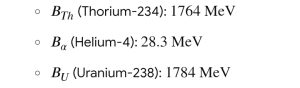
{238}_{92}U: 1784 MeV{234}_{90}Th: 1764 MeV{4}_{2}He: 28.3 MeV
To calculate the energy released in the reaction, one must consider the difference in binding energies between the products and the reactant. The energy released (\(\Delta E\)) can be calculated as:
Delta E = (B_{Th} + B_{\alpha}) - B_U
where
Substituting the given values:
Delta E = (1764 + 28.3) - 1784 = 8.3 {MeV}
The positive value of\(\Delta E\)indicates that the reaction is exothermic, releasing 8.3 MeV of energy.
Common Misconceptions About Binding Energy
Students often harbour misconceptions about binding energy, which can hinder their understanding of nuclear physics. One common misconception is that binding energy is the same as ionization energy. This understanding is incorrect because Binding energy for CUET PG refers to the energy required to disassemble a nucleus into its constituent protons and neutrons, where as ionization energy is the energy needed to remove an electron from an atom.
Another misconception is that binding energy is only applicable to nuclei. However, this is not entirely accurate. Binding energy is a concept that applies to any system where energy is required to separate the components, such as atomic nuclei, molecules, or even crystals. The term specifically refers to the energy associated with the strong nuclear force that holds nucleons together.
It is also commonly believed that the binding energy for CUET PG is a negative value. While it is true that the binding energy is often represented as a negative value on a mass-energy equivalence chart, this does not mean the energy itself is negative. Instead, it signifies that the nucleus has a lower energy state than its individual nucleons, indicating a stable configuration. A
| Binding Energy (B) | Mass Defect (Δm) |
| = Δmc^2 |
shows the relationship between binding energy and mass defect.
The accurate explanation is crucial: binding energy is a measure of the energy holding a nucleus together, calculated as the energy equivalent of the mass defect– the difference between the mass of the nucleus and the sum of its individual nucleons. Understanding this concept accurately is vital for students preparing for competitive exams like CSIR NET, IIT JAM, and GATE.
Application of Binding Energy in Real-World Scenarios
Nuclear power plants utilize the concept of Binding energy for CUET PG to generate electricity on a large scale. These plants rely on nuclear fission, a process where heavy atomic nuclei split into lighter ones, releasing a significant amount of energy. This energy is harnessed by exploiting the difference in binding energy between the parent nucleus and its daughter products. The released energy is then used to produce steam, driving turbines to generate electricity.
Particle accelerators, another application of binding energy, accelerate charged particles to high speeds to study subatomic interactions. In these facilities, scientists investigate the properties of nuclei and subatomic particles by inducing high-energy collisions. This helps researchers understand the strong nuclear force, which is responsible for holding quarks together inside protons and neutrons and binding these particles into atomic nuclei.
Medical applications of nuclear energy also rely on binding energy. Radiotherapy, a cancer treatment, employs ionizing radiation to destroy cancer cells. This is achieved through the use of radioactive isotopes, which undergo nuclear reactions that release energy. The energy released is directly related to the binding energy of the isotopes used. Additionally, nuclear medicine uses radioactive tracers to diagnose and treat diseases, taking advantage of the binding energy associated with radioactive decay.
- Nuclear power plants: generate electricity through controlled nuclear fission.
- Particle accelerators: study subatomic interactions and nuclear properties.
- Medical applications: cancer treatment and nuclear medicine.
Exam Strategy for CUET PG: Focus on Binding Energy
Students preparing for CUET PG must focus on nuclear reactions and binding energy, a crucial concept in physics. Binding energy for CUET PG is the energy required to disassemble a nucleus into its constituent protons and neutrons. Understanding this concept is vital for solving problems related to nuclear reactions.
The most frequently tested subtopics in CUET PG include mass defect, binding energy per nucleon, and Q-value of nuclear reactions. To master these subtopics, students should practice problems and questions from various sources, including previous years’ question papers and mock tests. A strong grasp of binding energy is essential for solving complex problems in nuclear physics.
To prepare effectively, students can utilize free video resources, such as this free VedPrep lecture on Binding energy for CUET PG, which provides expert guidance on the topic. VedPrep offers comprehensive study materials, including video lectures, practice questions, and doubt-clearing sessions, to help students prepare for CUET PG and other exams like CSIR NET, IIT JAM, and GATE.
By focusing on binding energy and practicing problems, students can improve their understanding of nuclear reactions and increase their chances of success in CUET PG. Binding energy for CUET PG is a critical topic that requires attention and practice to master.
Advanced Topics in Binding Energy For CUET PG
Exotic nuclei refer to atomic nuclei with an unusual number of protons or neutrons, often deviating from the stable valley of nuclides. In these nuclei, the binding energy helps understand their stability. The Binding energy for CUET PG in exotic nuclei is affected by the asymmetry term in the semi-empirical mass formula, which accounts for the unequal number of protons and neutrons.
Relativistic effects on binding energy become significant when dealing with high-energy particles or heavy nuclei. The relativistic mass increase leads to a decrease in the Binding energy for CUET PG, while the Darwin term contributes to an increase in the binding energy. These effects are essential in understanding the binding energy of nuclei with high atomic numbers.
Experimental methods for measuring binding energy include mass spectrometry and particle separation energies. Mass spectrometry involves measuring the mass difference between the nucleus and its constituent particles, while particle separation energies involve measuring the energy required to remove a particle from the nucleus. These methods provide valuable insights into the Binding energy for CUET PG of nuclei, which is essential for understanding various nuclear phenomena.
Understanding binding energy in exotic nuclei, relativistic effects, and experimental methods is crucial for students preparing for CUET PG. Binding energy for CUET PG is a critical topic, and a thorough grasp of these advanced topics will help students tackle complex problems in nuclear physics.
Frequently Asked Questions
Core Understanding
What is the binding energy for CUET PG?
Binding energy for CUET PG is the energy required to disassemble a nucleus into its constituent protons and neutrons. It is a measure of the strong nuclear force that holds the nucleus together.
What is the unit of binding energy?
The unit of binding energy is typically measured in megawatt-hours (MeV) or joules (J).
What is the relationship between binding energy and nuclear stability?
A higher binding energy per nucleon indicates greater nuclear stability, as more energy is required to remove a nucleon from the nucleus.
How is binding energy calculated?
Binding energy is calculated by finding the mass defect of the nucleus and converting it into energy using Einstein’s equation E=mc^2.
What is the significance of binding energy in nuclear physics?
Binding energy for CUET PG plays a crucial role in understanding nuclear reactions, stability, and the behavior of atomic nuclei.
What is the difference between binding energy and mass defect?
Binding energy is the energy equivalent of the mass defect, which is the difference between the mass of the nucleus and its constituent protons and neutrons.
How does binding energy relate to atomic and nuclear physics?
Binding energy is a fundamental concept in atomic and nuclear physics, describing the strong nuclear force that holds nuclei together.
What is the semi-empirical mass formula?
The semi-empirical mass formula is a mathematical expression used to estimate the binding energy of a nucleus based on its mass number and atomic number.
What is the importance of binding energy in understanding nuclear stability?
Binding energy is crucial in understanding nuclear stability, as it determines the energy required to remove a nucleon from the nucleus.
Exam Application
How is binding energy applied in CUET PG modern physics questions?
In CUET PG modern physics questions, binding energy is often applied to solve problems related to nuclear reactions, stability, and energy release.
What types of questions can be expected in CUET PG related to binding energy?
Expect questions on calculating binding energy, understanding nuclear stability, and applying binding energy concepts to nuclear reactions.
How to solve binding energy problems in CUET PG?
To solve binding energy problems, understand the concept of mass defect, binding energy per nucleon, and apply Einstein’s equation E=mc^2.
Can binding energy be negative?
No, binding energy is always positive, as it represents the energy required to disassemble a nucleus.
How to use binding energy to solve problems in modern physics?
To solve problems in modern physics, apply binding energy concepts to nuclear reactions, stability, and energy release, using formulas and equations.
Common Mistakes
What are common mistakes made when calculating Binding energy for CUET PG?
Common mistakes include incorrect calculation of mass defect, incorrect application of units, and failure to account for the strong nuclear force.
How to avoid mistakes in Binding energy for CUET PG calculations?
To avoid mistakes, carefully calculate the mass defect, use correct units, and ensure understanding of the strong nuclear force.
Is binding energy the same as kinetic energy?
No, binding energy is a measure of the strong nuclear force, while kinetic energy is the energy of motion.
How to identify and correct errors in binding energy calculations?
To identify and correct errors, carefully review calculations, ensure correct units, and verify understanding of binding energy concepts.
Advanced Concepts
What is the relationship between binding energy and nuclear fission?
In nuclear fission, the binding energy per nucleon of the resulting nuclei is lower than that of the original nucleus, releasing energy in the process.
How does binding energy impact nuclear reactor design?
Binding energy plays a crucial role in nuclear reactor design, as it affects the energy release and stability of the reactor.
What is the relationship between binding energy and nuclear forces?
Binding energy is a result of the strong nuclear force, which holds nuclei together, and is influenced by other nuclear forces, such as the electromagnetic force.