
Preparing for the RPSC Assistant Professor exam is a journey. When you are eyeing a prestigious job in higher education, you cannot just skim the surface of your syllabus. You need to master it. One area that frequently trips up aspirants due to its tricky thermodynamic calculations is the ionic bond, specifically focusing on lattice energy and the Born-Haber cycle.
Let’s break down these core concepts cleanly, dispel common myths, and look at how to tackle the exact kind of problems the RPSC panel loves to set.
Syllabus & Key Textbooks (Chemical Bonding and Molecular Structure) for Ionic Bond (Lattice Energy, Born-Haber Cycle) for RPSC Assistant Professor
The topic of ionic bonds, including lattice energy and the Born-Haber cycle, falls under the unit Chemical Bonding and Molecular Structure of the official syllabus. This is also a cornerstone of exams like CSIR NET, IIT JAM, and GATE, meaning your preparation here serves double duty.
To build an unshakable foundation, you should rely on standard reference books rather than local guidebooks. Here are the top recommendations:
- Physical Chemistry by P. W. Atkins and J. de Paula: Excellent for understanding the exact thermodynamic rigor behind the Born-Haber cycle.
- Inorganic Chemistry by Gary L. Miessler and Paul J. LaPaglia: Great for visualizing crystal structures and understanding the coordination chemistry surrounding ions.
- Inorganic Chemistry by N.N. Greenwood and A. Earnshaw (often referred to alongside standard physical chemistry texts like G.C. Bond): A brilliant resource for trends in lattice energy.
At VedPrep, we always advise aspirants to cross-reference these books because RPSC often picks conceptual questions directly from their data tables and solved examples.
Ionic Bond: Overview
At its simplest, an ionic bond forms between a metal and a non-metal through electron transfer. The metal gives away one or more electrons to become a positively charged cation, while the non-metal grabs those electrons to become a negatively charged anion. This creates a powerful electrostatic attraction between the oppositely charged particles.
Think of these metal cations and non-metal anions like microscopic magnets. They pack tightly together, which explains why ionic compounds have such high melting and boiling points—it takes massive amounts of thermal energy to shake that structure apart.
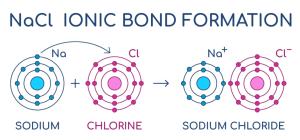
What Exactly is Lattice Energy?
The true strength of this atomic grip is measured by lattice energy. This is the energy released when gaseous ions come together from infinite distance to form one mole of a solid crystalline lattice.
M+(g) + X-(g) → MX(s) + Lattice Energy (U)
Because energy is released when stable bonds form, this value is highly exothermic (negative). But how do we measure it experimentally? You can’t just grab a single pair of gaseous sodium and chloride ions in a lab and measure the heat released. That is where the Born-Haber cycle comes in. It is a brilliant thermodynamic workaround that lets us calculate lattice energy using values we can actually measure in a lab.
Factors Influencing Ionic Bonds
The stability of an ionic compound boils down to a balance of size and charge. Here is the short version of the rules you need to memorize for the exam:
- Ion Charge: The higher the charge on the ions, the stronger the electrostatic pull. For instance, Magnesium Oxide (MgO) has a much higher lattice energy than Sodium Chloride (NaCl) because Mg2+ and O2- carry double the charge of Na+ and Cl–.
- Ion Size: Smaller ions can get much closer to each other. The shorter the distance between the nuclei, the tighter the bond. Therefore, lattice energy is inversely proportional to ionic radii.
Key Takeaway: >
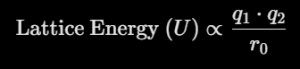
Where q1 and q2 are ionic charges, and r0 is the interionic distance. Smaller ions with bigger charges equal sky-high lattice energies, tighter bonds, and higher melting points.
The Born-Haber cycle ties all of this together by mapping out the entire energetic journey of a compound, broken into individual steps: atomization of the elements, ionization to form ions, and the final structural collapse into a crystal lattice.
Calculating Lattice Energy for NaCl
Let’s look at how this works in practice. Imagine you are sitting in the RPSC exam hall and you encounter a question asking you to calculate the lattice energy of sodium chloride (NaCl) using a Born-Haber cycle.
The cycle is built on Hess’s Law, which states that the total enthalpy change for a chemical reaction is the same whether the reaction occurs in one step or several steps.
Here is the data provided:
- Electron affinity of Cl (EA): -345 kJ/mol
- Ionization energy of Na (IE): +495 kJ/mol
- Sublimation energy of Na (ΔHsub): +108 kJ/mol
- Bond dissociation energy of Cl2 ( ΔHdiss): +242 kJ/mol (Note: We only need half of this value, +121 kJ/mol, to get a single mole of Cl atoms)
- Enthalpy of formation of NaCl (ΔHf): -411 kJ/mol
The Step-by-Step Breakdown
To find the lattice energy (U), we set up our thermodynamic bookkeeping balance sheet:

Rearranging the equation to solve for lattice energy (U):
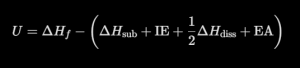
Let’s plug in our numbers:
U = -411 – ( 108 + 495 + 121 + (-345))
U = -411 – ( 724 – 345)
U = -411 – 379
U = -790 kJ/mol
(Note: Depending on how the question words it, lattice energy can be expressed as an exothermic value, -790 kJ/mol, for lattice formation, or an endothermic value, +790 kJ/mol, for lattice dissociation. Always check the sign options carefully in the multiple-choice section).
Common Misconceptions About Ionic Bonds
When our team at VedPrep reviews mock exam papers, we see brilliant students fall into the same trap options repeatedly. Let’s clear up two major misconceptions:
Misconception 1: “Ionic bonds are unbreakable and absolute.”
People often assume that because ionic bonds have huge lattice energies, they cannot be disrupted easily. That is far from the truth. Drop a spoonful of salt into a glass of room-temperature water, and the crystal structure falls apart in seconds. Water is highly polar, and its hydration energy is often large enough to overcome the lattice energy of the salt crystal, separating the ions.
Misconception 2: “All ionic compounds dissolve in water.”
This is the exact opposite error. Students often generalize that “like dissolves like,” assuming every ionic compound dissolves in polar water. Consider Silver Chloride (AgCl). It is heavily ionic, yet it sits stubbornly at the bottom of a beaker as a precipitate. Why? Because the electrostatic attraction between Ag⁺ and Cl⁻ is incredibly strong, and the hydration energy released by water isn’t enough to break their lattice.
Real-World Applications of Ionic Bonds
To make these concepts stick, let’s look at how they show up in the real world.
Imagine a geological survey team exploring the salt flats of Rajasthan. They come across vast deposits of halite (NaCl) and sylvite (KCl). Both are ionic minerals, but halite is noticeably harder and has a higher melting point than sylvite. Why? Because the sodium ion (Na⁺) is smaller than the potassium ion (K⁺). That smaller ionic radius gives halite a higher lattice energy, making its crystal structure tightly locked together and highly stable under the harsh desert sun.
In biological systems, ionic interactions keep us alive. Think of DNA packaging inside a cell nucleus. The phosphate backbone of your DNA is heavily negatively charged. To pack yards of DNA into a microscopic cellular space without it repelling itself and snapping, the body wraps it around positively charged proteins. This stable ionic architecture keeps the entire genome tightly coiled and safe.
Mastering Ionic Bonds for RPSC Assistant Professor Exam
If you want to clear the RPSC Assistant Professor exam, you need to move past simple memorization and focus on mechanical problem-solving.
When you study, spend your time practicing how to manipulate the Born-Haber cycle equation. RPSC examiners love to twist these questions—sometimes they will give you the lattice energy and ask you to find the electron affinity, or they might change the stoichiometry by asking you to calculate values for MgCl₂ instead of NaCl.
Watch Out for Stoichiometry: For a compound like MgCl₂, remember you will need the first and second ionization energies of Magnesium, and you must multiply the electron affinity of Chlorine by two.
We have put together deep-dive video breakdowns covering these exact exam traps. You can watch a free VedPrep lecture on ionic bonds, lattice energy calculations, and the Born-Haber cycle to see these multi-step problems solved in real time.
Additional Tips and Key Takeaways for Competitive Exams
As you refine your study notes, keep these core priorities in mind:
- Master the Signs: Sublimation, dissociation, and ionization always cost energy (positive signs). Electron affinity and lattice energy usually release energy (negative signs). Mixing up a single plus or minus sign will lead you directly to one of the distractor options on the exam sheet.
- Fajan’s Rules Connection: Always remember where ionic bonding ends and covalent character begins. RPSC often asks combined questions where you have to judge whether a bond is purely ionic or partially covalent based on ion size and polarizing power.
If you ever feel stuck on a tricky calculation or want to test your speed under real exam conditions, come check out our practice question banks at VedPrep. Working through past papers is the single best way to build your confidence.
Future Research Directions
Even though ionic bonding is foundational chemistry, it remains a highly active field of academic research. Modern material scientists are constantly investigating how extreme pressures and temperature variations alter lattice energy, allowing them to synthesize ultra-hard materials.
Furthermore, researchers are focusing heavily on ionic liquids—salts that remain liquid at room temperature due to poorly fitting, bulky ions with low lattice energy. These materials are opening new frontiers in green chemistry, catalysis, and advanced energy storage systems like long-lasting batteries.
Conclusion
Mastering the mechanics of the ionic bond, lattice energy, and the Born-Haber cycle is a non-negotiable step to securing your spot as an RPSC Assistant Professor. By understanding the balance of ion size and charge, practicing your thermodynamic calculations, and steering clear of common conceptual traps, you will be well-prepared for exam day.
To know more in detail from our expert faculty, watch our YouTube video:
Frequently Asked Questions
What is lattice energy?
Lattice energy is the energy released when one mole of ions in the gaseous state combine to form a solid crystal lattice. It is a measure of the strength of the ionic bond in an ionic compound.
What is the Born-Haber cycle?
The Born-Haber cycle is a thermodynamic cycle used to calculate the lattice energy of an ionic compound. It involves a series of steps, including the formation of ions from atoms, the combination of ions to form a crystal lattice, and the release of energy.
What are the factors that affect lattice energy?
The factors that affect lattice energy include the charge of the ions, the size of the ions, and the arrangement of the ions in the crystal lattice. Generally, lattice energy increases with increasing charge and decreasing size of the ions.
What is the relationship between lattice energy and ionic bond strength?
Lattice energy is a direct measure of the strength of the ionic bond in an ionic compound. A higher lattice energy indicates a stronger ionic bond.
What are inorganic and analytical chemistry?
Inorganic chemistry deals with the study of inorganic compounds, which are typically derived from mineral sources. Analytical chemistry involves the analysis of the chemical composition of substances, often using various techniques to identify and quantify the components.
How does chemical bonding relate to ionic bonds?
Chemical bonding refers to the attractive and repulsive forces between atoms that hold them together in a molecule. Ionic bonds are one type of chemical bond that forms between atoms with a large difference in electronegativity.
How to calculate lattice energy using the Born-Haber cycle?
To calculate lattice energy using the Born-Haber cycle, one must consider the enthalpy changes associated with each step of the cycle, including ionization energy, electron affinity, and the formation of the crystal lattice.
What are the applications of ionic bonds in inorganic chemistry?
Ionic bonds are crucial in understanding the properties and behavior of inorganic compounds, such as their solubility, conductivity, and reactivity. This knowledge is essential for various applications in fields like materials science and chemistry.
How to solve problems related to ionic bonds and lattice energy in RPSC Assistant Professor exams?
To solve problems related to ionic bonds and lattice energy, one must have a strong understanding of the underlying concepts, including the Born-Haber cycle and the factors that affect lattice energy. Practice with sample problems and previous year's questions is also essential.
How to apply knowledge of ionic bonds in analytical chemistry?
In analytical chemistry, knowledge of ionic bonds is essential for understanding the behavior of ions in solution, including their interactions with solvents and other species. This knowledge is crucial for various analytical techniques, such as chromatography and spectroscopy.
What are common mistakes in understanding ionic bonds?
Common mistakes include confusing ionic bonds with covalent bonds, not considering the role of electronegativity in bond formation, and misunderstanding the relationship between lattice energy and ionic bond strength.
How to avoid mistakes in calculating lattice energy?
To avoid mistakes in calculating lattice energy, one must carefully consider the enthalpy changes associated with each step of the Born-Haber cycle and ensure that the correct values are used for ionization energy, electron affinity, and other relevant parameters.
What are the limitations of the Born-Haber cycle?
The Born-Haber cycle assumes that the ions are point charges and neglects the effects of electron correlation and other complex interactions. These limitations can lead to discrepancies between calculated and experimental lattice energies.
How does lattice energy relate to other types of chemical bonds?
Lattice energy is a specific concept related to ionic bonds, but the underlying principles of electrostatic attraction and repulsion are relevant to other types of chemical bonds, such as covalent and metallic bonds.