
If you are eyeing the RPSC Assistant Professor post, you already know that navigating the massive syllabus requires a sharp strategy. The topic of Interhalogen compounds is a goldmine for scoring high marks. It regularly features in major competitive exams like CSIR NET, IIT JAM, and CUET PG.
For the RPSC exam, you will find this topic tucked under Inorganic Chemistry, specifically within the units covering chemical bonding, molecular structure, and p-block elements.
To build a flawless foundation, you don’t need to hoard dozens of books. Stick to the classics:
- NCERT Textbooks (Class 11 & 12): Do not skip these. They provide the fundamental spark for undergraduate-level clarity.
- O.P. Tandon (Inorganic Chemistry): Excellent for mapping out reactions and clear structural details.
- Huheey, Keiter, & Keiter / Miessler & Tarr: For the advanced coordination and bonding concepts that RPSC love to throw in to test your deep understanding.
Understanding Interhalogen compounds: Definition, Properties, and Types
Think of halogens as a group of highly opinionated individuals. Usually, they react with metals or non-metals, but sometimes they turn inward and react with each other. When two different halogens hook up, you get interhalogen compounds.
Because one halogen is always hungrier for electrons than the other, these bonds are polar. This uneven sharing of electrons makes them incredibly reactive—in fact, they are generally way more reactive than pure halogens (except for fluorine, which is a wild card on its own). They react eagerly with almost anything they touch.
We classify these compounds based on their formulas, matching a larger, less electronegative halogen (X) with a smaller, more electronegative one (X’):
- XX’ type (Di-interhalogens): ClF, BrCl, ICl (Simple linear molecules)
- XX’3 type (Tri-interhalogens): ClF₃, BrF₃ (T-shaped molecules)
- XX’5 type (Penta-interhalogens): IF₅, BrF₅ (Square pyramidal shapes)
- XX’7 type (Hepta-interhalogens): IF₇ (Pentagonal bipyramidal structure)
Getting a grip on these geometries is a massive advantage for your RPSC preparation on Interhalogen compounds.
Worked Example: Preparation of Interhalogen compounds
Let’s look at a classic textbook example: making Iodine Heptafluoride (IF₇).
Imagine you want to force iodine and fluorine to bond all the way up to IF7. You can’t just mix them in a beaker at room temperature and hope for the best. You need to blast them with heat and pressure.
You take iodine and mix it with an absolute excess of fluorine gas. Drop them into a specialized nickel or copper container—regular glass would melt or react instantly—and crank the temperature up to 250–300°C under 2–3 atmospheres of pressure. A dash of tungsten hexafluoride (WF6) works behind the scenes as a catalyst to keep things moving.
Here is the balanced equation:
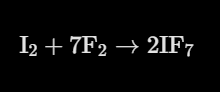
The final product, IF7, is a colorless solid with a beautiful pentagonal bipyramidal structure. It is an aggressive fluorinating agent, meaning it will happily slap fluorine atoms onto almost anything it encounters.
Misconception: Common Errors and Misconceptions in Interhalogen compounds
A common trap that many RPSC aspirants fall into is assuming that all interhalogen compounds behave exactly the same way when they hit water. You might think they all instantly hydrolyze to form halic and hydrohalic acids.
But chemistry is never that simple. While ClF and BrCl jump into water-based reactions instantly, compounds like ClF₃ and IF₅ behave quite differently and can be incredibly violent or highly specific.
Another trap is leaning too hard on electronegativity. It is easy to assume that a bigger electronegativity difference automatically means a more reactive molecule. In reality, reactivity is a puzzle. You have to look at the whole picture: bond strengths, steric hindrance, molecular geometry, and whether the central atom has vacant d-orbitals to accept incoming electron pairs. For example, IF7 is fiercely reactive not just because of the elements involved, but because its crowded pentagonal bipyramidal structure makes it eager to shed its outer atoms.
Application: Real-World Applications of Interhalogen compounds in Industry and Research
These compounds aren’t just lines on a whiteboard; they do some heavy lifting in real-world industries.
Because they love to donate fluorine atoms, they are widely used as fluorinating agents. Take ClF3, for example. It is used in nuclear fuel processing to turn uranium into uranium hexafluoride (UF6), which can then be enriched.
In research labs, compounds like BrF3 help synthesize unique metal fluorides that regular fluorine gas can’t easily make. Even in environmental science, iodine monochloride (ICl) finds use as a targeted disinfectant in specialized water treatment processes.
Exam Strategy: Tips and Tricks for Mastering Interhalogen compounds in Competitive Exams
When you are facing an exam like the RPSC Assistant Professor test, memorizing equations won’t cut it. You need to understand the underlying trends.
Here is a quick mental map to help you study:
- Focus on Hybridization: Be ready to quickly calculate the steric number for ClF₃ (sp³d) or IF₇ (sp³d³).
- Predict the Products: Remember that during hydrolysis, the larger, less electronegative halogen always turns into an oxyacid, while the smaller one becomes a halide ion.
Practicing previous years’ questions is your best tool here. We at VedPrep always recommend setting up a weekly quiz schedule to test your speed. If you want to see these visual structures explained step-by-step, you can check out the free VedPrep video lectures online to get a clearer picture of the orbital overlapping.
Key Concepts: Important Aspects of Interhalogen compounds
Let’s look at a fictional, everyday scenario to make this stick. Imagine a high-stakes corporate negotiation. You have a very aggressive mediator (ClF3) whose sole job is to break up an existing partnership and force one side to accept new terms. The mediator does this by handing off assets (fluorine atoms) at an incredible speed.
That is exactly how these compounds act as oxidizers and fluorinating agents. They disrupt stable bonds because the central halogen is highly polarized and ready to shift its oxidation state.
[Halogen X] ─── (Polar Bond) ─── [Halogen X’]
│ │
(Less Electronegative) (More Electronegative)
Whether they are acting as oxidizing agents or forcing a metal into its highest oxidation state, their behavior always comes down to that initial, unstable bond polarity between the two different halogens.
Additional Tips and Resources for Interhalogen compounds
As you organize your RPSC study tracker, treat this topic as a bridge between chemical bonding and main group chemistry.
- Our Recommended Study Method: Start by mastering VSEPR theory. Once you can draw the lone pairs on ClF3 or IF5 with your eyes closed, the chemical reactions will make far more sense.
We love breaking down these tough topics at VedPrep, and we suggest mixing your reading sessions with mock tests to keep things engaging. Don’t worry about memorizing every single reaction temperature; instead, focus on why a reaction happens and what the molecular shapes look like.
Final Thoughts
Mastering interhalogen compounds isn’t about memorizing a dry list of formulas—it’s about understanding the unique atomic tug-of-war that makes these molecules so fascinatingly reactive. For an RPSC Assistant Professor aspirant, a deep grasp of their structural geometries, bonding quirks, and real-world utility is exactly what separates a good score from a great one. Take it one molecular shape at a time, keep linking the concepts back to fundamental chemical principles, and trust the prep work you are putting in.
To know more in detail from our faculty, watch our YouTube video:
Frequently Asked Questions
How are interhalogen compounds formed?
Interhalogen compounds are formed through the direct reaction of two halogen elements, often requiring specific conditions such as high temperatures or the presence of a catalyst. The reaction involves the exchange of electrons and the formation of a covalent bond between the halogen atoms.
What are the general properties of interhalogen compounds?
Interhalogen compounds are typically highly reactive and exhibit properties intermediate between those of the individual halogen elements. They often have higher melting and boiling points than the elemental halogens and can form a range of compounds with other elements.
What are some common examples of interhalogen compounds?
Examples of interhalogen compounds include chlorine monofluoride (ClF), bromine monochloride (BrCl), and iodine pentachloride (ICl5). These compounds have various applications in chemistry and industry.
How do interhalogen compounds differ from halogen compounds?
Interhalogen compounds differ from halogen compounds in that they contain two or more different halogen elements, whereas halogen compounds typically contain a halogen element bonded to a non-halogen element. This difference in composition leads to distinct properties and reactivities.
What are the applications of interhalogen compounds?
Interhalogen compounds have various applications in chemistry and industry, including their use as reagents, catalysts, and precursors to other compounds. They are also used in the production of certain materials and in analytical chemistry.
What are the key topics related to interhalogen compounds for the RPSC Assistant Professor exam?
Key topics related to interhalogen compounds for the RPSC Assistant Professor exam include their formation, properties, and applications, as well as their classification and nomenclature. Understanding the chemistry of main group elements, including halogens, is essential for success in the exam.
How can I apply knowledge of interhalogen compounds to inorganic and analytical chemistry?
Knowledge of interhalogen compounds can be applied to inorganic and analytical chemistry by understanding their reactivity and properties, which can inform the design of synthesis routes, analytical techniques, and chemical reactions. This knowledge can also help in identifying and characterizing compounds in various chemical contexts.
How can I distinguish between interhalogen compounds and other types of compounds?
Interhalogen compounds can be distinguished from other types of compounds by their composition, which involves two or more different halogen elements. Their properties and reactivities also provide clues to their identification and classification.
What are common misconceptions about interhalogen compounds?
Common misconceptions about interhalogen compounds include assuming they have similar properties to the individual halogen elements or neglecting their reactivity due to their covalent nature. It is essential to understand the unique properties and reactivities of interhalogen compounds.
How can I avoid mistakes when working with interhalogen compounds?
To avoid mistakes when working with interhalogen compounds, it is crucial to carefully consider their reactivity and properties, handle them with caution, and follow established protocols for synthesis and handling. A thorough understanding of their chemistry and properties can help minimize errors.
What are the hazards associated with handling interhalogen compounds?
Handling interhalogen compounds can be hazardous due to their high reactivity and potential to release toxic gases. It is essential to follow proper safety protocols and handle these compounds with caution to minimize risks.
What are some recent advances in the field of interhalogen compounds?
Recent advances in the field of interhalogen compounds include the discovery of new compounds with unique properties, such as high-temperature superconductors and materials with specific optical properties. Research in this area continues to expand our understanding of interhalogen chemistry.
How do interhalogen compounds relate to main group elements?
Interhalogen compounds are closely related to main group elements, as they involve the chemistry of halogen elements, which are part of the main group. Understanding interhalogen compounds provides insights into the properties and reactivities of main group elements.
What are the theoretical aspects of interhalogen compounds?
Theoretical aspects of interhalogen compounds involve understanding their molecular structure, bonding, and reactivity using various computational methods and models. This helps predict their properties and behavior.