

If you are preparing for the RPSC Assistant Professor exam, you already know that navigating the massive syllabus can feel like a full-time balancing act. Today, we are diving deep into a topic that shows up reliably across CSIR NET, GATE, and our very own RPSC exams: the Rigid Rotor.
The topic sits squarely within the Quantum Mechanics unit. To really master it, we recommend keeping two classic textbooks on your desk: Quantum Mechanics by Lev Landau for the deep-dive quantum math, and Classical Mechanics by John R. Taylor to cement your foundational physics. Let’s break it down together in a way that actually sticks, without all the dry textbook jargon.
Rigid Rotor For RPSC Assistant Professor: Classical Perspective
Before we jump into the quantum weirdness, let’s look at the classical side of things. Think of a classical rigid rotor as a simplified model: two point masses attached to the ends of a completely rigid, weightless stick.
Imagine you are playing fetch with your dog and you throw one of those classic plastic dumbbells. As it spins through the air, it is acting just like a classical rigid rotor. It has a moment of inertia (I), which is just a fancy way of saying how much it resists spinning based on how heavy the ends are and how long that stick is.
In the classical world, the energy of this spinning dumbbell depends on its angular momentum (J) or its angular velocity (ω). You can calculate its rotational kinetic energy using either of these everyday formulas:
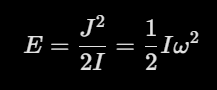
The most important takeaway here for your RPSC preparation is that a classical rotor can spin at any speed it wants. Its energy levels are completely continuous. If you give it a tiny nudge, it spins a tiny bit faster. But as we are about to see, things change drastically when we shrink down to the atomic scale.
Rigid Rotor For RPSC Assistant Professor: Quantum Mechanical Aspect
Now, let’s shrink that dumbbell down to the size of a carbon monoxide (CO) molecule. At this microscopic level, classical physics breaks down, and quantum mechanics takes the wheel.
The biggest shocker here? The energy levels are no longer a smooth, continuous ramp. They are a set of stairs. The molecule is locked into discrete energy levels, meaning it can spin at speed A or speed B, but it is physically forbidden from spinning at any speed in between.
We calculate these allowed quantum energy levels using this formula:
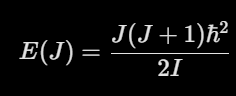
Here, J is your rotational quantum number (J = 0, 1, 2…), and h¯ is the reduced Planck constant.
To describe where and how the molecule is spinning, we use the rigid rotor wave function. This wave function gives us the mathematical blueprint of the molecule’s rotational states. Grasping this quantum transition is exactly what the RPSC examiners love to test, and it is a core focus in our study modules here at VedPrep.
Rigid Rotor For RPSC Assistant Professor: Mathematical Formulation
Let’s look at the math that underpins this model. Because our diatomic molecule is spinning freely in three dimensions, we treat its motion using the time-independent Schrödinger equation.
Since the bond length is fixed, we don’t have to worry about a radial distance (r). Instead, we focus entirely on the angular components, θ and φ. The Schrödinger equation for our rotor looks like this:
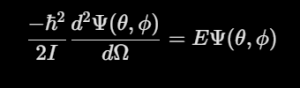
When you solve this equation, you get the energy eigenvalues we just talked about (EJ =  .
.
But you also get the allowed wave functions, denoted as ψJ,M(θ, φ). These are known mathematically as spherical harmonics. Notice that these wave functions depend on two quantum numbers: J (the total angular momentum) and M (the magnetic quantum number, which tells us the orientation of that spin in space). Keep an eye on M for the exam, because it explains why certain energy states are degenerate!
Misconception: Rigid Rotor as a Classical System
Let’s clear up a trap that trips up a lot of aspirants during self-study. It is easy to accidentally mix up classical and quantum rules during a high-pressure exam.
Remember, if a question describes a macroscopic object—like a spinning satellite or a playground merry-go-round—you are dealing with continuous classical energy (E = 1/2Iω²). The angular momentum can be absolutely anything.
But the moment the question mentions a molecule or a quantum rigid rotor, you must switch your brain to discrete energy stairs (EJ = 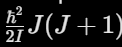 ). This stark contrast arises because quantum angular momentum is strictly quantized. It can only come in specific, neatly packaged amounts.
Worked Example: Solved Problem on Rigid Rotor
Let’s look at a concrete problem type that frequently pops up in competitive exams.
Problem:
A diatomic molecule acts as a rigid rotor with a moment of inertia I = 4.25 × 10⁻⁴⁶ kg m². Calculate the energy eigenvalues for J = 0, 1, 2 and state the wave function for J = 1.
Solution:
We use our reliable quantum energy formula. Let’s plug in the numbers, using h¯ = 1.05457 × 10⁻³⁴ J s:
- For J = 0:
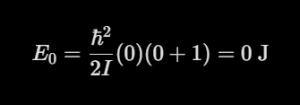
- For J = 1:

- For J = 2:

(Note: Double check your arithmetic on your scratch pad to ensure absolute precision with those negative exponents!)
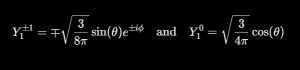
For the J = 1 state, the wave functions are the spherical harmonics (YJM). Since M can range from -J to +J, we have three degenerate states for J = 1:
Application: Rigid Rotor in Molecular Physics
Why do we spend so much time on this idealized model? Because it is the absolute foundation of microwave spectroscopy (or rotational spectroscopy).
When a gas-phase molecule absorbs microwave radiation, it jumps from one rotational stair to a higher one. By analyzing the gaps between these absorption lines in a spectrum, physical chemists can work backward to calculate the exact moment of inertia of a molecule, which directly reveals its precise bond lengths!
Beyond spectroscopy, the rigid rotor wave functions allow us to calculate other vital molecular features, like a molecule’s dipole moment and its polarizability. This tells us exactly how a gas will interact with electromagnetic fields in a lab setting.
Final Thoughts
As an RPSC Assistant Professor aspirant, your goal shouldn’t just be memorizing these equations. You want to understand how to derive them from the Schrödinger equation and how to apply them directly to spectroscopic data.
At VedPrep, we work alongside folks just like you every day, breaking down these complex quantum systems into manageable, structured concepts so you can walk into the exam hall with total confidence.
To know more in detail from our faculty, watch our YouTube video:
Frequently Asked Questions
What are the key assumptions of the rigid rotor model?
The rigid rotor model assumes that the molecule is a point mass, the bond between the atoms is rigid, and the rotation is about the center of mass.
What is the significance of the rigid rotor model?
The rigid rotor model provides a simple and accurate description of the rotational spectra of diatomic molecules, and is a fundamental concept in quantum mechanics and spectroscopy.
How does the rigid rotor model relate to quantum mechanics?
The rigid rotor model is a classic example of the application of quantum mechanics to a physical system, demonstrating the principles of wave-particle duality and quantization of energy.
What is the moment of inertia of a rigid rotor?
The moment of inertia of a rigid rotor is a measure of its resistance to changes in its rotational motion, and depends on the masses of the atoms and the bond length.
How is the rigid rotor model used in RPSC Assistant Professor exams?
The rigid rotor model is a key concept in physical chemistry and is frequently asked in RPSC Assistant Professor exams, particularly in questions related to quantum mechanics and spectroscopy.
What types of questions are typically asked about the rigid rotor model in exams?
Typical questions about the rigid rotor model in exams include derivation of energy levels, calculation of rotational spectra, and application to diatomic molecules.
How can I apply the rigid rotor model to solve problems in exams?
To apply the rigid rotor model to solve problems in exams, one needs to understand the assumptions, Hamiltonian operator, energy levels, and selection rules, and practice solving problems related to rotational spectra and spectroscopy.
What are some common applications of the rigid rotor model in physical chemistry?
The rigid rotor model has numerous applications in physical chemistry, including the interpretation of rotational spectra, prediction of molecular properties, and understanding of chemical bonding.
What are some common mistakes made when applying the rigid rotor model?
Common mistakes made when applying the rigid rotor model include neglecting the effects of vibration, assuming a non-rigid bond, and incorrect application of selection rules.
How can I avoid making mistakes when solving problems related to the rigid rotor model?
To avoid making mistakes when solving problems related to the rigid rotor model, one needs to carefully read the problem, understand the assumptions, and double-check calculations.
What are some pitfalls to watch out for when using the rigid rotor model?
Pitfalls to watch out for when using the rigid rotor model include over-simplification of molecular properties, neglect of anharmonic effects, and incorrect interpretation of spectroscopic data.
What are some advanced topics related to the rigid rotor model?
Advanced topics related to the rigid rotor model include the treatment of non-rigid rotors, the effects of magnetic fields, and the application to polyatomic molecules.
How can I extend the rigid rotor model to more complex systems?
The rigid rotor model can be extended to more complex systems by incorporating additional degrees of freedom, such as vibration, and using advanced mathematical techniques, such as perturbation theory.
What are some recent developments in the field of rigid rotor models?
Recent developments in the field of rigid rotor models include the application to large amplitude motions, the treatment of quantum chaos, and the development of new spectroscopic techniques.