
Preparing for the RPSC Assistant Professor exam can feel like a marathon, especially when you hit the deeper waters of physical chemistry. One topic that regularly shows up to test your grit is the Debye-Huckel theory. At its core, this concept explains how electrolytes actually behave when they are dissolved in a solution.
In an ideal world, ions would ignore each other and move freely. But in reality, long-range electrostatic forces mess things up. Ions attract and repel one another, causing the solution to deviate from ideal behavior. Think of it like walking through a calm, empty street versus trying to push your way through a packed market in Jaipur—the crowd changes how you move, and electrostatic forces do the same to ions.
Debye-Huckel theory For RPSC Assistant Professor: Syllabus and Electrochemistry
If you look at the landscape of competitive chemistry exams, this topic is everywhere. It sits comfortably in Section 2.5 of the CSIR NET syllabus, Section 4.2 for IIT JAM, Section 3.4 for CUET PG, and Section 2.3 in GATE. For the RPSC Assistant Professor exam, it is a cornerstone of the electrochemistry unit.
Electrochemistry is all about the interplay between chemical energy and electrical energy. Because the Debye-Huckel theory (often extended as the Debye-Hückel-Onsager theory) explains how ions conduct current and interact, you cannot skip it if you want to score well. While standard textbooks like Physical Chemistry by Peter Atkins or Lehninger Principles of Biochemistry give you the deep academic breakdown, we at VedPrep want to help you cut through the dense text and understand the core mechanics without the headache.
Debye-Huckel Theory: An Overview For RPSC Assistant Professor
When you dissolve an electrolyte in water, it breaks into ions. You might expect them to act independently, but they do not. As you raise the temperature or change the concentration, these interactions shift.
The theory fixes the flaws of older models by factoring in Coulombic forces—the attractions between opposite charges and repulsions between like charges.
To visualize this, imagine a fictional scenario where a highly popular celebrity walks into a crowded room. Naturally, a crowd of fans gathers around them, forming a protective, moving circle. In the chemical world, a positive ion acts like that celebrity. It gets surrounded by a cloud of negative ions, known as an ionic atmosphere or ion cloud. This cloud screens the net charge of the central ion.
Two critical terms you need to master for the exam are:
- Debye length: The measure of how far that electrostatic influence reaches out into the solution.
- Activity coefficient: A correction factor that tells us exactly how much the real solution deviates from ideal behavior.
Debye-Huckel theory For RPSC Assistant Professor: Formula
The math behind the theory relies on combining physics and chemistry. The derivation starts with the Poisson equation, which links the electric potential to the actual charge distribution in a space:
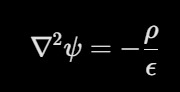
Where:
- Ψ is the electric potential.
- ρ is the charge density (how tightly packed the charges are, which depends on ion concentration).
- ε is the dielectric constant of the medium (assumed to be just the pure solvent here).
By assuming that the charge spreads out perfectly like a sphere around a central ion, we can solve this equation. The math yields the electric potential at a specific distance (r) from the central ion:
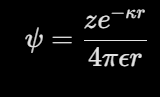
Here, z represents the charge on the central ion, e is the elementary charge, and κ is the famous Debye-Huckel parameter related to the thickness of the ionic cloud.
Worked Example: Calculating Activity Coefficient Using Debye-Huckel Theory For RPSC Assistant Professor
Let us look at a typical numerical problem you might face on exam day. Imagine we have a solution of sodium chloride (NaCl) at 25° C with an ionic strength (I) of 0.01 M. We can find the activity coefficient (γ) using the standard Debye-Huckel limiting law equation:
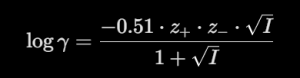
For NaCl, the charges are straightforward: z+ = +1 and z– = -1. Let us plug these numbers in:
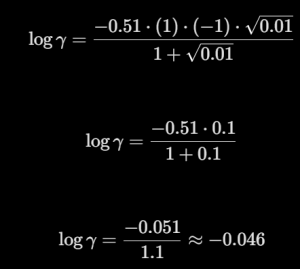
To get the actual activity coefficient, take the antilog:
An activity coefficient of 0.90 tells you that the ions are active at 90% of their total concentration because the surrounding ion cloud holds them back slightly.
Misconception: Debye-Huckel Theory Only Applies to Strong Electrolytes For RPSC Assistant Professor
A frequent trap for students is thinking that Debye-Huckel theory applies only to strong electrolytes like NaCl or HCl. That is a myth. The theory describes how free ions behave in a solution. It does not care if those ions came from a strong electrolyte that split completely or a weak electrolyte (like acetic acid) that only partially split. If there are free ions floating around, they form an ionic atmosphere.
However, the theory does have clear boundaries. It treats ions as mere point charges, ignoring their actual physical size. It also skips over ion association (when opposite ions stick together to form neutral pairs) and direct interactions between the ions and the solvent molecules. Because of this, the equations start to fall apart if the electrolyte concentration gets too high or if the ions are massive.
Real-World Application: Electrolyte Behavior in Biological Systems For RPSC Assistant Professor
This theory isn’t just for passing your RPSC exam; it explains real biological phenomena. Your cells rely constantly on electrolyte balance to fire nerves, contract muscles, and keep fluids moving. The ionic strength of your cellular fluids directly alters how proteins fold and how molecules pass through cell membranes.
Take blood plasma as an example. It is packed with proteins and ions. The Debye length determines how far a protein’s charge can reach out to bind with another molecule before the surrounding ions screen it off. Pharmacologists and medical researchers use these exact physical chemistry principles to design drugs that target specific ion channels in the human body.
Exam Strategy: Focus on Key Concepts and Practice Problems For Debye-Huckel theory For RPSC Assistant Professor
When you sit down to study this unit, do not just memorize the final formulas. Focus heavily on the physical meaning of the ionic atmosphere and how changing variables like temperature or solvent dielectric constants affects the Debye length.
Pro Tip: Practice calculating ionic strength (I = 1/2 ∑ci zi2) first, because a small mistake there ruins your entire activity coefficient calculation.
If you are feeling stuck on the derivations or need a structured approach, we have put together free video lectures at VedPrep. Watching an expert map it out on a whiteboard can save you hours of staring at a confusing textbook page.
Debye-Huckel Theory in RPSC Assistant Professor Exam: Important Subtopics For Debye-Huckel theory For RPSC Assistant Professor
To make your revision easier, focus on these core components:
| Subtopic | What You Need to Know |
| Ionic Strength (I) | How to calculate it for mixed electrolyte solutions. |
| Ionic Atmosphere | The physical picture of how an ion cloud screens the central charge. |
| Debye-Huckel Limiting Law | Using log = -A z2 √I for highly dilute solutions. |
| Extended Debye-Huckel Equation | How adding the ion size parameter fixes accuracy at moderate concentrations. |
Keep in mind that the standard limiting law works best at very low concentrations. When concentrations rise, you must adjust the equation by adding the ion size factor into the denominator.
Open Research Question: Further Investigation of the Debye-Huckel Theory For RPSC Assistant Professor in Biological Systems
Even though this theory is a classic, scientists are still tweaking it. As per Debye-Huckel theory, Standard Debye-Huckel equations struggle inside a living cell because cytoplasm is not a simple, dilute beaker of water—it is crowded with massive proteins, nucleic acids, and membranes.
Modern researchers are working on modified versions of the theory to better model how ions behave in these tightly packed, non-ideal biological spaces. Solving these equations cleanly could unlock deeper insights into cellular diseases and help design highly targeted biotechnological tools.
Final Thoughts
Wrapping your head around the Debye-Huckel theory might feel like a steep climb right now, but mastering it gives you a massive advantage for the RPSC Assistant Professor exam. At the end of the day, physical chemistry isn’t about memorizing scary-looking equations—it’s about understanding the underlying physical picture, like how those tiny ionic clouds dictate the behavior of the whole solution.
To know more in detail from our faculty, watch our YouTube video:
Frequently Asked Questions
Who proposed Debye-Huckel theory?
The Debye-Huckel theory was proposed by Peter Debye and Erich Hückel in 1923. They provided a mathematical framework to understand electrolyte behavior.
What are the key assumptions of Debye-Huckel theory?
The theory assumes a low concentration of ions, ions are point charges, and the solvent is a continuous medium. It also neglects ion-ion interactions at high concentrations.
What is the significance of Debye length?
The Debye length is a measure of the distance over which the electric field of an ion is significant. It's crucial in understanding the ionic atmosphere around charged particles.
How does Debye-Huckel theory relate to electrochemistry?
The theory is fundamental to electrochemistry as it explains the behavior of ions in solution, influencing electrode reactions and electrochemical equilibria.
What are the limitations of Debye-Huckel theory?
The theory is limited to low ion concentrations and doesn't account for ion size or short-range interactions. It also assumes a simple ionic atmosphere.
How does Debye-Huckel theory apply to Physical Chemistry?
In physical chemistry, the theory helps understand the thermodynamic properties of electrolyte solutions, such as activity coefficients and solubility.
How is Debye-Huckel theory tested in RPSC Assistant Professor exams?
Questions may test understanding of the theory's assumptions, its application to electrolyte solutions, and its significance in physical and organic chemistry.
What type of questions can be expected on Debye-Huckel theory in competitive exams?
Expect questions on the theory's principles, its mathematical derivations, and its applications in various chemical contexts.
How can one apply Debye-Huckel theory to solve problems in Organic Chemistry?
The theory can be applied to understand the behavior of ions in organic reactions, influencing reaction rates and equilibria in solutions.
What are common misconceptions about Debye-Huckel theory?
Common misconceptions include overestimating the theory's applicability to high ion concentrations and neglecting its assumptions.
How can one avoid mistakes when applying Debye-Huckel theory?
Carefully consider the theory's assumptions and limitations, and apply it within its valid range of concentrations and conditions.
How has Debye-Huckel theory been extended or modified?
Extensions include the inclusion of ion size effects and the development of more advanced theories, such as the Davies equation.
What are the implications of Debye-Huckel theory for biological systems?
The theory has implications for understanding ion interactions in biological systems, such as protein-ion interactions and membrane potentials.
How does Debye-Huckel theory relate to modern computational chemistry?
The theory provides a foundation for computational models of electrolyte solutions, influencing simulations of chemical reactions and processes.