
The topic of electrochemical cells falls right under the official CSIR NET / NTA syllabus unit of Physical Chemistry, specifically under Unit 4: Electrochemistry. If you are preparing for the RPSC Assistant Professor exam, you already know your syllabus spans Inorganic, Physical, and Analytical Chemistry. Having a rock-solid grip on this topic is non-negotiable if you want to clear the cutoff.
Understanding Electrochemical Cells: A Core Concept for RPSC Assistant Professor
At its heart, an electrochemical cell is just a setup where electrons move between two electrodes through an electrolyte solution. This movement lets us either turn chemical energy into electricity or use electricity to run a chemical reaction. Think of the electrolyte as a busy highway that lets ions move back and forth—without it, the whole system grinds to a halt.
We divide electrochemical cells into two main buckets: galvanic (voltaic) cells and electrolytic cells.
- Galvanic cells generate electricity all on their own through spontaneous redox reactions. A chemical reaction happens, and boom, you get electrical voltage.
- Electrolytic cells are the exact opposite. They need an external power source to force a non-spontaneous redox reaction to happen.
In a galvanic cell, you have two half-cells, each with its own electrode and electrolyte. The anode is where oxidation happens (loss of electrons), and the cathode is where reduction takes place (gain of electrons).
Understanding Electrochemical cells For RPSC Assistant Professor
Let’s focus a bit more on electrolytic cells, since RPSC loves testing the differences between the two types. Remember, these guys need an external electricity source to push reactions that wouldn’t happen otherwise.
Industries use electrolytic cells all the time. Take electroplating and electrorefining, for instance. Electroplating is how manufacturers deposit a thin layer of a high-quality metal onto another material. Imagine a fictional scenario where a jewelry maker wants to coat a cheap copper ring with a micro-layer of pure gold to protect it from tarnishing. They would set up an electrolytic cell to get the job done.
These cells also help produce essential gases like hydrogen and chlorine. The chlor-alkali process is a classic exam favorite: you electrolyze a sodium chloride solution (brine) to get sodium hydroxide, hydrogen gas, and chlorine gas.
Here is a quick summary of what makes an electrolytic cell tick:
- It needs an external power source to work.
- It drives non-spontaneous redox reactions.
- It is widely used in electroplating and metal refining.
- It helps manufacture hydrogen gas, chlorine gas, and caustic soda.
Worked Example: Electrochemical Cell for RPSC Assistant Professor
Let’s look at a classic example of an electrochemical cell: the Daniell cell. This cell uses zinc and copper electrodes dipped in their respective sulfate solutions.
The standard cell potential (E) for a Daniell cell is +1.10\text{ V. The overall cell reaction looks like this:

If you change the concentration of the zinc ions, the cell potential changes too. To find the new potential under non-standard conditions, we use the Nernst equation:
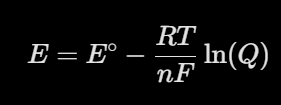
Where E° is the standard cell potential, R is the gas constant, T is the temperature, n is the number of electrons transferred, F is the Faraday constant, and Q is the reaction quotient.
Let’s say we are at T = 298 K (where the formula simplifies nicely using base-10 logs) and n = 2. What happens if we double the zinc ion concentration?
| Ion | Initial Concentration | Final Concentration |
| Zn2+ | 1 M | 2 M |
| Cu2+ | 1 M | 1 M |
The reaction quotient Q becomes Zn²⁺/Cu²⁺ = 2/1 = 2.
Now, let’s plug these values into the simplified Nernst equation:
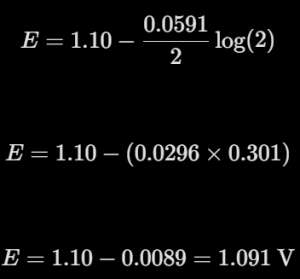
Notice how the voltage dropped slightly? Keeping track of these small shifts is exactly what will get you extra marks on exam day.
Common Misconceptions about Electrochemical Cells
A lot of students think electrochemical cells are only good for making electricity. That is a huge misconception! These systems work both ways. We use them all the time to manufacture chemicals, plate metals, and split water into hydrogen and oxygen.
This mix-up usually happens because introductory textbooks focus heavily on standard batteries. In reality, it’s all about the bidirectional conversion between chemical and electrical energy right at the electrode surfaces. Grasping this core concept will help you handle tricky conceptual questions with total confidence.
Real-World Applications of Electrochemical Cells For RPSC Assistant Professor
We see electrochemical cells in action every single day, especially in energy storage. The lead-acid battery in a car is a perfect example. It relies on chemical reactions between lead plates and sulfuric acid to generate the massive surge of electricity needed to start the engine.
Then you have fuel cells, which produce electricity by reacting a fuel (like hydrogen) with an oxidant (like oxygen). They are incredibly clean and efficient, leaving behind nothing but water and heat. You can find them powering everything from spaceships to backup power systems.
These cells are also changing the game for renewable energy. They help us store power generated by windy or sunny days so we can use it when the weather changes. We see this in electrochemical capacitors, which store energy using electrostatic double-layer capacitance and pseudocapacitance. While they offer high efficiency and reliability, they do face challenges like material wear and tear over time.
Study Tips and Important Subtopics for RPSC Assistant Professor Electrochemical Cells
If you want to ace this section in the RPSC Assistant Professor exam, focus heavily on electrode reactions, cell potentials, and how different cells are designed.
Key Subtopics to Master:
- Galvanic cells vs. electrolytic cells
- Electrode reactions and kinetics
- Standard electrode potentials and the electrochemical series
- Cell design, optimization, and the Nernst equation
Try to solve as many numerical problems as you can. If you ever feel stuck or need a bit of direction, our team at VedPrep has put together comprehensive study guides to help you out. You can also watch a free VedPrep lecture on electrochemical cells for the RPSC Assistant Professor exam to get a visual breakdown of these topics.
Electrochemical Cells For RPSC Assistant Professor: Important Subtopics and Study Tips
Fuel cells are a major highlight in the physical chemistry syllabus. They convert chemical energy straight into electrical energy, making them highly efficient and eco-friendly.
However, they do have design constraints. They need highly specialized electrodes and specific electrolytes to run smoothly. They are becoming more common in stationary power plants, electric vehicles, and portable electronics. Understanding how electrode potentials drive these fuel cells will give you a major advantage when solving application-based exam questions.
Make sure you spend time studying:
- The core thermodynamic principles of electrochemical cells
- Electrode kinetics and overpotential
- Real-world cell design limits
Regular practice with past exam papers is the absolute best way to sharpen your problem-solving speed.
Electrochemical Cells and RPSC Assistant Professor Exam Preparation
Mastering electrochemical cells is a fantastic way to secure solid marks in the Physical Chemistry portion of your exam. Because this topic overlaps so heavily with CSIR NET and GATE, the questions can get highly competitive.
Make sure you understand how electrodes, electrolytes, and the Nernst equation interact. To keep your preparation on track, map out a clear study schedule, stick to standard textbooks, and test yourself regularly.
We know how demanding this exam journey can be, but staying consistent with your practice and using the right resources will make a world of difference.
Final Thoughts
Mastering electrochemical cells isn’t just about memorizing formulas—it is about understanding the fundamental movement of electrons that powers everything from the car battery in your garage to the next generation of clean energy. For an exam as competitive as the RPSC Assistant Professor, the selectors aren’t just checking if you know the Nernst equation; they want to see if you can apply it under pressure when the parameters shift.
To learn more in detail from our faculty, watch our YouTube video:
Frequently Asked Questions
What are the types of electrochemical cells?
There are two main types: galvanic cells (voltaic cells) that generate electricity from spontaneous reactions, and electrolytic cells that use electricity to drive non-spontaneous reactions. Both types are crucial in understanding electrochemistry.
What is the role of an electrolyte in an electrochemical cell?
The electrolyte facilitates the movement of ions between the electrodes, enabling the electrochemical reaction to occur. It can be a liquid, gel, or solid material that conducts electricity through ion transport.
How do electrochemical cells relate to physical and organic chemistry?
Electrochemical cells involve physical principles of electron transfer and chemical reactions from organic chemistry. Understanding these cells requires knowledge of thermodynamics, kinetics, and molecular interactions.
What is electrochemistry?
Electrochemistry is the branch of chemistry that studies the relationship between chemical energy and electrical energy, and the conversion of one into the other through electrochemical reactions.
What is the Nernst equation?
The Nernst equation relates the electrode potential of a cell to the standard electrode potential and activities of the chemical species undergoing reduction and oxidation.
How does concentration affect electrochemical cell potential?
Concentration affects cell potential according to the Nernst equation. As concentration changes, the electrode potential changes, influencing the overall cell reaction.
What is polarization in an electrochemical cell?
Polarization refers to the deviation of the electrode potential from its equilibrium value due to current flow, affecting cell performance.
How are electrochemical cells tested in the RPSC Assistant Professor exam?
The exam may include questions on the principles, types, and applications of electrochemical cells, as well as their relevance to physical and organic chemistry. Candidates should focus on understanding concepts and their practical implications.
What are some common applications of electrochemical cells?
Electrochemical cells are used in batteries, fuel cells, electroplating, and electrochemical sensors. Understanding their applications helps in appreciating the practical relevance of electrochemistry.
How can I solve electrochemical cell problems in the RPSC Assistant Professor exam?
To solve problems, focus on applying concepts such as Nernst equation, electrode potentials, and electrochemical reaction kinetics. Practice with sample questions and past papers to build confidence.
Can electrochemical cells be used in medical applications?
Yes, electrochemical cells are used in medical applications such as pacemakers, neurostimulators, and biosensors for monitoring and therapeutic purposes.
What common mistakes are made when studying electrochemical cells?
Common mistakes include confusing the types of electrochemical cells, misunderstanding the role of electrolytes, and misapplying electrochemical principles to physical and organic chemistry problems.
What is a common misconception about electrochemical cells?
A common misconception is that electrochemical cells only involve chemical reactions. In fact, they involve both chemical and physical processes.
What are some advanced topics in electrochemical cells?
Advanced topics include fuel cells, solar cells, and electrochemical biosensors. These areas involve cutting-edge research and applications of electrochemical principles.