
To really crack RPSC Assistant Professor exam, we have to look at how things connect. The Band theory of solids isn’t just an isolated topic; it actually bridges the gap between the microscopic statistical distributions you study in statistical mechanics and the macroscopic properties you see in thermodynamics.
Standard textbooks like Statistical Mechanics by Rudolf Eisberg and Thermodynamics by Cengel are fantastic deep-dives for this unit. But let’s be honest: when you are juggling a massive syllabus, you need a clear, conceptual roadmap. That is exactly what we focus on here at VedPrep—breaking down the heavy theory into ideas that actually stick when you are sitting in the exam hall.
Core Concept: Band Theory of Solids For RPSC Assistant Professor
If you are grinding away for the RPSC Assistant Professor exam, you already know the syllabus is a beast. Unit 2 of the CSIR NET blueprint—which RPSC heavily leans on—holds some of the most beautiful yet challenging concepts in physical chemistry and solid-state physics.
Think about how we got here. In physics history, we tried explaining solids using the classical free electron theory (treating electrons like billiard balls) and then the quantum free electron theory (treating them like waves in a plain box). Both dropped the ball on explaining why some things conduct electricity and others don’t.
Enter the Band theory of solids. The secret sauce here is the periodic potential. Instead of pretending electrons roam around a completely empty space, this theory acknowledges that electrons live in a highly structured grid of positively charged atomic nuclei.
Because this environment repeats perfectly, the electron’s allowed energy states crowd together into continuous energy bands, separated by forbidden zones called band gaps. Think of it like a massive multi-story parking garage. You can park on the first floor or the second floor (the energy bands), but you cannot park your car floating in mid-air between the floors (the band gap). This simple quantum reality dictates whether a material acts as a conductor, insulator, or semiconductor.
Periodic Potential and Energy Bands in Band Theory of Solids For RPSC Assistant Professor
Let’s zoom in on that parking garage analogy. The repeating arrangement of positive ions in a crystal lattice creates a potential energy landscape that rolls up and down like a wave.
To solve the math for Band theory of solids, we use Bloch’s theorem. Simply put, Bloch said that an electron’s wave function in this periodic landscape is just a regular plane wave multiplied by a modifier that shares the exact same periodicity as the lattice.
When you solve the Schrödinger equation with this periodic potential, the individual atomic energy levels split into the massive bands we talked about. At VedPrep, we always remind students to visualize this splitting: the closer the atoms get, the more their orbitals overlap, and the wider these bands become. The size of the resulting band gap is what determines the optical and electrical properties of the material.
Misconception: Free Electrons in Metals
Here is a trap that trips up a lot of aspirants during preparation. It is incredibly easy to look at a block of copper and think, “Well, the valence electrons are totally free to zip around in any direction like gas molecules.”
Even in the best conductors, electrons are always feeling the tug of the periodic potential from the lattice ions. They are bound by the rules of quantum mechanics and must obey the allowed energy bands. They can move easily within a band, but they cannot simply take on any random energy value. Keeping this restriction in mind will save you from making easy mistakes on conceptual multiple-choice questions.
Worked Example: Solved Question on Band theory of solids For RPSC Assistant Professor
Let’s look at a typical problem you might encounter in Band theory of solids.
Question:
In a one-dimensional crystal lattice, the energy of electrons in the n-th band is given by the equation:
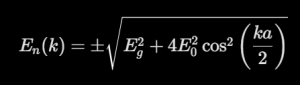
Where Eg is the energy gap, E0 is a constant, k is the wavevector, and a is the lattice constant. For a specific crystal, Eg = 2 eV and E₀ = 1 eV. Find the energy of electrons at the edge of the Brillouin zone, where k = π/a.
Solution:
Let’s plug k = π/a straight into the cosine term:
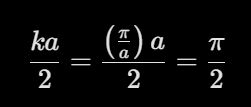
We know that cos (π/2) = 0. Now let’s substitute this back into our main energy equation:
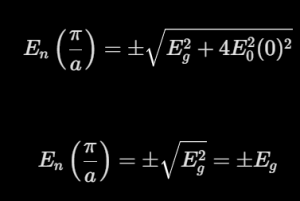
Since the problem states Eg = 2 eV, our final energies at the zone boundary are:
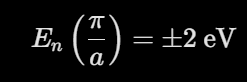
This tells us that the valence band tops out at -2 eV and the conduction band starts at +2 eV. The mathematical gap between them is exactly what creates the forbidden zone.
Application: Real-World Applications of Band Theory of Solids
To make this feel a bit more concrete, imagine a fictional tech startup trying to build the next generation of ultra-fast smartphones. If their engineers didn’t understand the Band theory of solids, they wouldn’t know how to manipulate semiconductors to build microchips or solar cells.
Every transistor that switches on and off in your laptop, and every diode that lights up your TV screen, relies on us engineering these exact energy bands. By intentionally introducing tiny impurities into a pure crystal lattice (a process called doping), we can shift the Fermi level and change how easily electrons hop across the band gap. The same principles let us design perfect electrical insulators for high-voltage power lines to keep the current where it belongs.
Exam Strategy: Tips for RPSC Assistant Professor Exam on Band Theory of Solids
When you are aiming for a position as an Assistant Professor, the examiners aren’t just looking to see if you memorized formulas. They want to see if you can explain the core physical reality behind them.
- Focus on the Models: Pay extra attention to the Kronig-Penney model. Understand how changing the width or height of the potential barriers alters the allowed energy bands.
- Link it to Stats: Connect band occupancy to the Fermi-Dirac distribution function. Ask yourself how temperature changes where the electrons sit.
- Practice Boundary Conditions: Make sure you are comfortable finding values at the center (k=0) and the edges (k=±π/a) of the Brillouin zones.
Final Thoughts
As you wrap up this topic, keep in mind that you might see questions referring to “Zone theory” instead of “Band theory of solids.” Don’t let the vocabulary throw you off—they are just two sides of the same coin.
While the Band theory of solids approaches the problem by looking at how atomic orbitals merge together into broad molecular bands across the entire solid, Zone theory emphasizes how electron waves reflect off the lattice planes (Bragg reflection) to create distinct Brillouin zones. Both paths lead you to the exact same conclusion: energy bands and band gaps rule the solid-state world.
Mastering these overlapping perspectives is what separates a good candidate from a great one. If you ever want to talk through these derivations or need a structured way to practice old exam questions, the team at VedPrep is always here to help you sort through the noise and study smart.
To learn more in detail from our faculty, watch our YouTube video:
Frequently Asked Questions
What are the main assumptions of the band theory?
The band theory assumes that electrons in a crystal interact with the periodic potential of the lattice, leading to the formation of energy bands. It also assumes that electrons are delocalized and can move freely within the crystal.
What is the difference between valence and conduction bands?
The valence band is the highest energy band that is fully occupied by electrons at absolute zero, while the conduction band is the lowest energy band that is empty at absolute zero. The energy gap between these bands is known as the bandgap.
What is the significance of the Fermi level in band theory?
The Fermi level is the energy level at which the probability of finding an electron is 50%. It is a critical concept in band theory, as it determines the electrical conductivity and other properties of a solid.
How does band theory explain the properties of metals and insulators?
Band theory explains that metals have a partially filled conduction band, allowing for high electrical conductivity. Insulators, on the other hand, have a fully filled valence band and an empty conduction band, resulting in low conductivity.
What is the role of impurities in band theory?
Impurities can introduce additional energy levels within the bandgap, affecting the electrical conductivity and other properties of a solid. They can also alter the Fermi level, leading to changes in the material's behavior.
How can band theory be applied to RPSC Assistant Professor exams?
Band theory is a crucial topic in physics and is often tested in competitive exams like RPSC Assistant Professor. Questions may focus on understanding the concepts, applying them to different materials, and analyzing their implications.
What types of questions can be expected on band theory in RPSC Assistant Professor exams?
Expect questions on the basics of band theory, its application to metals, semiconductors, and insulators, and its relevance to solid-state physics and materials science.
How can I prepare for band theory questions in RPSC Assistant Professor exams?
To prepare, focus on understanding the fundamental concepts, practicing numerical problems, and reviewing the applications of band theory in various fields.
What are common misconceptions about band theory?
Common misconceptions include thinking that band theory only applies to metals, or that it is only relevant to solid-state physics. Additionally, some may confuse the valence and conduction bands or misunderstand the concept of the Fermi level.
How can I avoid mistakes when applying band theory?
To avoid mistakes, carefully review the assumptions and limitations of band theory, and ensure that you understand the underlying physics. Practice applying the concepts to different materials and scenarios.
What are some advanced topics related to band theory?
Advanced topics include the study of band structure in nanomaterials, the effects of spin-orbit coupling, and the application of band theory to topological insulators and superconductors.
How can band theory be used to understand the behavior of topological insulators?
Band theory plays a crucial role in understanding the behavior of topological insulators, which exhibit non-trivial band structures and surface states.
What is the relationship between band theory and quantum computing?
Band theory is relevant to quantum computing, as it provides a framework for understanding the behavior of electrons in quantum systems, such as quantum dots and topological quantum computers.
How does band theory relate to the study of superconductors?
Band theory is essential for understanding the behavior of superconductors, which exhibit unique properties due to their band structure and electron-phonon interactions.