
If you are gearing up for the RPSC Assistant Professor exam, you already know that the animal kingdom has some pretty wild evolutionary stories. Today, let’s break down the General characters and classification of Reptilia—a topic that frequently pops up in the vertebrates section.
Overview: General characters and classification of Reptilia
Think of reptiles as the ultimate pioneers of dry land. While amphibians couldn’t quite quit their water dependency, reptiles completely cut the umbilical cord to aquatic life. They achieved this through a few brilliant engineering upgrades:
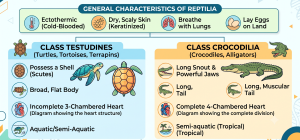
- Ectothermic (Cold-Blooded) Nature: They do not burn internal energy to keep warm. Instead, they rely on the environment—like a lizard sunbathing on a hot rock in western Rajasthan to kickstart its metabolism.
- Dry, Rugged Skin: Unlike frogs, a reptile’s skin is completely dry, rough, and devoid of glands. It is covered in tough, keratinized epidermal scales. This acts like a premium waterproof jacket, locking moisture inside so they do not dry out in arid climates.
- A Precision-Engineered Skull: Their skull structure went through massive evolutionary modifications, creating powerful leverage for highly efficient jaw action. If you have ever seen a monitor lizard catch its prey, you have seen this mechanical advantage in action.
- True Land Respiration: No skin-breathing tricks here. Reptiles rely entirely on well-developed lungs to exchange gases, making them perfectly suited for a full-time terrestrial lifestyle.
At VedPrep, we always tell our students to visualize these features as a survival toolkit for land living. It makes remembering the core traits for the exam a whole lot easier.
Syllabus: General characters and classification of Reptilia (Class 21.1 and 21.2)
For those tracking their progress against the official syllabus for General characters and classification of Reptilia, this specific breakdown falls squarely under Unit 21: Animal Diversity – III (Vertebrates). If you want to cross-reference standard academic literature, you can find excellent deep-dives in Zoology by Solomon and Berg as well as the classic Vertebrate Zoology by Alfred Sherwood Romer.
Let’s look closer at the two major classes you need to know inside out:
Class 21.1: Testudines (Turtles, Tortoises, and Terrapins)
These creatures are essentially walking fortresses. Their defining feature is a rigid shell made of bony plates called scutes. They sport a broad, flattened body frame with relatively short limbs. While tortoises have adapted perfectly to land, most testudines are highly adapted for aquatic or semi-aquatic life.
Class 21.2: Crocodilia (Crocodiles and Alligators)
This group represents the apex predators of the reptile world. Found throughout tropical and subtropical wetlands, they are easily recognized by their elongated, muscular tails, armored skin, and devastating jaw strength.
Classification: General characters and classification of Reptilia For RPSC Assistant Professor
Let’s look at how these animals are organized. When classifying the class Reptilia, herpetologists primarily look at skull architecture and body forms. While the entire group shares the baseline traits of scaly skin, egg-laying, and air-breathing, they split into vastly different lifestyles.
To help visualize how these traits display themselves in real life, let’s imagine a fictional scenario. Picture a herpetology student out in the field who stumbles across an unknown reptilian specimen. The creature has thick, scaly skin, an elongated snout, incredibly powerful jaws, and anatomical records show it possesses a four-chambered heart.
How do we classify it? Let’s look at the breakdown:
- Scaly skin & egg-laying: Instantly lands it in the larger group Reptilia.
- A four-chambered heart: This is the massive giveaway. While most reptiles have an incomplete three-chambered heart, this complete four-chambered setup is a classic signature of the archosaurs.
- Long snout + powerful jaws minus a shell: This completely rules out the shelled turtles and points straight to the order Crocodilia.
Here is a quick, scannable look at how these groups stack up against each other when you are trying to differentiate them under exam pressure:
| Characteristic | Class Testudines | Class Crocodilia |
| Scaly Skin | Yes | Yes |
| Bony Shell (Scutes) | Yes | No |
| Long Snout & Powerful Jaws | No | Yes |
| Heart Structure | 3-Chambered (Incomplete) | 4-Chambered (Complete) |
Application of General characters and classification of Reptilia For RPSC Assistant Professor
Mastering the General characters and classification of Reptilia isn’t just about clearing a multiple-choice exam; these concepts have massive real-world utility that RPSC often loves to frame conceptual questions around.
1. Wildlife Conservation
As per General characters and classification of Reptilia, Conservation biologists rely heavily on dermal morphology and specific scalation patterns to track animal populations. For instance, the unique arrangement of scutes on a sea turtle’s shell acts almost like a biological barcode. By identifying these variations, researchers can monitor endangered species and map out protective habitats.
2. Forensic Science & Anti-Poaching
Illegal wildlife trafficking is a massive global issue. When customs or law enforcement seize illegal goods like leather bags or exotic boots, forensic experts step in. By analyzing the structural patterns of the reptile skin and scale remnants, they can pinpoint the exact species and geographic origin of the material, providing crucial evidence to bust poaching rings.
Exam Strategy: Studying General characters and classification of Reptilia For RPSC Assistant Professor
When you are preparing for a highly competitive exam like the Assistant Professor post, you cannot just memorize a list of facts to cover General characters and classification of Reptilia—you need a strategy. Here is how our team at VedPrep recommends tackling this topic:
- Focus on the Deviations: Standard features are easy, but the exam loves exceptions. Pay special attention to things like heart chambers (the 3 vs 4 chamber rule) and skull fenestration (temporal openings), which set the major orders apart.
- Practice Identification Keys: Try practicing taxonomic keys where you classify a specimen based on a checklist of morphological traits. It builds the exact muscle memory you need for situational questions.
- Stick to High-Yield Resources: For a solid conceptual foundation, the NCERT Class 11 Biology textbook gives a great, crisp introduction. If you want to build the advanced depth required for the RPSC level, dive into Biology by Campbell and Reece.
Misconception about Reptilia
Let’s clear up a few common traps that catch students while covering General characters and classification of Reptilia.
First, the term “cold-blooded” causes a lot of confusion. Many students accidentally assume reptiles just have cold blood running through their veins all the time. In reality, they are ectothermic, meaning their internal temperature fluctuates based on their surroundings. They are incredibly smart about sourcing external heat—if they are cold, they bask; if they are too hot, they find some shade.
Second, don’t fall into the trap of thinking every single reptile follows the exact same scale template. While classic scales cover snakes and lizards, nature loves to throw curveballs. Take the legless glass lizard, for example—it looks just like a snake at first glance, but it actually sports a incredibly smooth body texture and possesses moveable eyelids and external ear openings, proving it is thoroughly a lizard.
Finally, reptiles aren’t strictly locked into tropical rainforests or scorching deserts as per General characters and classification of Reptilia. While they certainly love the heat, certain species have adapted to surprisingly cold environments. A stellar example is the Common Lizard (Lacerta vivipara), which manages to thrive in the high alpine regions of Europe and Asia, surviving freezing temperatures and snowy conditions that would stun most other cold-blooded species.
Final Thoughts
Wrapping your head around the General characters and classification of Reptilia is all about seeing the evolutionary logic behind how these creatures conquered the land. When you look past the raw memorization and focus on the structural adaptations—like how a modified skull or a specialized skin layer solved real-world survival problems—the taxonomic orders start making perfect sense. As you continue your prep for the RPSC Assistant Professor exam, keep connecting these biological concepts to real-world examples.
To learn more in detail from our faculty, watch our YouTube video:
Frequently Asked Questions
How do Reptilia differ from Amphibia?
Reptilia have scales, lay eggs on land, and are more adapted to terrestrial life, whereas Amphibia have moist skin, lay eggs in water, and lead a semi-aquatic life.
What are the main groups of Reptilia?
The main groups of Reptilia include Testudines (turtles and tortoises), Crocodilia (crocodiles and alligators), Squamata (lizards and snakes), and Rhynchocephalia (tuataras).
What is the classification basis for Reptilia?
Reptilia are classified based on their morphology, physiology, and evolutionary relationships. They are grouped into orders based on characteristics like skull structure, limb presence, and scales.
What are the key features of Chordata?
Chordata are characterized by the presence of a notochord, a dorsal nerve cord, pharyngeal slits, and a post-anal tail at some stage in their development.
What are the characteristics of Taxonomy: Chordata?
Taxonomy of Chordata involves grouping animals based on the presence of a notochord, dorsal nerve cord, and other specific features. It includes subphyla like Vertebrata and Cephalochordata.
How are Reptilia and Chordata related?
Reptilia are a subgroup of Chordata, sharing characteristics like a notochord and dorsal nerve cord. They are vertebrates with a backbone.
What are the subclasses of Reptilia?
Subclasses of Reptilia include Anapsida (turtles), Diapsida (lizards, snakes, crocodiles), and Synapsida (mammal-like reptiles).
How can knowledge of Reptilia classification help in RPSC Assistant Professor exam?
Understanding Reptilia classification helps in answering questions related to taxonomy, evolution, and biodiversity, which are crucial for the exam.
What are the common examples of Reptilia?
Examples include snakes, lizards, crocodiles, turtles, and tortoises. These are often asked about in exams for their characteristics and classification.
How to apply knowledge of Chordata taxonomy in exams?
Applying knowledge of Chordata taxonomy helps in identifying and classifying animals, understanding evolutionary relationships, and answering detailed questions in the RPSC Assistant Professor exam.
What common mistakes are made in classifying Reptilia?
Common mistakes include confusing Reptilia with Amphibia or misclassifying species based on superficial characteristics rather than evolutionary relationships.
What are the evolutionary relationships within Reptilia?
Reptilia are believed to have evolved from a group of amphibian-like ancestors. Their evolutionary relationships are studied through fossil records and comparative anatomy.
What are the recent developments in Reptilia taxonomy?
Recent developments include the use of molecular phylogenetics to understand evolutionary relationships and the discovery of new species, which refine the classification of Reptilia.
What are the phylogenetic relationships among Reptilia subclasses?
Phylogenetic relationships are studied through comparative anatomy, fossil records, and molecular biology, helping to understand how subclasses diverged.