

Preparing for the RPSC Assistant Professor exam is a massive journey. If you are eyeing that chemistry or biochemistry slot, you already know that Enzyme Kinetics isn’t just another topic—it is a heavy-hitter. This core concept deals with how fast enzyme-catalyzed reactions run and what actually changes their speeds.
Getting a solid grip on this isn’t just about clearing the RPSC hurdle either. If you are simultaneously keeping your eyes on CSIR NET, IIT JAM, CUET PG, or GATE, mastering this math-meets-biology framework will give you a serious edge across the board.
Enzyme Kinetics (Michaelis-Menten) For RPSC Assistant Professor: Syllabus and Key Textbooks
Let’s talk strategy to cover Enzyme Kinetics. If you look at the standard syllabus blueprints, the Enzyme Kinetics model pops up everywhere, but under slightly different labels depending on the exam:
- CSIR NET: You will find it tucked away under Physical Chemistry in Section A, Subsection 3.
- IIT JAM: It sits comfortably inside Section 1 under Chemical Kinetics.
- RPSC Assistant Professor: It bridges the gap between pure chemical dynamics and real-world biochemical applications, making it a favorite for both paper theory and interview questions.
When you are diving deep, skip the surface-level internet summaries. Grab standard textbooks that treat the math with respect. We highly recommend turning to classics like Physical Chemistry by I. M. Kolthoff or Chemical Kinetics and Dynamics by P. W. Atkins. These books map out the derivation of enzyme kinetics without skipping the vital steps.
At VedPrep, we always tell our students that building a foundation from authentic textbooks is what separates those who just memorize formulas from those who actually clear the cut-off.
Enzyme Kinetics (Michaelis-Menten) For RPSC Assistant Professor: The Michaelis-Menten Model
At its heart, the Enzyme Kinetics model is just a neat mathematical way to show how the speed of a reaction (V) changes when you throw more substrate ([S]) at an enzyme.
Think of the classic mechanism like a three-step dance:
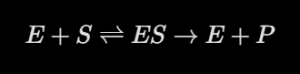
Here, E is your free enzyme, S is the substrate it wants to grab, ES is the temporary enzyme-substrate complex, and P is the final product.
To make the math work, the model makes a few big assumptions. First, it assumes a “steady-state,” meaning the amount of the ES complex stays relatively constant because it forms at the same speed it breaks down. Second, it assumes you have way more substrate floating around than enzyme molecules.
Two major parameters define this model:
- Vmax: The absolute speed limit of the reaction when the enzyme is completely buried in substrate.
- Km (The Michaelis Constant): The exact substrate concentration where the reaction hits exactly half of its Vmax.
You also have k2 (often called kcat), which is the turnover number. It tells you exactly how many substrate molecules a single active site can convert into product every single second.
Put it all together, and you get the famous Enzyme Kinetics equation:
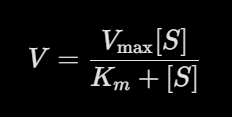
This equation tells a simple story: as you add more substrate, the rate (V) climbs quickly at first. But eventually, the curve flattens out into a straight horizontal line because the enzyme gets fully saturated.
Worked Example: Applying the Michaelis-Menten Model to an Enzyme-Catalyzed Reaction
Let’s look at how this actually plays out in a typical exam problem. Suppose you get a question like this:
Fictional Practice Problem: An enzyme-catalyzed reaction runs at a rate of 2.5 μM/min when the substrate concentration is 10 μM. The Km for this enzyme is known to be 5 μM, and the total starting enzyme concentration ([E]0) is 0.1 μM. Calculate the catalytic rate constant (k2).
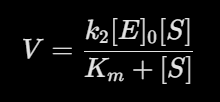
To solve this, we can use the variation of the equation that explicitly includes total enzyme concentration, where Vmax = k₂[E]₀:
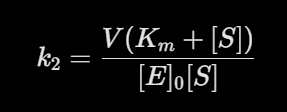
Let’s flip the equation around to isolate k2:
Now, plug in the numbers from the problem:
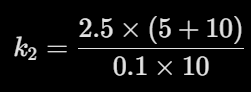
Simplify the top and bottom:
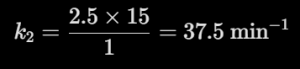
Taking a few minutes to walk through these algebraic adjustments step-by-step prevents simple math slips on exam day.
Common Misconceptions in Enzyme Kinetics (Michaelis-Menten) For RPSC Assistant Professor
A lot of smart aspirants get tripped up by the same few details. Let’s clear those up right now so you don’t lose easy marks.
1. The Real Meaning of Km
The absolute biggest misconception is that Km is the substrate concentration where the enzyme hits its maximum velocity (Vmax). That is completely wrong. As we saw on the graph, Km is where the enzyme hits half of Vmax.
Think of Km as an inverse gauge of love or affinity. A low Km means the enzyme has a super high affinity for the substrate—it grabs onto it tightly even when there is barely any around. A high Km means the affinity is low; you need to flood the system with substrate just to get the enzyme to work at half-speed.
2. Oversimplifying the Mechanism
The basic model assumes a clean, single-step ES complex. In the real world, enzymes often go through multiple intermediate shapes and complexes before letting go of the product. While the simple model works beautifully for ideal calculations, keep this real-world complexity in mind for conceptual true/false questions.
3. k2 vs. kcat
People often use k2 and kcat interchangeably, and while they align perfectly in the simplest mechanisms, they represent distinct concepts. kcat is the overarching turnover number for the entire catalytic cycle, while k2 specifically tracks the rate of that single step where the ES complex breaks down into the free enzyme and product.
Real-World Applications of Enzyme Kinetics (Michaelis-Menten) For RPSC Assistant Professor
Why do we care so much about these curves and constants? Because they run the modern biotech and pharmaceutical industries.
Imagine a fictional chemical plant trying to make a sustainable bioplastic using an industrial enzyme. If the engineers don’t know the Km of their enzyme, they might dump millions of rupees worth of excess substrate into the reaction tanks, completely wasting it because the enzyme was already saturated at a much lower concentration. By calculating the exact kinetic parameters, they can run the reaction at peak efficiency without wasting a single gram of raw material.
Similarly, in drug design, understanding enzyme kinetics is how scientists figure out how long a medicine will stay active in your body before your liver enzymes break it down. It allows researchers to design targeted enzyme inhibitors—like medications that lower blood pressure or fight viral infections—by knowing exactly how to outcompete the natural substrate.
Exam Strategy: How to Approach Enzyme Kinetics (Michaelis-Menten) For RPSC Assistant Professor
When you sit down to study this for the RPSC exam, don’t just stare at the equations.
- Master the Linear Transformations: Make sure you can comfortably convert a hyperbolic Enzyme Kinetics curve into a straight-line Lineweaver-Burk plot (1/V vs. 1/[S]). RPSC loves asking about the intercepts (1/Vmax and -1/Km).
- Practice Varying the Variables: Know exactly what happens to the curve when you double the enzyme concentration or add a competitive inhibitor.
- Use Good Mentorship: If the derivations start feeling like a blur of symbols, we have plenty of conceptual breakdowns and step-by-step problem sessions over at VedPrep to help you sort through the noise.
Key Concepts in Enzyme Kinetics (Michaelis-Menten) For RPSC Assistant Professor
| Key Parameter / Concept | What It Actually Tells You | Why It Matters for Exams |
| Michaelis Constant (Km) | Substrate concentration at 1/2 Vmax. | Measures enzyme-substrate affinity (Inverse relationship). |
| Max Velocity (Vmax) | Total top speed when all enzyme active sites are full. | Depends directly on how much enzyme you start with. |
| Turnover Number (kcat) | How many substrate molecules one active site handles per second. | Measures pure catalytic efficiency. |
| Lineweaver-Burk Plot | A double-reciprocal graph that turns the curve into a straight line. | Used to visually identify types of enzyme inhibition. |
Lab Applications of Enzyme Kinetics (Michaelis-Menten) For RPSC Assistant Professor
If you transition from the lecture hall to a research laboratory, this model becomes your primary diagnostic tool. When scientists develop new treatments for metabolic pathways or investigate cellular signaling, they run high-throughput kinetic assays.
Imagine a fictional lab group screening thousands of chemical compounds to find a cure for a specific enzyme-linked disease. They run kinetic assays on every single compound, tracking how the Km shifts. If a compound increases the apparent Km without touching Vmax, they instantly know they have found a competitive inhibitor. This kind of practical analysis is exactly the type of knowledge RPSC looks for during the interview stage.
Conclusion
The study of enzyme dynamics isn’t a closed chapter from the last century. As we look forward, enzyme kinetics is evolving alongside computational chemistry and single-molecule imaging.
Instead of just looking at a massive average of billions of enzymes working together in a test tube, scientists can now watch a single enzyme molecule capture and release substrate in real-time. Yet, even with this futuristic tech, the core principles of the Michaelis-Menten framework remain the baseline language everyone uses to interpret the data. Whether you end up teaching the next generation of scholars as an Assistant Professor or driving breakthroughs in green biocatalysis, this topic will remain your foundational toolkit.
To know more in detail from our faculty, watch our YouTube video:
Frequently Asked Questions
What does Vmax physically represent?
Vmax is the absolute maximum speed limit of the reaction. It occurs when the substrate concentration is so high that every single available enzyme active site is saturated and working at full capacity.
What is the absolute definition of the Michaelis Constant (Km)?
Km is defined as the specific substrate concentration at which the reaction velocity reaches exactly half of its maximum value (1/2 Vmax).
Why is a low Km value considered "better" than a high one?
Km share an inverse relationship with enzyme-substrate affinity. A low Km means the enzyme has a high affinity for its substrate—it can bind tightly and work effectively even when very little substrate is floating around.
Does Km change if I add more enzyme to the test tube?
No. Km is an intrinsic property of the enzyme-substrate pair under specific conditions (like pH and temperature). Altering the enzyme concentration will shift Vmax, but Km stays exactly the same.
What does the ratio kcat / Km signify?
This ratio is known as the specificity constant or catalytic efficiency. It measures how efficiently an enzyme turns a specific substrate into a product when substrate concentrations are low. The upper physical limit for this value is dictated by how fast molecules can diffuse through water.
What happens to the graph at exceptionally high substrate concentrations?
When [S] is vastly greater than Km, the Km term becomes negligible (Km + [S] ≈ [S]). The equation simplifies to V = Vmax. The reaction rate becomes completely independent of the substrate concentration (zero-order kinetics), resulting in a flat plateau.
How does a competitive inhibitor alter Vmax and Km?
A competitive inhibitor mimics the substrate and fights for the active site. Because you can override the inhibitor by dumping massive amounts of real substrate into the mix, Vmax remains unchanged. However, because it takes more substrate to get the same job done, the apparent Km increases.
What happens to the parameters during uncompetitive inhibition?
An uncompetitive inhibitor only binds to the enzyme after the substrate has already locked into place (the ES complex). This locks the complex up and prevents product formation, causing both the apparent Vmax and the apparent Km to decrease by the exact same proportion.
What type of numerical problems are most common for the RPSC Assistant Professor exam?
You will typically encounter questions that ask you to calculate kcat given total enzyme concentration and Vmax, determine reaction rates at given multiples of Km (e.g., "What is V when [S] = 2Km?"), or identify the type of inhibition based on shifting x and y intercepts on a straight-line plot.
How do shifts in pH or temperature influence Michaelis-Menten parameters?
Enzymes are proteins that require precise 3D shapes to function. Deviating from the optimal pH or temperature can destabilize the active site, which typically lowers Vmax (slower chemistry) and increases Km (weaker binding).
What is a common pitfall when resolving units in these kinetics questions?
Always double-check that the units for your reaction rate (V), substrate concentration ([S]), and Michaelis constant (Km) match up seamlessly before plugging them into the equation. It's common to see rates given in nmol/min alongside enzyme concentrations in μM—convert them to a uniform baseline first to protect your marks.