

The harmonic oscillator is a heavyweight topic if you are eyeing the RPSC Assistant Professor exam. While it sits comfortably within the Mathematical Physics and Classical Mechanics units of physics syllabi, its shadow looms large over physical chemistry too.
Understanding the Syllabus for Harmonic Oscillator For RPSC Assistant Professor
If you have ever prepared for exams like CSIR NET, IIT JAM, or GATE, you already know how frequently this concept pops up across both physics and chemistry sections.
To really get a grip on this, skip the shallow summaries and dive into the classic textbooks. Goldstein’s Classical Mechanics and Landau and Lifshitz’s Mechanics are excellent companions to have on your desk. We at VedPrep always remind aspirants that mastering this topic isn’t just about memorizing formulas—it is about understanding simple harmonic motion, nailing the equations of motion, and visualizing how energy levels transition from the macro world to the quantum world.
Overview: Harmonic Oscillator For RPSC Assistant Professor
Let’s strip away the heavy jargon for a moment. At its core, a harmonic oscillator is just a system that wobbles, swings, or vibrates around a stable, cozy equilibrium point. Think of a marble resting at the bottom of a round bowl; pull it slightly to the side, let go, and it slides back and forth.
Mathematically, the classical equation of motion looks like this:
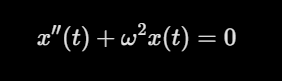
Here, x(t) is where the object is relative to its starting point (displacement), ω is the angular frequency, and x”(t) is just a fancy way of writing acceleration.
On the macro scale, the total energy of this system splits its time between moving fast (kinetic energy) and being stretched or compressed (potential energy):
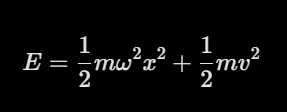
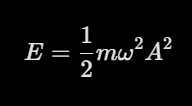
When the oscillator hits its maximum stretch—the amplitude (A)—the velocity drops to zero for a split second, meaning the total energy simplifies to:
But here is where things get wild. When you shrink down to the quantum level—like looking at individual atoms vibrating inside a molecule—nature stops dealing in smooth, continuous curves. In quantum mechanics, the energy of the harmonic oscillator is quantized. It can only exist in specific, discrete packets:
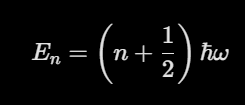
In this equation, n is an integer (0, 1, 2…), and h¯ is the reduced Planck constant. Notice how the steps between energy levels are exactly the same size (h¯ω)? That perfect, equal spacing is a defining feature of the quantum oscillator, and it explains everything from how molecules absorb infrared light to how atoms behave in a crystal lattice.
Worked Example 1: Energy of a Harmonic Oscillator
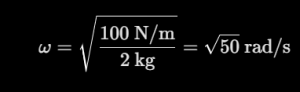
Let’s look at a classic textbook problem to see how this works in practice. Imagine a fictional lab setup where a 2 kg metal block is hooked up to a spring with a force constant (k) of 100 N/m. You pull the block back by 4 cm (0.04 m) from its resting spot and let it rip.
First, we need to figure out how fast it wants to oscillate, which is the angular frequency (ω). The math links it directly to the spring’s stiffness and the mass:
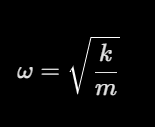
Plugging in our numbers:
Now, let’s find the total energy using our amplitude formula:
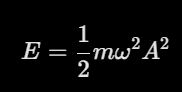
So, the total energy keeping that system moving is exactly 0.16 Joules. This shows a simple rule: if you double the distance you pull the spring, the energy quadruples because energy depends on the square of the amplitude.
Common Misconceptions About Harmonic Oscillator For RPSC Assistant Professor
When you are grading university papers or sitting for a competitive exam yourself, you spot the same conceptual traps over and over. Let’s clear up a few big ones.
- Misconception 1: An oscillator can only ever vibrate at one single frequency. That is true if you leave it alone (free oscillation). But imagine a child on a swing. If an adult steps in and pushes the swing at a totally different rhythm, the swing adapts to that external pace. This is a forced harmonic oscillator, and its driving frequency comes from the outside force, not the system’s internal traits.
- Misconception 2: Energy depends solely on amplitude. While true for a mechanical spring, look closely at the math. Total energy depends on the square of both amplitude and frequency (E = 1/2mω²A²). Drop the frequency, and the energy drops too, even if the amplitude stays the same.
- Misconception 3: The restoring force is always linear. We love using Hooke’s Law (F = -kx) because it makes the math incredibly clean. But in the real world, this is just an approximation. If you pull a real spring too far, it stretches out of shape, the linear relationship breaks down, and you enter the territory of anharmonic oscillators.
Harmonic Oscillator For RPSC Assistant Professor: Real-World Applications
Why do physicists care so much about this model? Because nature loves it.
Take earthquakes, for example. When tectonic plates shift, they send seismic waves rippling through the crust. Scientists model these ground vibrations as massive harmonic oscillations to map out what the deep layers of the Earth actually look like.
On a scale you can see on your desk, think of a grandfather clock’s pendulum. A physical pendulum swinging through a tiny angle mimics simple harmonic motion perfectly. It is the steady, predictable nature of these oscillations that made accurate timekeeping possible for centuries.
[Image diagram showing a simple pendulum swinging with small angle approximation]
If we zoom all the way down to atomic physics, imagine a lone electron trapped inside a microscopic pocket of a semiconductor—a potential well. Researchers often model this setup as an electron sitting in a smooth, U-shaped parabolic potential energy curve. By treating it as a quantum harmonic oscillator, scientists can predict how the electron interacts with light, which is how we design modern optoelectronic gadgets and lasers.
Exam Strategy for Harmonic Oscillator For RPSC Assistant Professor
When you are prepping for the RPSC Assistant Professor exam, you aren’t just trying to pass; you are preparing to teach this material to the next generation. That means you need a deep, intuitive strategy.
- Focus on the Core Subtopics: Don’t get bogged down in endless derivations. Prioritize energy quantization levels, wave functions, probability densities (especially why the quantum oscillator can leak into classically forbidden regions), and the time-independent Schrödinger equation.
- Spot the Differences: Keep a clear mental boundary between classical behavior (where the particle loves spending time at the turning points) and quantum behavior (where, in the ground state, the particle is most likely right in the middle).
- Practice Active Problem-Solving: Don’t just read through solutions. Work through problems where you have to calculate frequencies, shifting spring constants, or expectation values from scratch.
We have put together a completely free VedPrep video lecture specifically tailored for the RPSC Assistant Professor exam. It walks through these exact pain points with expert guidance, breaking down the toughest mathematical hurdles without the usual academic stuffiness.
Newton’s second law: Harmonic Oscillator in RPSC Assistant Professor Exam
At the end of the day, the RPSC panel wants to see if you can connect Newton’s second law (F = ma) to a physical system experiencing a restoring force. When you write down the classic second-order linear differential equation:
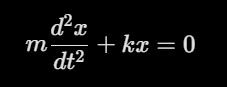
You are looking at the foundation of a huge chunk of physics. Whether you are dealing with a mass on a spring, a current sloshing back and forth in an LC circuit, or a acoustic vibration, the underlying math is exactly the same.
The exam will push you to handle variations of this theme—like what happens when friction slows things down (damped oscillations) or when an external rhythm keeps things moving (forced oscillations). Mastering these variations is your ticket to a top score.
Worked Example 2: Finding the Frequency
Let’s look at one more scenario. Imagine a 3 kg mass attached to a heavy-duty industrial spring with a force constant (k) of 150 N/m. You give it a 6 cm tug and let it vibrate. How many times does it bounce per second?
First, calculate the angular frequency (ω):

To find the actual frequency (f) in Hertz (cycles per second), we use the standard conversion:
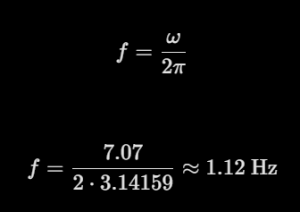
So, this system will complete roughly 1.12 full oscillations every single second.
By grounding your prep in these kinds of concrete calculations and keeping the physical picture clear, you’ll be in great shape to tackle whatever the RPSC paper throws at you. If you ever want to talk strategy or map out your study plan, the team here at VedPrep is always around to help you sort through the noise.
Final Thoughts
Preparing for the RPSC Assistant Professor exam is less about rushing to memorize formulas and more about developing a genuine, intuitive feel for how the physics works. The harmonic oscillator is the perfect example of this—it is a beautiful, unifying thread that connects the classical world we can touch to the quantum world we can only measure. If you can confidently explain why a swinging pendulum behaves like a vibrating molecule, you are already thinking like a professor. Take your time with the mathematics, practice breaking down the complex equations step-by-step, and focus on building a rock-solid conceptual foundation.
To know more in detail from our faculty, watch our YouTube video:
Frequently Asked Questions
What are the types of harmonic oscillators?
There are two main types: simple harmonic oscillators, which are undamped and have a sinusoidal motion, and damped harmonic oscillators, which experience energy loss and have a modified sinusoidal motion.
What is the equation of motion for a simple harmonic oscillator?
The equation of motion is given by m*x'' + k*x = 0, where m is the mass, k is the spring constant, and x is the displacement from equilibrium, leading to sinusoidal solutions.
What is the significance of harmonic oscillators in Quantum Mechanics?
Harmonic oscillators serve as a crucial model in Quantum Mechanics, helping to understand quantized energy levels and wave functions, particularly in the study of quantum systems like the quantum harmonic oscillator.
How is energy quantized in a harmonic oscillator?
In a quantum harmonic oscillator, energy is quantized into discrete levels given by E_n = (n + 1/2)*hbar*ω, where n is an integer, hbar is the reduced Planck constant, and ω is the angular frequency.
How does damping affect a harmonic oscillator?
Damping reduces the amplitude of oscillations over time by dissipating energy, with the effect being categorized into underdamped, overdamped, and critically damped systems based on the damping coefficient.
How to solve harmonic oscillator problems for RPSC Assistant Professor exams?
To solve problems, understand the basic equations of motion, practice solving for different types of harmonic oscillators, and apply concepts like energy quantization in quantum mechanics, ensuring a strong grasp of both classical and quantum aspects.
What are common problems faced in harmonic oscillator questions?
Common problems include finding the frequency of oscillation, determininand x isgy levels in quantum harmonic oscillators, and analyzing the effect of damping on oscillator motion, requiring a solid understanding of formulas and principles.
How to approach quantum mechanics problems in RPSC Assistant Professor exams?
Approach quantum mechanics problems by mastering the Schrödinger equation, understanding wave functions and operators, and practicing with a variety of problems, especially those related to harmonic oscillators and their quantized energy levels.
What are common mistakes in solving harmonic oscillator problems?
Common mistakes include incorrect application of formulas, misunderstanding the role of damping, and confusion between classical and quantum harmonic oscillator concepts, highlighting the need for careful problem analysis and concept clarity.
How to avoid errors in quantum mechanics problems?
To avoid errors, ensure a strong foundation in basic principles, carefully read and understand the problem statement, and double-check calculations, especially when dealing with complex quantum mechanics concepts like wave functions and operators.
What are advanced topics related to harmonic oscillators?
Advanced topics include anharmonic oscillators, which deviate from the simple harmonic oscillator model, and the application of harmonic oscillator concepts to more complex systems, such as coupled oscillators and quantum field theory.
How are harmonic oscillators used in modern physics?
Harmonic oscillators are used in modern physics to model a wide range of phenomena, from the behavior of atoms and molecules to the study of optical and electrical systems, demonstrating their versatility and fundamental importance.
What is the connection between harmonic oscillators and wave-particle duality?
The study of harmonic oscillators, particularly in quantum mechanics, illustrates wave-particle duality, as particles like electrons exhibit both wave-like and particle-like behavior in harmonic oscillator potentials.
How does chaos theory relate to harmonic oscillators?
Chaos theory relates to harmonic oscillators through the study of nonlinear oscillators, which can exhibit chaotic behavior under certain conditions, contrasting with the predictable motion of simple harmonic oscillators.