





A Power Series is an infinite polynomial of the form ∑∞n=0an (x – c)n. It represents a function within its Interval of Convergence. Mathematicians use the Ratio Test to find the Radius of Convergence, which determines the set of real numbers where the series converges absolutely.
Fundamentals of Power Series in Real Analysis
A Power Series acts as a bridge between infinite sequences and continuous functions. Unlike a standard polynomial with a finite degree, this series continues indefinitely. The value c represents the center of the series. Most problems in the IIT JAM Mathematics Syllabus focus on series centered at zero, where the form simplifies to ∑an xn.
The convergence of these series is predictable. Every Power Series converges at its center. Beyond the center, the series might converge for all real numbers, a specific range, or only at the center itself. This behavior defines the function the series represents. You will find that Power Series provide a way to define functions like ex, sin x, and cos x as infinite sums.
Calculating the Radius of Convergence
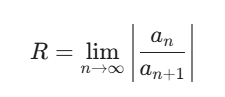
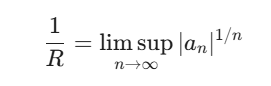
The Radius of Convergence, denoted as R, is the distance from the center to the edge of the convergence region. If R is the Radius of Convergence, the series converges for |x – c| < R and diverges for |x – c| > R. You calculate R using the coefficients an through the Cauchy-Hadamard Theorem or the Ratio Test.
The formula for the Radius of Convergence using the Ratio Test is:
Alternatively, the Root Test provides:
Determining the Interval of Convergence
The Interval of Convergence is the set of all x values for which the Power Series converges. This interval always includes the open interval (c – R, c + R). However, you must test the endpoints x = c – R and x = c + R separately. The Ratio Test fails at these specific points, so you apply other convergence tests like the Leibniz Test or p-series test.
IIT JAM Math Previous Year Questions (PYQs) frequently ask students to identify whether endpoints are included. The interval can be open, closed, or half-open. For example, the series ∑xn/n has a Radius of Convergence R = 1. Testing x = 1 results in a divergent harmonic series. Testing x = -1 results in a convergent alternating harmonic series. The Interval of Convergence is[-1, 1).
Table of Convergence Properties for Common Series
| Series Form | Coefficients (an) | Radius of Convergence (R) | Interval of Convergence |
|---|---|---|---|
| ∑xn | 1 | 1 | (-1, 1) |
| ∑xn/n! | 1/n! | ∞ | (-∞, ∞) |
| ∑n! xn | n! | 0 | \{0\} |
| ∑xn/n | 1/n | 1 | [-1, 1) |
| ∑{(-1)n x2n+1}/{(2n+1)!} | Varied | ∞ | (-∞, ∞) |
Term-wise Differentiation of Power Series
You can differentiate a Power Series term by term within its Interval of Convergence. If f(x) = ∑an (x – c)n, then f'(x) = ∑n an (x – c)(n-1). This new series has the same Radius of Convergence as the original series. This property allows you to find derivatives of complex functions by manipulating their series representations.
Term-wise differentiation is a standard topic in the IIT JAM Mathematics Syllabus. It simplifies solving differential equations. Even though the Radius of Convergence stays the same, the behavior at the boundaries might differ. You need to check the endpoints again for the derivative series to ascertain the revised Interval of Convergence.
Term-wise Integration of Power Series
Integration of a Power Series is performed by integrating each term individually. The integral of f(x) = ∑an (x – c)n is ∫f(x) dx = C + ∑{an (x – c)n+1}/{n+1}. Like differentiation, the Radius of Convergence stays the same. This method is effective for evaluating integrals that do not have elementary anti-derivatives.
For IIT JAM Math Previous Year Questions (PYQs), calculus involving integration frequently serves to determine the total of a number sequence. If you can see a numerical sequence as a Power Series evaluated at a certain x, integrating a familiar geometric series allows you to discover the total. This method is crucial for tasks related to series containing logarithms or inverse trigonometric functions.
Numerical Examples and Application
Consider the Power Series ∑∞n=1 {(x-2)n/n2 3n}. To find the Radius of Convergence, identify an =1/n2 3n.
Using the Ratio Test:
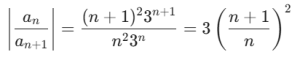
As n approaches infinity, the limit is 3. Thus, R = 3.
The interval is centered at x = 2, so the series converges for |x – 2| < 3, or -1 < x < 5.
At x = 5, the series is ∑1/n2, which converges.
At x = -1, the series is ∑(-1)n/n2}, which also converges.
The final Interval of Convergence is [-1, 5].
Convergence Analysis Summary Table
| Test Condition | Result for |x-c| = R | Result for |x-c| < R | Result for |x-c| > R |
|---|---|---|---|
| Absolute Convergence | Depends on Endpoints | Always Convergent | Always Divergent |
| Term-wise Calculus | Valid | Valid | Invalid |
| Uniform Convergence | Requires Compact Subsets | Always on Compact Sets | Never |
| Function Continuity | Continuous on Interval | Continuous | Discontinuous |
Limitations and Critical Perspectives on Convergence
A common error is assuming that a Power Series converges uniformly on its entire open Interval of Convergence. While the series converges pointwise for all x in (c – R, c + R), it only converges uniformly on compact subsets [a, b] within that interval. This distinction is vital when swapping limits and integrals in advanced calculus.
A further constraint concerns the conduct at the edge. Should a sequence arrive at convergence at one end, Abel’s Theorem assures us the function maintains continuity at that specific point. Nevertheless, the series of derivatives may fail to settle at that very same limit. You cannot assume the properties of the original series transfer perfectly to its derivative series at the points where |x – c| = R.
Practical Application in Mathematical Physics
Power Series serve as the primary tool for solving linear differential equations with variable coefficients. In physics, the Bessel functions and Legendre polynomials arise as Power Series solutions to specific equations. Engineers use these series to approximate complex oscillations where simple trigonometric functions are insufficient.
Within the scope of the IIT JAM Mathematics Syllabus, these uses frequently manifest as Taylor Series expansions. Developing a function into a Power Series permits the linearization of non-linear setups close to a balance point. This estimation forms the groundwork for assessing stability in dynamic systems and foundational mechanics.
Strategic Approach for IIT JAM Preparation
Reviewing IIT JAM Math Previous Year Questions (PYQs) reveals a pattern in Power Series problems. Examiners frequently combine the Radius of Convergence with sequence limits or improper integrals. You should practice identifying the coefficients an quickly and applying the root test when n appears in the exponent of the coefficient itself.
Focus on the relationship between a function and its series representation. If you know the series for 1/(1-x), you can derive the series for ln(1-x) through integration or 1/(1-x)2 through differentiation. Mastering these transformations saves time during the exam and ensures accuracy in finding the Interval of Convergence.
Conclusion
Grasping Power Series is key for excelling in the IIT JAM Mathematics assessment since it links how sequences get closer to a limit with principles of functional analysis. Regularly working through finding the Radius of Convergence and examining the ends of the Interval of Convergence develops the technical exactness needed for advanced calculus. VedPrep offers complete materials and professional direction to assist tackling these intricate subjects covered by the authorized curriculum. Concentrate your study efforts on operations performed on individual terms and past examination questions to guarantee rapid and precise solving of all series challenges.
Frequently Asked Questions (FAQs)
How does a Power Series differ from a standard polynomial?
Polynomials have a finite number of terms and a fixed degree. A Power Series continues indefinitely. While a polynomial is defined for all real numbers, a Power Series only represents a valid function within its specific Interval of Convergence. This infinite nature allows for the representation of transcendental functions.
What is the center of a Power Series?
The center is the constant c in the term (x-c)n. It is the specific point on the real number line where the series is guaranteed to converge. Most IIT JAM Mathematics Syllabus problems use zero as the center. At this point, every term except the first becomes zero.
Why are Power Series important for IIT JAM Mathematics?
The IIT JAM Mathematics Syllabus requires mastery of Power Series for solving differential equations and finding function limits. Examiners test your ability to calculate the Radius of Convergence and handle term-wise operations. These series provide the foundation for understanding Taylor expansions and complex analytic functions.
What does absolute convergence mean for a Power Series?
Absolute convergence occurs when the series of absolute values ∑|an (x-c)n| converges. For Power Series, absolute convergence is guaranteed for every value of x within the open Interval of Convergence. This property allows you to rearrange terms without changing the sum of the series.
What happens if the Radius of Convergence is zero?
A Radius of Convergence of zero means the series converges only at its center. This usually happens when coefficients grow extremely fast, such as n!. In such cases, the series does not represent a useful function for any value other than x = c.
Why does the Ratio Test fail at the endpoints?
The Ratio Test yields a limit of 1 at the boundaries of the interval. A limit of 1 is inconclusive for convergence. You must use other tools like the Comparison Test, Alternating Series Test, or p-series test to determine if the series converges at these specific points.
What if the limit for the Radius of Convergence does not exist?
If the standard limit does not exist, use the limit superior as defined in the Cauchy-Hadamard Theorem. The formula 1/R = lim sup |an|1/n provides the radius even when the sequence of coefficients behaves irregularly. This ensures you can always find a convergence boundary.
How do you check for uniform convergence?
Power Series converge uniformly on any closed sub-interval within the open Interval of Convergence. If the series converges at an endpoint, Abel's Theorem states it is uniformly convergent on the closed interval including that endpoint. Uniform convergence allows you to pass limits through the summation sign.
Does the Radius of Convergence change after differentiation?
No, the Radius of Convergence remains exactly the same after term-wise differentiation. However, the behavior at the endpoints can change. A series that converged at an endpoint might diverge after differentiation. You must always re-test the boundaries for the derivative series.
How is Abel’s Theorem used in Power Series?
Abel’s Theorem relates the limit of a function to the sum of its Power Series at the boundary. If a series converges at x = R, then the function defined by the series is continuous at x = R from the left. This is used to sum series like the alternating harmonic series.
What is the significance of the Cauchy-Hadamard Theorem?
The Cauchy-Hadamard Theorem provides a definitive way to calculate the Radius of Convergence using the reciprocal of the limit superior of |an|1/n. It works for any Power Series, regardless of whether the ratio of consecutive coefficients converges. It is the most general tool available.
Can a Power Series converge for all real numbers?
Yes, if the limit of the Ratio Test is infinity, the Radius of Convergence is infinite. This means the series converges for every real value of x. Common examples include the series for ex, sin(x), and cos(x). These are called entire functions.