
Photochemistry is the study of chemical reactions initiated by the absorption of light. This branch of chemistry explains how molecules transition to excited states, leading to unique transformations like fluorescence or structural changes. Mastering photochemistry requires understanding energy pathways, kinetic rules, and precise laboratory techniques for exam and practical success.
Fundamentals of Photochemistry
Photochemistry focuses on chemical changes triggered by ultraviolet, visible, or infrared light. When a molecule absorbs photons, electrons jump to higher energy levels. This excited state allows reactions that are impossible under normal thermal conditions, making this field essential for advanced chemical synthesis and energy conversion.
To understand Photochemistry subject, students must first grasp the Grotthuss-Draper law. This core rule states that only light absorbed by a system can bring about a photochemical change. If light simply passes through a substance without absorption, no reaction will ever occur.
Another foundational principle is the Stark-Einstein law. This rule states that for each photon of light absorbed by a chemical system, only one primary molecule is activated. This strict one-to-one ratio helps chemists predict expected reaction yields accurately.
These laws govern how we measure reaction efficiency using quantum yield. The quantum yield compares the total number of reacted molecules to the total number of absorbed photons. A high quantum yield means the process is highly efficient and optimal for synthesis.
Standard thermal reactions rely entirely on heat to overcome high activation energy barriers. In contrast, light-driven reactions bypass these thermal barriers immediately. This allows chemists to build complex, heat-sensitive organic structures at room temperature safely and effectively.
Understanding the Jablonski Diagram in Photochemistry
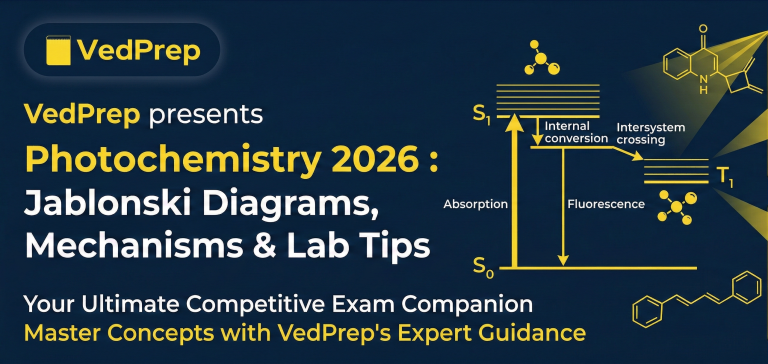
A Jablonski diagram is a visual tool that illustrates the electronic states of a molecule and the transitions between them. It maps how an excited molecule absorbs light, loses energy through vibrations, and eventually returns to its ground state via processes like fluorescence or phosphorescence.
Photochemistry change.
The diagram uses stacked horizontal lines to represent distinct energy levels. The lowest line represents the ground singlet state ($S_0$). Higher lines represent excited singlet states ($S_1$, $S_2$) and excited triplet states ($T_1$, $T_2$).
When a molecule absorbs a photon, it jumps rapidly from $S_0$ to an excited singlet state. This absorption happens almost instantly, typically in femtoseconds. Following this jump, the molecule holds excess energy that makes it highly unstable.
After absorption, the molecule quickly loses some energy as heat, dropping down to the lowest excited singlet state ($S_1$). This rapid, radiationless energy loss is called internal conversion. It is a mandatory step before any light emission occurs.
From the $S_1$ state, the molecule can return directly to the ground state by emitting a photon. This specific light emission is called fluorescence. Because some energy is lost during internal conversion, fluorescence always occurs at a longer, lower-energy wavelength than the initially absorbed light.
Alternatively in Photochemistry, the molecule can undergo intersystem crossing. This event happens when the molecule flips its electron spin and moves laterally from a singlet state to a triplet state ($T_1$). Triplet states last much longer, creating a wider window for complex chemical reactions to take place.
Essential Rules of Pericyclic Photochemistry
Pericyclic photochemistry involves concerted reactions where bond breaking and forming occur simultaneously in a cyclic transition state. Light provides the exact energy needed to alter molecular orbital symmetries, allowing specific ring-closing or ring-opening reactions that heat cannot achieve due to symmetry restrictions.
The Woodward-Hoffmann rules heavily govern these unique transformations. These rules predict whether a concerted reaction is “allowed” or “forbidden” based purely on orbital symmetry. A reaction completely forbidden under thermal conditions is very often allowed under light-driven conditions.
Electrocyclic reactions are a primary focus in most advanced chemistry exams. In these specific reactions, a conjugated polyene closes into a cyclic compound, or a cyclic ring opens to form a polyene. The physical outcome depends entirely on the number of pi electrons and the energy source applied.
Under light irradiation, molecules use their lowest unoccupied molecular orbital (LUMO) as the new reactive frontier orbital. This excitation changes the required twisting motion of the molecule’s ends. For example, a system rotating in opposite directions (disrotatory) under heat will rotate in the same direction (conrotatory) under light.
Cycloadditions form another vital exam topic in pericyclic photochemistry. The [2+2] cycloaddition of two simple alkenes to form a square cyclobutane ring is photochemically allowed. This specific reaction is strictly impossible using just heat, making it an exclusive tool for creating strained chemical rings.
Photocatalysis Basics and Green Photocatalysis
Photocatalysis basics involve using a catalyst that absorbs light to accelerate a chemical reaction without being consumed itself. Green photocatalysis applies these principles to develop environmentally friendly processes, utilizing renewable light sources to drive chemical synthesis while minimizing hazardous waste and heavy metal usage.
A standard photocatalyst acts primarily as a powerful electron transfer agent. It absorbs a photon, reaches an energetic excited state, and then either donates or accepts an electron from a target molecule. This crucial single-electron transfer creates highly reactive intermediate radical species.
Historically, ruthenium and iridium metal complexes served as the main traditional photocatalysts. They offer strong light absorption and possess highly stable excited states. However, these transition metals are rare, expensive, and leave toxic residues in pharmaceutical products.
To solve this, green photocatalysis focuses heavily on replacing rare metals with safe organic dyes like Eosin Y or Rose Bengal. These metal-free catalysts perform the exact same electron transfers but are vastly safer for the environment. They also operate with high efficiency under standard visible light.
By utilizing gentle visible light instead of harsh ultraviolet rays, chemists successfully prevent unwanted molecular degradation. This targeted approach significantly reduces chemical waste, improves total reaction yields, and aligns perfectly with modern sustainability mandates in global chemical manufacturing.
The Role of Solar Photochemistry in Modern Science
Solar photochemistry is the direct use of sunlight to drive chemical reactions, harvest energy, or break down environmental pollutants. It mimics natural photosynthesis, aiming to capture abundant solar energy and convert it into storable chemical fuels like hydrogen or valuable industrial chemicals.
The most prominent and widely researched goal of this field is artificial photosynthesis. Scientists engineer complex systems that use sunlight to actively split water molecules into hydrogen and oxygen gas. The generated hydrogen acts as a completely clean, renewable fuel source.
Inorganic semiconductors play a crucial role in these advanced solar systems. Materials like titanium dioxide readily absorb solar photons, creating distinct electron-hole pairs within the crystal lattice. These separated electrical charges then migrate outward to the material’s surface to initiate reactions.
At the surface, these charges facilitate the direct oxidation of water and the rapid reduction of hydrogen ions. Beyond energy generation, sunlight is frequently used for massive environmental remediation projects. Solar-driven reactions can rapidly degrade persistent organic pollutants found in municipal wastewater.
Scaling up these solar reactors remains a massive engineering challenge. Designers must build systems that maximize light exposure while maintaining a fast, continuous flow for the chemical reactants. Despite these physical hurdles, using the sun as a free reagent defines the future of sustainable chemistry.
Understanding Photochemical Kinetics and Fluorescence Lifetime
Photochemical kinetics studies the rates of light-driven reactions and the competing pathways of excited molecules. Measuring fluorescence lifetime the average time a molecule remains in its excited singlet state before emitting a photon is crucial for determining how efficiently a reaction will occur.
When a molecule becomes excited, multiple physical processes immediately compete for its stored energy. The molecule can fluoresce, undergo intersystem crossing, or react chemically with a neighbor. The distinct rates of these individual processes determine the final observed outcome.
The fluorescence lifetime acts as a critical baseline metric in photochemistry. It typically ranges from just 1 to 10 nanoseconds for most organic molecules. If a chemical reaction is physically slower than this brief lifetime, the molecule will simply emit light and deactivate before reacting.
To guarantee a successful transformation, the desired chemical step must kinetically outpace the fluorescence. Chemists routinely use the mathematical Stern-Volmer equation to study this kinetic competition. This equation models how increasing a reactant’s concentration successfully “quenches” the normal fluorescence.
Measuring these incredibly rapid kinetic events requires highly specialized laboratory equipment. Techniques like time-correlated single-photon counting allow researchers to accurately observe energy decay at the nanosecond level. Understanding photochemical kinetics is vital for maximizing yields in both academic labs and industrial plants.
Practical Guide to Lab Photochemistry
Lab photochemistry requires precise control over light sources, reaction vessels, and safety protocols. Successful experiments depend on selecting the correct wavelength, ensuring uniform light penetration, and using appropriate glassware, as standard lab glass blocks crucial ultraviolet wavelengths needed for many reactions.
The choice of physical glassware represents the very first critical step. Standard borosilicate lab glass heavily blocks ultraviolet light below 300 nanometers. For high-energy UV reactions, chemists must substitute expensive quartz vessels, which allow completely clear light transmission down to 200 nanometers.
Selecting the absolute right light source is equally critical for success. Mercury vapor lamps remain common for UV reactions, offering intense power at specific spectral wavelengths. For visible light reactions, specialized blue or green LED arrays provide safe, highly targeted illumination.
Light penetration, mathematically defined by the Beer-Lambert law, strictly dictates all reactor design. Light simply cannot penetrate deeply into dark or highly concentrated solutions. Therefore, optimal setups utilize thin glass tubing or flow microreactors to guarantee complete light exposure.
Safety remains paramount when working with high-intensity radiation in lab photochemistry. UV radiation causes rapid, severe damage to the human eye and exposed skin. Researchers must mandate UV-blocking acrylic shields, wear dark protective eyewear, and securely seal reaction boxes.
Case Study: Photoisomerization in Real-World Synthesis
As photochemistry the photoisomerization is a structural change where a molecule transforms into a different isomer upon absorbing light. This case study explores how changing the geometry of an alkene from a trans-isomer to a cis-isomer enables the synthesis of highly specific, sterically strained pharmaceutical compounds.
Consider the complex synthesis of a large macrocyclic drug molecule. The final target molecule strictly requires a cis-alkene geometry to fold correctly and bind tightly to its biological receptor. However, standard thermal chemical synthesis strongly and naturally favors the more stable trans-alkene geometry.
To successfully overcome this strict thermodynamic constraint, synthetic chemists apply targeted light. The starting material, heavily containing the unwanted trans-alkene, is dissolved in a solvent and irradiated. The molecule absorbs a photon, which temporarily breaks the rigid pi-bond in the excited state.
While occupying photochemistry this highly energized excited state, the molecule can freely rotate around the remaining carbon-carbon single bond. When the molecule rapidly loses its excess energy and drops back to the ground state, it can randomly reform the pi-bond in either geometry.
By carefully adding a specific triplet sensitizer, the entire reaction becomes completely biased. The sensitizer transfers energy exclusively to the trans-isomer, continually exciting it until the whole mixture converts into the desired cis-isomer. This elegant photoisomerization builds molecular tension effortlessly.
Critical Thinking: When Standard Photochemistry Fails
Standard photochemistry fails when reactions scale up, because light cannot penetrate deep into large reaction vessels. As the container size increases, molecules at the center remain in the dark, leading to incomplete reactions, wasted materials, and significant manufacturing inefficiencies.
A very common misconception among chemistry students is that you can scale up a reaction simply by increasing the power of the light bulb. This brute-force approach is fundamentally flawed. According to the Beer-Lambert law, light intensity decreases exponentially as it travels through a absorbing medium.
In a large 5-liter batch reactor, only the molecules situated within a few millimeters of the glass wall actually absorb light. The rest of the vast solution acts as a dense, dark shield. Cranking up the light wattage only causes severe localized overheating.
This extreme localized heating at the glass surface inevitably leads to unwanted side reactions and rapid product degradation. The dark core of the reactor remains completely unreacted, creating a terrible overall yield. Therefore, standard round-bottom flasks are terrible choices for scaling photochemistry.
To permanently mitigate this failure, industry experts abandon large batch flasks entirely. Instead, they universally adopt continuous flow chemistry. Pumping the solution through incredibly narrow, fully illuminated tubing completely bypasses the penetration limit, transforming a failing approach into a highly profitable industrial solution.
What competitors miss quick wins
The term photochemistry most textbooks and competitor blogs oversimplify energy transfer and ignore modern lab realities. This section highlights the high-value gaps often missed in standard study materials, providing students with quick, actionable insights to improve exam answers and practical laboratory understanding.
Competitor resources as photochemistry frequently fixate on abstract theory while entirely neglecting modern, practical laboratory applications. Recognizing and understanding these specific informational gaps provides a distinct, measurable advantage in both competitive academic testing and real-world industrial research interviews.
- Gap 1: Neglecting Flow Systems. Traditional textbooks focus exclusively on round-bottom batch flasks. Quick Fix: Always mention continuous flow microreactors when discussing industrial scale-up, as batch scaling is physically impossible due to exponential light attenuation.
- Gap 2: Ignoring LED Technology. Older study guides only discuss hazardous, heat-producing mercury lamps. Quick Fix: Make sure to highlight the modern use of narrow-band LEDs, which have completely revolutionized precise visible-light reactions without generating destructive thermal heat.
- Gap 3: Confusing Spin Flips. Many sources mention intersystem crossing but fail to explain why it actually happens. Quick Fix: Explicitly state that spin-orbit coupling, often enhanced by heavy atoms, is strictly required to flip the electron spin during this transition.
- Gap 4: Overlooking Solvent Effects. Competitors routinely treat solvents as purely neutral, inactive backgrounds. Quick Fix: Note that solvent polarity drastically shifts molecular energy levels, subsequently altering both the target absorption wavelength and the critical fluorescence lifetime.
- Gap 5: Missing Sensitizers. Basic guides ignore how to drive reactions that don’t absorb available light. Quick Fix: Explain that adding a chemical sensitizer allows the system to harvest light and transfer the energy to the target, bypassing direct absorption limits completely.
Learn More :