
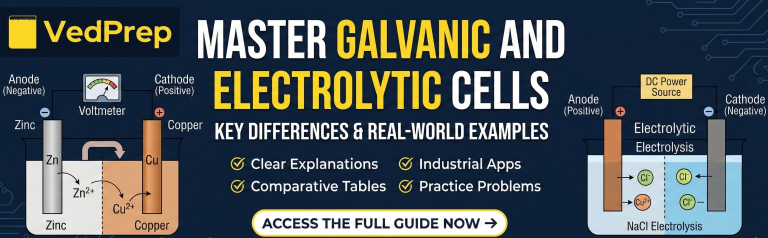

Galvanic and Electrolytic cells are the two main types of electrochemical cells. Galvanic and Electrolytic cells differ fundamentally: one generates electrical energy from spontaneous chemical reactions, while the other requires an external current to drive non-spontaneous reactions.
What Are Galvanic and Electrolytic Cells?
Galvanic and Electrolytic cells represent the absolute core of electrochemistry basics. When you studying a galvanic unit converts chemical energy into electrical energy naturally. Conversely, an electrolytic unit does the exact opposite, using an external power source to force reactions.
Both Galvanic and Electrolytic cells fundamentally rely on the active transfer of electrons between different chemical species. This continuous transfer occurs smoothly through an external circuit wire, creating a measurable flow of electrical charge that can be utilized or manipulated.
In a galvanic setup, the internal chemical potential naturally drives the electrons outward. Everyday devices like dry cells, standard car batteries, and modern fuel cells operate entirely on this specific principle. They act as reliable, self-contained power sources for electronics.
Electrolytic systems strictly require an outside power source to function properly. A battery or direct voltage supply actively pushes electrons into the chemical system. Exploring Galvanic and Electrolytic cells reveals that this forced electron flow causes specific chemical changes that would never happen naturally.
Major industries rely heavily on the electrolytic process for manufacturing vital goods. Extracting highly reactive metals like pure sodium or aluminum requires this forced, massive energy input. Splitting water molecules to produce clean hydrogen gas also utilizes this specific cell type.
Core Differences in Galvanic and Electrolytic Cells
The primary difference between Galvanic and Electrolytic cells lies in energy conversion and thermodynamic spontaneity. While evaluating these, remember galvanic units produce electricity from spontaneous reactions, whereas electrolytic units actively consume electricity to drive non-spontaneous reactions.
Understanding these core differences in Galvanic and Electrolytic cells is absolutely vital for mastering competitive chemistry exams. In a standard galvanic setup, the physical anode acts as the negative terminal, and the physical cathode acts as the positive terminal.
The electrolytic setup completely flips this standard electrical polarity. The external power source dictates the electrical charge, making the anode positive and the cathode negative. However, the chemical process of oxidation always occurs at the anode in both Galvanic and Electrolytic cells.
Energy flow provides another extremely clear dividing line between the two systems. Galvanic setups act as active energy producers, discharging raw power to an external load. Electrolytic setups act as passive energy consumers, requiring a continuous and steady power supply to operate.
Exam students must meticulously track the electron flow direction during complex calculations. Electrons always travel from the anode to the cathode in the external circuit wire. This strict physical rule remains constant across all types of Galvanic and Electrolytic cells.
The Role of Anode and Cathode in Galvanic and Electrolytic Cells
The anode and cathode are the physical conductive electrodes where electron transfer occurs in Galvanic and Electrolytic cells. Oxidation strictly happens at the anode, while reduction strictly happens at the cathode, regardless of which of the these you are analyzing.
Electrodes serve as the vital conductive bridge between the external metallic wire and the internal chemical solution. They are typically constructed from reactive metals or inert conductive graphite. Their primary mechanical job is to seamlessly facilitate the necessary electron exchange for reactions.
At the physical anode, specific chemical species lose their electrons. These newly released electrons travel up through the solid electrode and into the external wire. This continuous oxidation process frequently causes the solid anode material to degrade or dissolve over time.
At the physical cathode, the exact opposite chemical process takes place. Electrons arriving from the external wire interact directly with chemical species suspended in the solution. This active reduction process often leads to solid metal plating or visible gas bubble formation.
Exam questions frequently test this specific foundational knowledge about Galvanic and Electrolytic cells. Remembering the simple mnemonic “An Ox and Red Cat” helps ensure complete accuracy. Oxidation matches strictly with the anode in all Galvanic and Electrolytic cells.
Understanding Redox Reactions and Cell Potentials
Redox reactions drive the fundamental function of all Galvanic and Electrolytic cells. These reactions involve the simultaneous transfer of electrons between two different chemical substances. Cell potentials precisely measure the voltage generated or required to drive these specific electron transfers.
Redox is a scientific portmanteau for the crucial terms reduction and oxidation. You cannot possibly have one process occur without the other occurring simultaneously. One specific chemical species acts as the electron donor, while another species acts as the electron acceptor.
The natural tendency of a specific substance to gain electrons is called its standard reduction potential. Chemists carefully measure this specific value in standard volts. Comparing the established potentials of two different metals accurately determines how they will chemically interact.
In a spontaneous chemical setup, the calculated cell potentials always yield a positive value. This positive voltage indicates that the chemical reaction proceeds naturally, yielding usable electrical energy. Standard thermodynamic tables of reduction potentials help students predict this exact measurable voltage.
Non-spontaneous chemical setups naturally possess a negative calculated cell potential. This negative value tells chemists exactly how much external voltage they must artificially apply. The external power source must overcome this massive negative potential to force the redox reactions forward.
Salt Bridge Function and Cell Diagram Notation
Understanding the salt bridge function is critical for maintaining electrical neutrality between separate half-cells in many Galvanic and Electrolytic cells. Furthermore, mastering cell diagram notation provides a standardized, efficient shorthand method for illustrating Galvanic and Electrolytic cells without drawing complex diagrams.
Without a highly functional salt bridge, a working galvanic battery would quickly stop operating. As oxidation and reduction actively occur, massive charge imbalances build up in the separate chemical solutions. The anode compartment becomes excessively positive, and the cathode compartment becomes excessively negative.
The physical salt bridge contains an inert conductive electrolyte, like aqueous potassium chloride. Non-reactive ions from this bridge flow into the respective compartments to actively neutralize the building electrical charges. This constant, balancing ion flow completely closes the internal electrical circuit.
Cell diagram notation vastly simplifies the written representation of complex chemical systems. It utilizes single vertical lines to represent physical phase boundaries, like a solid metal submerged in a liquid solution. A double vertical line strictly represents the physical salt bridge separating the two half-cells.
The specific anode information always sits on the far left side of the written notation. The specific cathode information always sits on the far right side. This highly standard format allows scientists and exam graders to communicate complex cell structures instantly and accurately.
Gibbs Free Energy and Spontaneous Cell Reactions
Gibbs free energy accurately indicates the overarching thermodynamic favorability of any chemical process within Galvanic and Electrolytic cells. Spontaneous cell reactions possess a strictly negative Gibbs free energy, while non-spontaneous reactions in Galvanic and Electrolytic cells have a positive value, heavily requiring external energy.
Thermodynamics provides the unbreakable mathematical foundation for all electrochemistry basics. The primary equation relating Gibbs free energy to electrical potential is delta G equals negative nFE. This precise formula directly connects raw chemical energy to measurable electrical voltage.
When calculated cell potentials yield positive numbers, the resulting Gibbs energy is inherently negative. This mathematical fact confirms that the specific setup will run entirely on its own. It represents a thermodynamically favored physical state that reliably releases highly usable electrical power.
Conversely, driven chemical systems deal exclusively with positive Gibbs energy values. The natural chemical tendency is for the target reaction to run completely in reverse. The external electrical power supply must successfully provide enough energy to overcome this massive thermodynamic barrier.
Examiners heavily ask students to calculate one specific value from the other. A strong mathematical grasp of Faraday’s constant and exact mole transfers is rigorously required here. Understanding this specific mathematical relationship is non-negotiable for advanced competitive chemistry mastery.
Practical Mini-Case Study: Industrial Copper Refining
Industrial copper refining utilizes massive, highly specific electrolytic cells to carefully purify raw mined copper. Impure mined copper acts as the dissolving anode, while pure copper serves as the receiving cathode. This massive process highlights the incredible industrial power of Galvanic and Electrolytic cells.
Raw mined copper typically contains various problematic impurities like iron, zinc, silver, and solid gold. To be functional in modern electrical wiring, commercial copper must be over 99.9% pure. The manufacturing industry achieves this extreme high purity through highly controlled, massive-scale electrorefining.
Industrial workers place massive, heavy slabs of impure copper into a highly acidic copper sulfate bath. These massive slabs are actively wired as the positive electrical anode. Paper-thin sheets of already purified copper are wired carefully as the negative electrical cathode.
A carefully calibrated, high-amperage electrical current runs continuously through the entire system. The applied voltage is high enough to oxidize the copper, but deliberately not high enough to oxidize the precious metal impurities. The impure solid copper dissolves into the acidic solution as charged copper ions.
These newly charged ions travel physically through the chemical bath and neatly reduce onto the pure copper cathode. The highly valuable unreacted impurities, like pure gold and silver, do not successfully dissolve. They safely fall to the bottom of the massive industrial tank as “anode mud,” which is later collected.
Why Memorizing Electrode Signs Fails: A Critical Thinking Approach
Many GATE or other students blindly memorize electrode signs without truly understanding the mechanics of Galvanic and Electrolytic cells. This rigid approach fails spectacularly when actively switching between Galvanic and Electrolytic cells on exams. True academic comprehension requires aggressively focusing on actual electron flow.
Standard textbooks almost always introduce basic batteries first, firmly teaching that the anode is the negative terminal. Students immediately lock this visual association deeply into their minds. When they subsequently encounter an electrolytic problem on a competitive exam, they incorrectly apply this exact same rule.
In a driven electrolytic setup, the external power source entirely dictates the physical sign, making the anode positive. Relying purely on memorized signs leads to wildly incorrect predictions about internal ion movement. It causes fundamental, catastrophic errors in calculating overall cell potentials and reaction directions.
Instead of rigidly memorizing signs, intelligent students must meticulously track the chemical process. Accurately identify which specific chemical species is actively undergoing oxidation. That specific physical location is always the anode, absolutely regardless of the painted physical sign attached to it.
Understanding the fundamental “why” safely prevents simple, frustrating test-day mistakes. If you definitively know electrons are being actively released by a reaction, you mathematically know it is oxidation. This critical thinking approach works flawlessly across all possible variations of Galvanic and Electrolytic cells.
What Competitors Miss Quick Wins
Most standard educational platforms severely oversimplify electrochemistry basics, leaving advanced students highly vulnerable when answering complex questions about Galvanic and Electrolytic cells. They focus excessively on standard states and completely ignore real-world variables affecting Galvanic and Electrolytic cells. Here are the crucial academic gaps.
Competitor materials frequently omit the severe impact of chemical concentration changes.
- Gap: Ignoring the complex Nernst equation for non-standard chemical states.
- Fix: Always carefully check if solution molarities are exactly 1.0 M; if not, you must actively calculate the shifted cell potentials manually.
Many competitor blogs utterly fail to carefully explain overpotential in driven electrolytic systems.
- Gap: Assuming theoretical calculated voltage is enough to drive a physical reaction.
- Fix: Real-world reactions, especially those producing physical gases, strictly require extra applied voltage (overpotential) to successfully overcome massive kinetic barriers.
Competitors rarely detail the inevitable physical depletion of the vital salt bridge function.
- Gap: Treating the physical salt bridge as an infinite, magical resource.
- Fix: Recognize that as bridge ions deplete, internal resistance massively increases, eventually causing the active cell voltage to drop completely to zero.
Finally, the dynamic transition point between active cell types is frequently poorly explained.
- Gap: Viewing Galvanic vs Electrolytic setups as two entirely separate physical devices.
- Fix: A modern rechargeable battery acts as a Galvanic unit when discharging power, and an Electrolytic unit when plugged into the wall to recharge.
Applications of Galvanic and Electrolytic Cells in 2026
The highly practical applications of Galvanic and Electrolytic cells are expanding rapidly in 2026. From advanced solid-state electric vehicle batteries to industrial green hydrogen production, Galvanic and Electrolytic cells strictly drive modern sustainability. Mastery of this complex topic connects directly to emerging engineering careers.
Modern global energy storage relies entirely on highly advanced Galvanic principles. New solid-state batteries for modern electric vehicles offer much higher cell potentials and vastly safer operation than older lithium-ion models. These massive innovations directly stem from meticulously manipulating anode and cathode materials at the nanoscale.
On the massive manufacturing side, heavy Electrolytic processes are absolutely crucial for building sustainable infrastructure. Clean green hydrogen is actively produced by electrolyzing water using renewable solar or wind power. This efficiently replaces older, highly carbon-heavy methods of industrial chemical and fuel production.
Advanced medical implants also heavily utilize tiny, highly specialized micro-electrochemical cells. Life-saving pacemakers rely strictly on highly stable, exceptionally long-lasting Galvanic setups that operate completely safely within the delicate human body. Understanding these specific reactions perfectly ensures life-saving reliability.
For dedicated students actively preparing for elite engineering or medical entrance exams, this isn’t just dry scientific theory. The exact differences in Galvanic and Electrolytic cells literally form the physical basis of next-generation green technology. Excelling in these specific concepts easily opens immediate doors to highly lucrative technical careers.
Learn More :



