


The canal system in sponges is a complex network of water channels and chambers that facilitates nutrition, respiration, excretion, and reproduction. Water enters through ostia, moves through internal canals lined with choanocytes, and exits via the osculum. This physiological system replaces higher organ functions, allowing sponges to thrive as sessile organisms.
Understanding the Fundamental Canal System in Sponges
The canal system in sponges functions as a life support network. It circulates water through the body to provide oxygen and capture food particles. Since sponges lack specialized nervous or circulatory systems, they rely on water currents. Flagellated cells called choanocytes drive these currents. These cells create a pressure gradient that pulls water into the body. This process is essential for sponges to maintain metabolic activity while remaining attached to a substrate. You can identify different sponge species by the specific complexity of their internal channels.
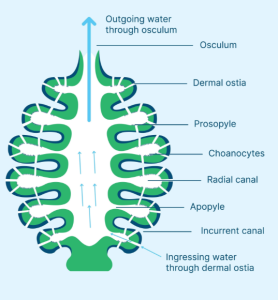
The canal system in sponges works through three main components. The incurrent pores or ostia serve as the entry points. The internal chambers or spongocoel act as the processing area. Finally, the osculum serves as the exit. This continuous flow ensures that waste products like ammonia do not accumulate within the tissues. Students preparing for the RPSC Assistant Professor Zoology syllabus must master these structural details from Paper I and Paper II. The efficiency of this system determines the growth rate and size of the sponge.
The Ascon Type Canal System
The ascon type is the simplest version of the canal system in sponges. It appears in primitive sponges like Leucosolenia. The body is vase shaped and thin walled. Water enters directly through dermal ostia into a large central cavity called the spongocoel. The spongocoel is lined entirely with choanocytes. These flagellated cells push the water out through a single large opening at the top known as the osculum. This arrangement limits the size of the sponge because a large volume of water is difficult to move with a single layer of cells.
As per canal system in sponges, you will find that the asconoid structure is rare in larger sponges. The surface area to volume ratio is low in this model. This means the sponge cannot filter enough food to support a massive body. Most sponges evolve more complex systems to increase the number of choanocytes. In the RPSC Assistant Professor Zoology syllabus, the ascon type serves as the baseline for understanding evolutionary complexity. It demonstrates the basic principle of flagellar water movement without the complications of folding or branching.
The Sycon Type Canal System
The sycon type canal system in sponges represents an evolutionary step toward increased surface area. This system occurs in sponges like Sycon or Grantia. The body wall folds to form radial canals and incurrent canals. Water enters through dermal ostia into incurrent canals. It then passes through small openings called prosopyles into radial canals. Unlike the ascon type, only the radial canals contain choanocytes. This specialization increases the efficiency of food filtration and oxygen exchange.
The water moves from the radial canals into the spongocoel through internal openings called apopyles in canal system in sponges . From the spongocoel, the water exits through the osculum. This folding allows the sponge to grow thicker walls and reach larger sizes than asconoid sponges. The syconoid stage also appears during the development of more complex sponges. Understanding this transition is vital for those studying the RPSC Assistant Professor Zoology syllabus. It shows how structural complexity leads to better physiological performance in aquatic environments.
The Leucon Type Canal System
The leucon type is the most complex version of the canal system in sponges. It is the standard structure for most Calcarea and Demospongiae. In this system, the radial canals divide into small, rounded flagellated chambers. The spongocoel is often reduced or absent. Water follows a branched path through incurrent canals, flagellated chambers, and excurrent canals. This complexity creates a massive surface area for choanocytes. It allows the sponge to filter vast amounts of water every hour.
Sponges with a leuconoid structure can grow to immense sizes and take various shapes. The water flow slows down inside the small chambers, which gives the cells more time to capture nutrients. This is a significant advantage in nutrient poor waters. The RPSC Assistant Professor Zoology syllabus emphasizes the leucon type because it represents the peak of poriferan evolution. Many specialized sub types exist, including the eurypylous and aphodal types. These variations depend on the presence of small ducts between the chambers and the excurrent channels.
Structure and Role of the Rhagon Type Canal System
The rhagon type canal system is a specific leuconoid arrangement found in the larvae of many sponges. It features a broad base and a conical shape. The Rhagon type canal system has flagellated chambers that open into a wide central spongocoel. It differs from the adult leuconoid form by its simpler branching. This system is named after the Rhagon larva, which demonstrates this particular organization. It provides the initial filtering mechanism for the developing sponge before it reaches its final adult complexity.
You will see the Rhagon type canal system as a bridge between simpler and more advanced structures. The presence of the Rhagon type canal system ensures that the young sponge can feed efficiently as soon as it settles. It lacks the dermal crust found in many adults, making the water flow more direct. Studying this canal system helps researchers understand the ontogeny of Porifera. It is a frequent topic in advanced biology exams and the RPSC Assistant Professor Zoology syllabus. The efficiency of this type of canal system supports the rapid growth required during the juvenile stages.
Physiological Functions of Water Circulation
The canal system in sponges performs several vital life functions simultaneously. Nutrition is the primary function. Sponges are filter feeders that trap bacteria and microscopic plankton in the collars of choanocytes. The water flow also brings in dissolved oxygen for respiration. As water passes over the internal cells, oxygen diffuses in and carbon dioxide diffuses out. This eliminates the need for a respiratory system or specialized blood vessels. The constant current maintains a fresh supply of oxygenated water.
Excretion and osmoregulation depend on this flow in canal system in sponges . Metabolic wastes, mainly ammonia, leave the sponge body through the osculum. In freshwater sponges, contractile vacuoles in the cells help regulate water balance, but the canal system carries the excess water away. Reproduction is the final major function. The canal system in sponges transports sperm from one individual to another for internal fertilization. It also carries away larvae so they can settle in new locations. This multi functional nature makes the canal system the most important anatomical feature of the phylum Porifera.
Hydrodynamics and Water Flow Regulation
The movement of water within the canal system in sponges follows specific physical laws. The total cross sectional area of the flagellated chambers is much larger than the area of the osculum. This causes the water to slow down in the chambers, where feeding happens. It then speeds up as it exits through the osculum. This high velocity exit prevents the sponge from re inhaling its own waste water. This principle is similar to how a chimney works to pull smoke away from a fire.
Sponges can regulate this flow by contracting their ostia or oscula. Myocytes, which are contractile cells, surround these openings. If the water becomes too turbid or full of silt, the sponge can close its pores to prevent clogging. This level of control shows that sponges are not passive filters. They actively manage their internal environment. The RPSC Assistant Professor Zoology syllabus requires a deep understanding of these hydrodynamic principles. VedPrep students often use these details to explain the survival strategies of sponges in different ecological niches.
Limitations and Evolutionary Constraints
While the canal system in sponges is efficient, it has clear limitations. The system depends entirely on the constant beating of flagella. This requires a significant amount of energy. If the flagella stop, the sponge loses its ability to feed and breathe. Furthermore, the reliance on water flow makes sponges vulnerable to sediment. High levels of silt can block the ostia and suffocate the animal. This is why you rarely find sponges in very muddy or stagnant waters.
Another constraint involves the size of food particles. The ostia act as a physical filter that only allows small particles to enter. This means sponges cannot consume larger prey like many other aquatic animals. They are limited to the microscopic niche. Despite these drawbacks, the leuconoid and Rhagon type canal system prove that sponges can adapt to many environments. The ability to modify the internal architecture has allowed Porifera to survive for hundreds of millions of years. This evolutionary resilience is a key focus of the RPSC Assistant Professor Zoology syllabus.
Practical Application in Zoology Exams
Mastering the canal system in sponges is essential for scoring well in competitive exams. The RPSC Assistant Professor Zoology syllabus frequently includes detailed questions about the differences between Sycon and Leucon types. You should be able to sketch these systems and label the direction of water flow. Understanding the Rhagon type canal system specifically helps in answering questions about larval development.
Practical laboratory work often involves examining sponge sections under a microscope. As per canal system in sponges, you will need to identify flagellated chambers and incurrent canals. Recognizing these structures is a core skill for any professional zoologist or assistant professor. VedPrep provides quality resources for subjects like Chemistry, Biology, Mathematics, and Physics to ensure students are prepared for these challenges. The canal system in sponges is not just a biological curiosity; it is a model of efficient fluid dynamics and biological engineering.
Final Thoughts
The canal system in sponges represents one of nature’s most efficient biological filtration designs, serving as a singular solution for respiration, nutrition, and waste removal. From the basic asconoid structure to the specialized Rhagon type canal system, these evolutionary adaptations allow sponges to dominate diverse aquatic niches. Understanding the fluid dynamics and cellular organization of these systems is a core requirement for mastering the RPSC Assistant Professor Zoology syllabus. VedPrep provides expert guidance and comprehensive resources to help students achieve top ranks in prestigious examinations like CSIR NET, GATE, and Assistant Professor roles.
To know more in detail from our expert faculty, watch our YouTube video:
Frequently Asked Questions (FAQs)
How does water move through the canal system in sponges?
Water enters through microscopic pores called ostia. It passes into internal chambers or a central spongocoel. Choanocyte flagella create the necessary pressure to move water. The water then exits through a large opening called the osculum. This one-way flow ensures efficient nutrient capture and waste removal for the organism.
What are the primary types of canal systems in sponges?
Sponges exhibit three main structural types: asconoid, syconoid, and leuconoid. The asconoid type is the simplest with a direct path. The syconoid type features folded walls and radial canals. The leuconoid type is the most complex with numerous flagellated chambers. Each type represents an evolutionary increase in surface area.
Why is the canal system essential for sponge survival?
Sponges lack true tissues and organs. The canal system replaces these missing systems by circulating water. It brings in oxygen and microscopic food particles while removing carbon dioxide and metabolic waste. This circulation supports the metabolic needs of the sponge. Without this water flow, the sponge cannot maintain life processes.
How do you identify a syconoid canal system?
You can identify a syconoid system by looking for radial canals. These canals branch off from the central spongocoel. Unlike asconoid sponges, the choanocytes are restricted to these radial canals. This folding increases the surface area for filtration. It is a common structure in sponges like Sycon.
What distinguishes the leuconoid type from other systems?
The leuconoid type is characterized by small, rounded flagellated chambers. These chambers connect to a complex network of incurrent and excurrent canals. The spongocoel is usually absent or highly divided. This system allows the sponge to grow much larger than other types. Most marine sponges possess this structure.
What happens if the ostia become clogged?
Clogged ostia prevent water from entering the sponge. This stops the supply of oxygen and food. The sponge may contract its body to force out debris. Prolonged blockage leads to cellular death and eventual decay. Sponges typically avoid high sediment areas to prevent this issue.
Why do sponges regulate their water flow?
Sponges regulate flow to adapt to environmental changes. They can close their pores during high turbidity to protect internal chambers. Regulation also helps in maximizing nutrient capture when food density is low. Contractile cells called myocytes control the diameter of the openings to manage this process.
What is the aphodal type of leuconoid system?
The aphodal type is a specialized leuconoid arrangement. It features a small duct called an aphodus between the flagellated chamber and the excurrent canal. This adds another layer of complexity to the water path. It is found in specific genera like Geodia. This structure further refines water regulation.
What is the diplodal type of leuconoid system?
In the diplodal type, two ducts exist for each flagellated chamber. A prosodus connects the incurrent canal to the chamber, while an aphodus connects the chamber to the excurrent canal. This represents the peak of structural complexity in the canal system in sponges. It is seen in sponges like Spongilla.
How does the canal system facilitate internal fertilization?
The canal system carries sperm released by one sponge into the ostia of another. The water current brings the sperm to the choanocytes, which capture them. The choanocytes then transform into carrier cells to deliver the sperm to the eggs. This makes the water current a critical part of the reproductive cycle.
Why is the Rhagon type canal system considered a larval form?
The Rhagon type canal system is considered a larval form because it is the initial functional state after the sponge larva settles. It lacks the complex folding found in adult leuconoid sponges. It provides a simplified version of the canal system to support early growth. It eventually develops into more complex adult structures.
How do environmental toxins enter the sponge via the canal system?
Toxins dissolved in water or attached to particles enter through the ostia. The choanocytes capture these contaminated particles during the feeding process. Because sponges filter such large volumes of water, they often accumulate pollutants. This makes them excellent bioindicators for monitoring the health of aquatic ecosystems.