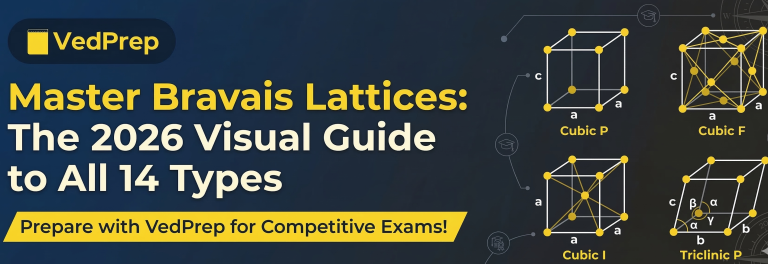

Bravais lattices are the 14 unique infinite arrays of discrete points that describe the periodic arrangement of atoms in a crystal. Defined by translational symmetry and unit cell parameters, these lattices represent every possible symmetrical arrangement in three-dimensional space, forming the mathematical foundation for modern solid state physics and crystallography.
Understanding the Concept of Bravais Lattices
Bravais lattices are the fundamental building blocks of crystallography, representing the only 14 ways points can be arranged in 3D space such that each point looks identical. By combining seven crystal system types with four centerings—primitive, body-centered, face-centered, and base-centered scientists can mathematically categorize every known crystalline solid structure.
In the study of solid state physics, a lattice is not a physical object but a mathematical abstraction. When we talk about Bravais lattices, we are describing the underlying “skeleton” of a crystal. To form a real crystal, a “basis” (an atom or group of atoms) is attached to every lattice point. This distinction is vital for students to master: the lattice provides the geometry, while the basis provides the chemistry.
These 14 configurations are constrained by translational symmetry. This means if you move from one lattice point to another using a specific vector, the environment remains unchanged. Understanding these arrangements allows researchers to predict how materials will react to heat, pressure, and electricity. For competitive exams, mastering these 14 types is the first step toward understanding complex material science and chemical bonding.
The Seven Crystal System Types and Their Geometry
The seven crystal system types cubic, tetragonal, orthorhombic, hexagonal, monoclinic, triclinic, and rhombohedral are defined by their unit cell parameters. These parameters consist of three edge lengths (a, b, c) and three interaxial angles (α, β, γ). The specific relationship between these lengths and angles determines the classification.
The classification begins with the most symmetrical system, the Cubic system, where all sides are equal (a=b=c) and all angles are 90 degrees. As symmetry decreases, we move through the other systems. For example, in the Tetragonal system, one axis length changes (a=b ≠ c), while in the Orthorhombic system, all three lengths are different but the 90-degree angles remain. The Triclinic system is the least symmetrical, with no equal sides and no 90-degree angles.
| Crystal System | Axial Relationships | Angular Relationships | Bravais Lattices |
|---|---|---|---|
| Cubic | a = b = c | α = β = γ = 90° | P, I, F |
| Tetragonal | a = b ≠ c | α = β = γ = 90° | P, I |
| Orthorhombic | a ≠ b ≠ c | α = β = γ = 90° | P, I, F, C |
| Hexagonal | a = b ≠ c | α = β = 90°, γ = 120° | P |
This hierarchy is essential for calculating the atomic packing factor and density of materials. By identifying the crystal system, a student can immediately narrow down the potential Bravais lattices and predict the material’s physical properties.
Exploring Lattice Point Symmetry and Space Groups
Lattice point symmetry refers to the mathematical operations—such as rotation, reflection, and inversion—that leave the lattice unchanged when performed around a specific point. In solid state physics, these symmetry operations define the point group of the lattice, which ensures that every point in the Bravais lattices array remains indistinguishable.
Symmetry is what limits the number of possible lattices to exactly 14. While there are infinitely many ways to draw a shape, there are only 14 ways to arrange points that satisfy translational symmetry in three dimensions. For instance, you cannot have a five-fold rotational symmetry in a 3D lattice because pentagons cannot tile 3D space without leaving gaps. This is a common question in advanced chemistry and physics papers.
When we combine the 14 Bravais lattices with additional symmetry elements like screw axes and glide planes, we derive the 230 Space Groups. However, for most undergraduate competitive exams, focusing on the point symmetry of the 14 primary types is sufficient. Understanding how unit cell parameters relate to these symmetries helps in visualizing 3D crystal structures and solving complex numerical problems involving diffraction and interplanar spacing.
Visualizing 3D Crystal Structures and Unit Cells
3D crystal structures are visualized using the unit cell, which is the smallest repeating portion of a space lattice. In Bravais lattices, these cells are classified as Primitive (P), Body-Centered (I), Face-Centered (F), or Base-Centered (C) based on the specific position of the lattice points within the cell.
Visualizing these structures is often the hardest part for students. A Primitive cell has points only at the corners. A Body-Centered cell adds one point at the very center of the volume. A Face-Centered cell adds points to the center of each of the six faces. These arrangements significantly impact the atomic packing factor, which is the fraction of volume in a crystal structure that is occupied by constituent particles.
For example, in the Cubic system, the Face-Centered Cubic (FCC) lattice has a higher atomic packing factor (0.74) compared to the Simple Cubic (0.52). This means FCC structures, like those found in gold or copper, are more “tightly packed.” When studying Bravais lattices, always try to sketch the 14 types. Seeing the difference between a Monoclinic-P and a Monoclinic-C lattice helps cement the concept of space lattice geometry in your memory.
The Role of Translational Symmetry in Lattice Formation
Translational symmetry is the property where a lattice remains invariant under a translation by a lattice vector. In all 14 Bravais lattices, this symmetry ensures that an observer standing at any lattice point would see the exact same arrangement of surrounding points, extending infinitely in all directions of space lattice geometry.
Without translational symmetry, we wouldn’t have a crystal; we would have an amorphous solid or a quasicrystal. This symmetry is mathematically represented by the vector T = n1a + n2b + n3c, where a, b, and c are primitive translation vectors. This concept is a cornerstone of solid state physics because it allows us to simplify the study of a massive crystal into the study of a single unit cell.
GATE Students often confuse translational symmetry with point symmetry. Remember: point symmetry is about rotating or reflecting around a fixed spot, while translational symmetry is about shifting the entire pattern. In Bravais lattices, these two must work together. The 14 types are the only ones where the translation vectors and the point symmetry are compatible. This compatibility is what defines the unit cell parameters for each specific system.
Calculating Unit Cell Parameters and Miller Indices
Unit cell parameters (a, b, c and α, β, γ) are the physical dimensions that define the shape and size of the unit cell. These parameters are used alongside the Miller indices guide to identify specific planes and directions within Bravais lattices, which is crucial for analyzing X-ray diffraction patterns.
To calculate these parameters, scientists use Bragg’s Law and X-ray crystallography. The Miller indices (h, k, l) provide a shorthand notation for crystal planes. For instance, the (100) plane in a cubic lattice intersects the x-axis but is parallel to the y and z axes. Mastering the Miller indices guide is non-negotiable for students, as it connects the abstract 3D crystal structures to real-world experimental data.
When you know the unit cell parameters, you can calculate the volume of the cell and the density of the material. In Bravais lattices, the interplanar spacing (d) depends entirely on these parameters and the Miller indices. For a cubic system, the formula is simple: d = a / √(h² + k² + l²). This mathematical relationship is a favorite topic for “Level 2” difficulty questions in competitive exams.
Atomic Packing Factor and Density Calculations
The atomic packing factor (APF) is the ratio of the volume of atoms in a unit cell to the total volume of the unit cell. It is a dimensionless number that indicates how efficiently atoms are packed within the various Bravais lattices, directly influencing the density and mechanical strength of 3D crystal structures.
To calculate APF, you must first determine the number of effective atoms per unit cell. For a Simple Cubic lattice, it’s 1; for Body-Centered Cubic (BCC), it’s 2; and for Face-Centered Cubic (FCC), it’s 4. In solid state physics, these numbers are vital for calculating theoretical density using the mass of atoms within the unit cell parameters divided by the total volume.
A high atomic packing factor usually correlates with higher ductility and density. For example, most metals crystallize in FCC or Hexagonal Close-Packed (HCP) arrangements because they represent the most efficient way to store energy and space. Understanding how Bravais lattices dictate the APF allows engineers to select the right materials for high-stress applications.
Common Crystalline Solid Defects in Bravais Lattices
Crystalline solid defects are irregularities in the ideal arrangement of Bravais lattices. No crystal is perfect; atoms may be missing (vacancies), placed in the wrong spot (interstitials), or the lattice planes might be misaligned (dislocations). These defects significantly alter the physical and electrical properties of materials.
In the context of solid state physics, defects are classified by their dimension. Point defects like Schottky and Frenkel defects involve single lattice sites. Linear defects, such as edge or screw dislocations, affect entire rows of atoms. These interruptions in translational symmetry are what allow metals to be hammered into sheets or drawn into wires. Without these defects, materials would be much more brittle.
Students should understand that while Bravais lattices describe the “perfect” state, real-world chemistry is the study of how crystalline solid defects interact with that perfect state. For instance, the color of a gemstone is often caused by a foreign atom occupying a site in the host space lattice geometry.
Case Study: Analyzing Iron’s Phase Transitions
In this practical scenario, we examine Iron (Fe), which demonstrates how a single material can inhabit different Bravais lattices depending on temperature. At room temperature, Iron exists as a Body-Centered Cubic (BCC) lattice, but it transforms into a Face-Centered Cubic (FCC) lattice when heated above 912°C.
This change in 3D crystal structures has massive industrial implications. The FCC structure of Gamma-iron can hold more carbon atoms in its interstitial gaps than the BCC structure. This is the fundamental secret behind the creation of steel. When we quench (rapidly cool) the iron, the carbon gets trapped, creating a strained, hard version of the lattice.
This case study shows that unit cell parameters are dynamic, not static. A student must understand that Bravais lattices can change under external constraints. This transition from BCC to FCC also changes the atomic packing factor from 0.68 to 0.74, causing the material to actually contract slightly as it is heated through the transition zone.
The Contrarian View: Why “Perfect” Lattices Can Be Misleading
A common mistake in educational content is presenting Bravais lattices as the final word on material structure. In reality, the “14 Lattices” model is a simplification that occasionally fails to describe modern nanoscale materials where surface symmetry differs from bulk symmetry.
When a crystal is only a few atoms thick, the translational symmetry is broken in one direction. This creates “Surface Reconstruction,” where the atoms move to new positions to lower their energy. If you rely solely on the standard Miller indices guide or traditional Bravais lattices theory, you will calculate the wrong electronic properties.
Furthermore, the rise of “Amorphous Metals” proves that you can have metallic bonding without any space lattice geometry at all. These materials are often stronger and more corrosion-resistant than their crystalline counterparts. While mastering the 14 lattices is essential for passing exams, a top-tier student must recognize that these are “idealized models.”
Summary and Key Takeaways for 2026 Exams
Mastering Bravais lattices requires a balance of visual imagination and mathematical rigor. By categorizing structures into the seven crystal system types, students can simplify the complex world of atomic arrangements into 14 manageable models that define our understanding of solid matter.
- There are only 14 Bravais lattices due to the constraints of translational symmetry.
- The Miller indices guide is your primary tool for navigating 3D crystal structures.
- Phase transitions prove that lattices are influenced by temperature and pressure.
- Crystalline solid defects are just as important as the lattice itself for determining properties.
As you prepare for your 2026 exams, keep this guide as a reference for the geometrical foundations of solid state physics. The ability to move between a 2D diagram and a 3D lattice concept is what will set you apart.
Learn More :