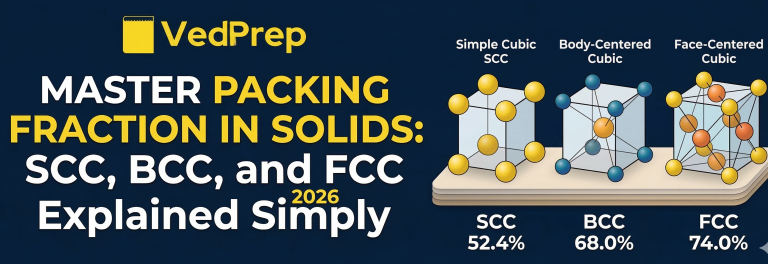

Packing fraction is the ratio of the volume occupied by atoms to the total volume of a unit cell in a crystal lattice. It measures the efficiency of space usage within a solid structure. Calculated as a decimal or percentage, it determines physical properties such as crystal lattice density and stability.
Understanding the Fundamental Concept of Packing Fraction
Packing fraction is a dimensionless value that describes how much of a crystal’s total volume is filled by atoms. It is often referred to as the Atomic Packing Factor (APF) in physics and materials science. This value is essential for understanding how tightly matter is packed, which directly influences the strength and density of a solid material.
In the study of solids, we assume atoms are hard, rigid spheres of a fixed radius (r). These spheres are arranged in repeating patterns called unit cells. However, because spheres cannot fit together perfectly without leaving gaps, some space always remains empty. The packing fraction is the mathematical way of expressing this “fullness.”
To calculate it, we use the formula: Packing Fraction = (Z × Volume of one atom) / Total volume of unit cell, where Z is the number of atoms per unit cell. A higher value indicates a more efficient arrangement, meaning the material has a high space occupancy ratio. Understanding this concept is the first step toward mastering solid-state chemistry and engineering.
Simple Cubic Volume and Efficiency Explained
In a Simple Cubic (SCC) structure, atoms are located only at the eight corners of the cube. Each corner atom is shared by eight adjacent cells, which means only 1/8th of each atom belongs to a single unit cell. This results in an effective total of only one atom per unit cell, leading to a low packing fraction of approximately 0.52.
To find the Simple Cubic Volume and its efficiency, we look at the relationship between the cube’s edge (a) and the atomic radius (r). In an SCC lattice, the spheres touch along the edge, so a = 2r. The total volume of the cube is a³, which equals (2r)³ or 8r³. Since there is only one atom (Z=1), its volume is 4/3πr³.
When we divide the atom’s volume by the total cell volume, we get π/6, which is roughly 0.524. This means that in an SCC arrangement, only 52.4% of the space is occupied. The remaining 47.6% is empty space, which makes this structure very inefficient and unstable. This explains why very few elements, like Polonium, crystallize in this manner.
Atomic Packing Factor in Body-Centered Cubic (BCC) Structures
The Body-Centered Cubic (BCC) structure is more efficient than the simple cubic model. It features atoms at all eight corners and one additional atom resting exactly in the center of the cube. This arrangement increases the number of atoms per unit cell (Z) to two, resulting in a significantly higher packing fraction of 0.68.
In a BCC lattice, the atoms do not touch along the edges. Instead, they touch along the body diagonal of the cube. This means that the body diagonal, which is equal to a√3, is equal to four times the atomic radius (4r). From this, we can find that the edge length a = 4r/√3.
When we calculate the Atomic Packing Factor for BCC, we multiply the volume of two spheres by the inverse of the total unit cell volume. The math results in a value of 0.6802, or 68%. This higher space occupancy ratio makes BCC metals like Iron, Chromium, and Tungsten much stronger and denser than SCC materials. Students should note that even though it is dense, BCC is not considered a “close-packed” structure because it still contains 32% empty space.
Space Occupancy Ratio in Face-Centered Cubic (FCC) Systems
The Face-Centered Cubic (FCC) system represents the most efficient way to pack spheres of equal size. In this structure, atoms are located at the corners and in the center of each of the six faces of the cube. This leads to a total of four atoms per unit cell (Z=4) and a maximum packing fraction of 0.74.
In an FCC lattice, the atoms touch along the face diagonal. The face diagonal length is a√2, which equals 4r. Therefore, the edge length is a = 2√2r. Because there are four atoms, the total volume of atoms is much higher than in SCC or BCC. When we divide this by the total unit cell volume, the result is π / (3√2), which is approximately 0.74.
A packing fraction of 74% is the theoretical limit for any crystal made of identical spheres. This high unit cell efficiency is why FCC metals such as Gold, Silver, Aluminum, and Copper are known for their high crystal lattice density and excellent ductility. FCC and Hexagonal Close Packing share this same maximum efficiency.
Coordination Number Relation to Structural Stability
The Coordination Number Relation describes the number of nearest neighbors surrounding a single atom in a lattice. There is a direct link between this number and the packing efficiency. Generally, as the coordination number increases, the packing efficiency also increases because atoms are squeezed closer together with fewer gaps.
In a Simple Cubic structure, the coordination number is 6. In a BCC structure, it increases to 8. In an FCC structure, each atom is surrounded by 12 others. This jump from 6 to 12 neighbors is what allows the packing fraction to move from 52% to 74%. When atoms have more neighbors, they occupy space more effectively, which minimizes the overall volume of the lattice.
Understanding this relation helps students predict physical properties. Materials with a high coordination number (like 12) tend to be more “closely packed.” This makes them more resistant to external pressure but often more capable of plastic deformation because they have more contact points. This relationship is a cornerstone of crystallography frequently tested in competitive exams.
Understanding FCC Void Space and Its Significance
FCC Void Space refers to the 26% of the volume in a Face-Centered Cubic unit cell that is not occupied by atoms. While 74% of the space is full, the remaining empty space is organized into specific shapes called octahedral and tetrahedral voids. These gaps are critical for determining how other elements interact with the crystal.
Even though FCC is a highly efficient structure, these voids are not useless “nothingness.” In many alloys, smaller atoms (like Carbon) sit inside these FCC void space gaps to change the material’s properties. For example, when Carbon enters the voids of an Iron lattice, it creates Steel. The size and number of these voids are determined entirely by the primary packing fraction of the lattice.
In an FCC unit cell, there are four octahedral voids and eight tetrahedral voids. The octahedral voids are larger and can accommodate bigger guest atoms. If the packing fraction were lower, the voids would be shaped differently, changing how the material forms chemical bonds. By understanding the space occupancy ratio, scientists can design new functional materials like semiconductors and high-strength alloys.
Calculating Crystal Lattice Density from Packing Efficiency
Crystal lattice density is the mass per unit volume of a crystalline solid. It is mathematically tied to the packing fraction because both rely on the number of atoms and the volume of the unit cell. A higher packing fraction generally leads to a higher density, as more mass is packed into the same amount of space.
To calculate the density (ρ) of a unit cell, we use the formula: ρ = (Z × M) / (a³ × Na). In this equation, Z is the number of atoms, M is the molar mass, a³ is the volume, and Na is Avogadro’s number. Since the packing fraction is derived from Z/a³, it serves as the geometric foundation for the material’s density.
For example, if two metals have the same atomic mass, the one with an FCC structure will be denser than one with a BCC structure. This is because the FCC arrangement has a higher space occupancy ratio (74% vs 68%). This knowledge is vital for engineers who need to select materials for weight-sensitive applications, such as aircraft or high-speed trains.
What Competitors Miss: Quick Wins for Students
Most educational blogs like provide standard formulas but fail to connect them to broader concepts like Hexagonal Close Packing (HCP) or thermal effects. To truly master this topic,GATE students should look for the “hidden” details that appear in advanced competitive exam questions to gain a major advantage.
- HCP vs. FCC Comparison: Both have a packing fraction of 0.74, but different stacking patterns (ABAB vs. ABCABC).
- The Z-Value Shortcut: Memorize Z=1, 2, 4 for SCC, BCC, and FCC to save time.
- Void Ratio Formulas: Learn the void ratio (1 – Packing Fraction) for “empty space” questions.
- Thermal Expansion: Real-world temperature changes the edge length (a), altering the effective density.
Why Theoretical Packing Fraction Often Fails in Reality
The theoretical packing fraction is a mathematical ideal that assumes atoms are perfect, rigid spheres. However, real-world materials are rarely perfect. Crystal defects impact the actual efficiency of a solid, meaning measured density is often lower than the theoretical calculation.
One common reason for this failure is the presence of “vacancies”—spots where an atom is missing from the lattice. This reduces the number of atoms (Z) and lowers the real-world packing fraction. Another factor is the “Crystal Defects Impact” caused by dislocations or impurities. If an impurity atom is larger than the host atom, it can distort the entire unit cell.
Furthermore, atoms are not actually hard spheres; they are nuclei surrounded by electron clouds. Under high pressure, these clouds can overlap or deform. This means the 0.74 limit for FCC is only an approximation for real substances. Acknowledging that the packing fraction is a simplified model helps students transition from basic chemistry to advanced materials engineering.
Case Study: Selecting Alloys for Aerospace Components
In aerospace engineering, the packing fraction of a metal is a life-or-death variable. Engineers must select materials that offer maximum strength with minimum weight. Understanding the unit cell efficiency of different alloys is critical for designing components like turbine blades or airframes.
Consider Titanium. At room temperature, it has an HCP structure (0.74). However, when heated, it can shift to a BCC structure (0.68). This shift in the space occupancy ratio causes the metal to expand and changes its mechanical properties. If an engineer doesn’t account for this 6% change in efficiency, the engine parts could fail.
To prevent this, engineers create alloys by adding small amounts of other elements. These additives sit in the FCC void space or BCC gaps to stabilize the structure. Manipulating the packing fraction through alloying ensures the metal stays in its densest, strongest form regardless of temperature.
Summary of Packing Efficiencies in Cubic Systems
A summarized comparison of SCC, BCC, and FCC allows for quick recall during exams. These values represent the foundation of solid-state physics and are essential for calculating material properties like density and volume occupancy in crystal lattices.
| Crystal System | Atoms per Cell (Z) | Edge Length (a) vs Radius (r) | Packing Fraction | Void Space (%) |
|---|---|---|---|---|
| Simple Cubic (SCC) | 1 | a = 2r | 0.524 | 47.6% |
| Body-Centered (BCC) | 2 | a = 4r / √3 | 0.680 | 32.0% |
| Face-Centered (FCC) | 4 | a = 2√2r | 0.740 | 26.0% |