




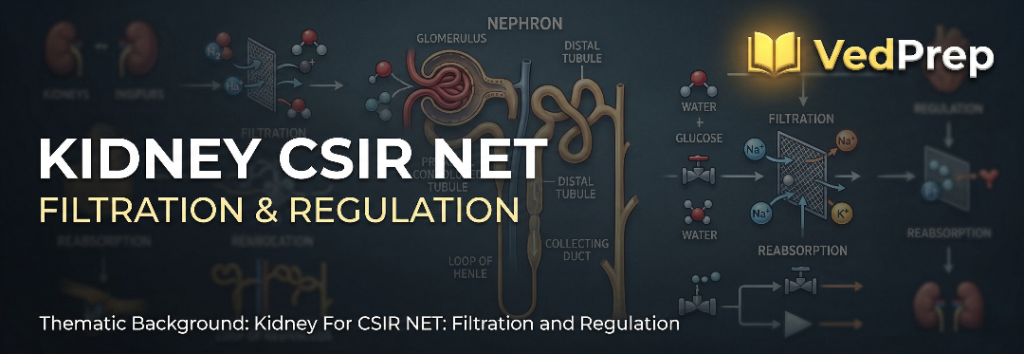

Understanding Kidney For CSIR NET: Structure and Function
Direct Answer: Kidney For CSIR NET involves understanding the structure and function of the kidney, including its blood supply, filtration units, and regulatory mechanisms, to prepare for competitive exams like CSIR NET.
Syllabus: Anatomy and Physiology of Kidney For CSIR NET
This topic belongs to Unit 5: Cell Biology and Physiology of the official CSIR NET syllabus. Understanding the anatomy of the kidney is necessary for CSIR NET, as it the physiological processes that occur within the body.
The anatomy of the kidney includes its structure, vascular supply, and innervation. Knowledge of the vascular supply and innervation is required to comprehend the physiological processes like filtration and reabsorption that occur in the kidney. Standard textbooks like Lehninger Principles of Biochemistry and Berne & Levy Physiology cover these topics in detail.
Students preparing for CSIR NET, IIT JAM, and GATE exams should focus on understanding Kidney For CSIR NET concepts, including the nephron structure, glomerular filtration, and tubular reabsorption and secretion. Key physiological processes like filtration and reabsorption are essential to grasp. Kidney For CSIR NET topics are integral to the syllabus.
Core: Kidney For CSIR NET Structure and Function
The kidney, a vital organ in the human body, consists of two main regions: the renal cortex and renal medulla. The renal cortex, the outer layer, contains the majority of the nephrons, while the renal medulla, the inner layer, is composed of the renal pyramids and the renal columns. The kidney’s structure allows it to perform its primary function of filtering waste and excess fluids from the blood.
The nephrons, often referred to as the functional units of the kidney, maintaining the body’s homeostasis. Each nephron is composed of two main parts: the glomerulus and the renal tubules. The glomerulus, a cluster of blood capillaries, is responsible for the filtration of the blood, allowing small molecules such as water, ions, and glucose to pass through.
The renal tubules, which include the proximal convoluted tubule, loop of Henle, and distal convoluted tubule, facilitate the reabsorption and secretion of substances. The process of reabsorption returns essential nutrients and ions to the bloodstream, while secretion removes waste products. Understanding the structure and function of the kidney, a key concept in Kidney For CSIR NET, is essential for students preparing for competitive exams.
Kidney For CSIR NET: Filtration and Regulation
The kidney maintaining homeostasis in the body. The process of filtration occurs in the glomerulus, a cluster of blood capillaries located in the nephron, the functional unit of the kidney. Here, the blood is filtered to produce a filtrate, which is a fluid that contains water, ions, and small molecules.
The renal tubules, which include the proximal convoluted tubule, loop of Henle, and distal convoluted tubule, regulate the composition of the filtrate. The renal tubules reabsorb essential nutrients and ions back into the bloodstream and secrete waste products and excess ions into the filtrate. This process helps maintain the balance of electrolytes and fluids in the body.
Hormonal regulation also kidney function. Hormones such as aldosterone and antidiuretic hormone (ADH)help regulate the amount of water and ions reabsorbed by the renal tubules. For example, aldosterone stimulates the reabsorption of sodium ions, while ADH regulates water reabsorption. Understanding the kidney’s role in filtration and regulation is essential for students preparing for exams like CSIR NET, IIT JAM, and GATE. Kidney For CSIR NET aspirants should focus on grasping these fundamental concepts. Kidney For CSIR NET is a critical area of study.
Worked Example: Kidney For CSIR NET Question with Solution
A 30-year-old individual has a glomerular filtration rate (GFR) of 120 mL/min. The renal clearance of inulin is 125 mL/min, and that of creatinine is 100 mL/min. If the plasma concentration of creatinine is 1.5 mg/dL, what is the filtered load of creatinine?
The filtered load of a substance is the amount of that substance filtered by the glomeruli per unit time. It can be calculated using the formula: Filtered Load = GFR × Plasma Concentration. Here, the GFR is given as 120 mL/min, and the plasma concentration of creatinine is 1.5 mg/dL.
First, convert the plasma concentration of creatinine to mg/mL: 1.5 mg/dL = 0.015 mg/mL (since 1 dL = 100 mL). The nephron, the functional unit of the kidney, is responsible for filtration, reabsorption, and secretion. The glomerulus within the nephron filters the blood.
Now, calculate the filtered load: Filtered Load = 120 mL/min × 0.015 mg/mL = 1.8 mg/min. Key points to focus on when answering questions on Kidney For CSIR NET include understanding nephron structure and function, and being able to apply formulas related to renal physiology. Kidney For CSIR NET study materials can help with this.
Misconception: Common Errors in Understanding Kidney For CSIR NET
Students often confuse the structure and function of the renal cortex and medulla while preparing for Kidney For CSIR NET. A common misconception is that the renal cortex and medulla have similar functions. However, this is not accurate. The renal cortex, which is the outer layer of the kidney, contains the glomeruli (capillary clusters where filtration occurs) and the proximal and distal convoluted tubules, which are involved in reabsorption and secretion.
In contrast, the renal medulla, the inner layer, primarily consists of the loops of Henle and the collecting ducts, which concentrating or diluting the urine. Understanding the distinct roles of the renal cortex and medulla is essential for grasping kidney function. Kidney For CSIR NET concepts should be clear.
Another misconception arises from confusing filtration and reabsorption. Filtration occurs in the glomeruli, where water, ions, and small molecules are forced out of the blood. Reabsorption, on the other hand, occurs mainly in the proximal convoluted tubule, where most of the filtered substances are returned to the bloodstream. Accurate understanding of these processes is vital for Kidney For CSIR NET and related exams.
The role of hormones in regulating kidney function is also frequently misunderstood. Hormones like antidiuretic hormone (ADH)and aldosterone play critical roles in regulating water and electrolyte balance. ADH, for example, helps regulate water reabsorption in the collecting ducts, affecting urine concentration.
Application: Kidney For CSIR NET in Real-World Scenarios
The kidney maintaining overall health by regulating various bodily functions. One of its primary functions is to control blood pressure and electrolyte balance. The kidney achieves this by adjusting the amount of water and electrolytes, such as sodium and potassium, in the blood. This process is vital for maintaining proper blood pressure and ensuring that muscles and nerves function correctly.
The kidney is also responsible for waste removal and toxin regulation, a critical function for overall health. It filters waste products, such as urea, and excess substances from the blood, which are then excreted in urine. This process helps prevent the buildup of toxins in the body, which can lead to various health problems. The kidney’s ability to regulate waste removal is essential for maintaining proper bodily functions, making Kidney For CSIR NET a vital concept to understand. Kidney For CSIR NET topics are crucial.
In real-world scenarios, the kidney’s functions have significant implications for human health. For instance, individuals with kidney disease or failure may experience electrolyte imbalances, anemia, and bone disease due to the kidney’s inability to regulate waste removal and electrolyte balance. Understanding the kidney’s functions, including its role in blood pressure regulation and waste removal, is crucial for developing effective treatments for kidney-related disorders. Effective management of kidney function is essential for maintaining overall health, highlighting the importance of Kidney For CSIR NET in research and medical applications. Kidney For CSIR NET knowledge is applied here.
Exam Strategy: Tips for Studying Kidney For CSIR NET
Students preparing for CSIR NET, IIT JAM, and GATE exams often find the topic of kidney function challenging. A strategic approach is essential to mastering this topic. The kidney, a vital organ, maintaining homeostasis in the body. Understanding its structure and function is fundamental to answering questions in the exam.
Focus on key subtopics such as nephron structure, glomerular filtration, tubular reabsorption and secretion, and urine formation. These topics are frequently tested and require a thorough understanding of the underlying concepts. Practicing questions on kidney function and regulation is also vital to reinforce knowledge and identify areas that need improvement. Kidney For CSIR NET preparation requires focus.
To aid in memorization, flashcards can be an effective tool. Creating flashcards with key terms and concepts, such as renal corpuscle, proximal convoluted tubule, and antidiuretic hormone, can help students quickly recall important information. VedPrep offers expert guidance and study materials, including video lectures and practice questions, to support students in their preparation for Kidney For CSIR NET and other life science topics. Kidney For CSIR NET study tips are available.
Key Textbooks: Recommended Resources for Kidney For CSIR NET
The topic of Kidney For CSIR NET falls under the unit “Human Physiology” in the official CSIR NET / NTA syllabus. This unit is crucial for understanding various physiological processes in the human body.
For in-depth study, standard textbooks such as Ganong’s Review of Medical Physiology and Guyton and Hall Textbook of Medical Physiology are highly recommended. These textbooks provide comprehensive coverage of human physiology, including the functioning of the kidney.
In addition to these textbooks, online resources like Khan Academy and Crash Course can also be useful for supplementary learning. These resources offer video lectures and interactive content that can help clarify complex concepts.
For CSIR NET preparation, it is essential to focus on recommended study materials that cover the syllabus comprehensively. Some popular study materials include CSIR NET study guides and previous year question papers. A list of recommended textbooks and resources is as follows:
- Ganong’s Review of Medical Physiology
- Guyton and Hall Textbook of Medical Physiology
Kidney For CSIR NET in Relation to Other Systems
The kidney maintaining overall health by interacting with other systems in the body. The nervous system regulates kidney function through the autonomic nervous system, which controls the contraction and relaxation of blood vessels, thereby adjusting blood pressure and flow to the kidneys. The circulatory system also interacts with the kidney, as the kidneys receive approximately 20% of the cardiac output and regulate blood pressure through the renin-angiotensin-aldosterone system. Kidney For CSIR NET is interconnected.
Dysfunction of the kidney can have a significant impact on overall health and disease. For example, chronic kidney disease (CKD) is a condition characterized by a gradual loss of kidney function over time, which can lead to end-stage renal disease(ESRD) and require dialysis or transplantation. Understanding kidney function in relation to other systems is crucial for managing diseases such as hypertension and diabetes mellitus, which are major risk factors for CKD. Kidney For CSIR NET concepts are applied.
The importance of understanding kidney function in relation to other systems cannot be overstated. Homeostasis, the ability of the body to maintain a stable internal environment, is critical for proper bodily functions. The kidney maintaining homeostasis by regulating electrolyte and fluid balance, and acid-base balance. Kidney For CSIR NET aspirants, it is essential to grasp these concepts to appreciate the intricate relationships between different bodily systems. Kidney For CSIR NET knowledge helps in understanding.
Frequently Asked Questions
Core Understanding
What is the primary function of the kidney?
The primary function of the kidney is to filter waste and excess fluids from the blood, regulating electrolyte levels, and maintaining acid-base balance.
What are the main parts of the kidney?
The main parts of the kidney include the renal cortex, renal medulla, renal pelvis, and the nephrons, which are the functional units of the kidney responsible for filtration.
How does the kidney regulate blood pressure?
The kidney regulates blood pressure through the renin-angiotensin-aldosterone system, which involves the release of hormones that control vasoconstriction and fluid balance.
What is the role of the nephron in the kidney?
The nephron is the functional unit of the kidney responsible for filtering waste and excess substances from the blood, and it consists of the glomerulus, proximal convoluted tubule, and distal convoluted tubule.
How does the kidney maintain electrolyte balance?
The kidney maintains electrolyte balance by regulating the levels of ions such as sodium, potassium, and calcium through the process of filtration, reabsorption, and secretion.
What is the excretory system?
The excretory system, also known as the urinary system, is a system of organs that work together to remove waste and excess fluids from the body.
What are the main components of the excretory system?
The main components of the excretory system include the kidneys, ureters, bladder, and urethra, which work together to filter waste and excess fluids from the blood and remove them from the body.
How does the kidney filter waste from the blood?
The kidney filters waste from the blood through the process of glomerular filtration, which involves the passage of small molecules through the glomerular capillaries.
What is the role of the renal pelvis in the kidney?
The renal pelvis is the part of the kidney that collects urine from the calyces and channels it into the ureter, which carries it to the bladder for storage.
What is the role of the nephron in maintaining acid-base balance?
The nephron plays a critical role in maintaining acid-base balance by regulating the levels of ions such as hydrogen and bicarbonate through the process of filtration, reabsorption, and secretion.
Exam Application
How does the kidney’s function relate to CSIR NET questions?
The kidney’s function is a critical topic in CSIR NET, as it is a key aspect of System Physiology – Animal, and questions often focus on its role in maintaining homeostasis and responding to disease.
What type of questions can be expected on kidney function in CSIR NET?
CSIR NET questions on kidney function may include topics such as the structure and function of nephrons, renal blood flow, and the regulation of electrolyte balance.
How does System Physiology – Animal relate to the excretory system?
System Physiology – Animal is a field of study that focuses on the physiological processes that occur in animals, including the excretory system, which plays a critical role in maintaining homeostasis.
How does the excretory system relate to disease?
The excretory system plays a critical role in responding to disease, as changes in kidney function can have significant effects on the body’s ability to regulate electrolyte balance and remove waste.
How does the kidney’s function relate to environmental factors?
The kidney’s function can be affected by environmental factors such as changes in temperature, humidity, and exposure to toxins, which can impact its ability to regulate electrolyte balance and remove waste.
Common Mistakes
What is a common mistake made when studying kidney function?
A common mistake made when studying kidney function is confusing the roles of the different parts of the nephron, such as the proximal and distal convoluted tubules.
How can students avoid mistakes when answering kidney-related questions?
Students can avoid mistakes by thoroughly understanding the structure and function of the kidney, and by practicing questions that test their knowledge of kidney physiology.
What is a common mistake made when studying the excretory system?
A common mistake made when studying the excretory system is confusing the roles of the different organs, such as the kidneys and the liver.
What is a common mistake made when studying System Physiology – Animal?
A common mistake made when studying System Physiology – Animal is confusing the different physiological processes that occur in animals, such as the excretory and digestive systems.
Advanced Concepts
What are some advanced topics related to kidney function?
Advanced topics related to kidney function include the molecular mechanisms of ion transport in the nephron, and the role of the kidney in regulating blood pressure through the renin-angiotensin-aldosterone system.
How does the kidney adapt to changes in blood volume?
The kidney adapts to changes in blood volume through changes in renal blood flow and glomerular filtration rate, which are mediated by the renin-angiotensin-aldosterone system.
What are some advanced topics related to the excretory system?
Advanced topics related to the excretory system include the molecular mechanisms of ion transport in the nephron, and the role of the excretory system in regulating blood pressure.
What are some advanced topics related to System Physiology – Animal?
Advanced topics related to System Physiology – Animal include the molecular mechanisms of physiological processes, and the role of different systems in maintaining homeostasis.
https://www.youtube.com/watch?v=1rW3pYkzMHQ