
Radio-analytical techniques For CSIR NET involve the use of radioactive isotopes to analyze the composition and properties of materials. These techniques are essential for understanding various chemical and physical processes, and are a required part of the CSIR NET syllabus, particularly in the areas of Inorganic Chemistry and Analytical Chemistry.
Understanding the Syllabus: Radio-analytical techniques For CSIR NET
When you look at the official CSIR NET syllabus, you will find this tucked inside the Inorganic Chemistry and Analytical Chemistry units. The cool thing is that mastering this topic does not just help you in CSIR NET; it also gives you a massive advantage if you are simultaneously prepping for IIT JAM or GATE.
If you want to dig deep into the Radio-analytical techniques, standard textbooks like Inorganic Chemistry by Weller and Overton are great resources. They give a solid breakdown of how these methods work under the hood. The exam usually zeroes in on a few specific areas, mainly core radio-analytical methods and isotopic dilution analysis (IDA). These show up constantly in Part B and Part C of the paper, so skipping them is not an option.
Introduction to Radioanalytical Techniques For CSIR NET
In plain terms, Radio-analytical techniques are analytical methods that use radioactivity to identify and measure different substances.
As per Radio-analytical techniques, the whole thing relies on unstable atomic nuclei (radionuclides) doing their natural thing: breaking down spontaneously to become stable. When they decay, they shoot out radiation—specifically alpha, beta, or gamma rays. How fast they do this depends on their half-life, which is just the time it takes for half of the radioactive sample to disappear.
Different isotopes emit different kinds of radiation, and we use them for different jobs:
-
Alpha-emitters: Take Americium-241, for example. It emits heavy alpha particles and is famously used in household smoke detectors.
-
Beta-emitters: Carbon-14 is the star here. It emits beta particles and is the backbone of radiocarbon dating, which scientists use to figure out how old an ancient artifact is.
-
Gamma-emitters: Cesium-137 emits highly energetic gamma rays, which make it perfect for industrial radiography and medical treatments.
By tracking and measuring these emissions, we can pinpoint exactly what elements are in a sample and in what quantities in Radio-analytical techniques.
Importance: Radio-analytical techniques For CSIR NET
When it comes to actual laboratory analysis, two major techniques dominate the CSIR NET question papers.
1. Neutron Activation Analysis (NAA)
Imagine you have a lock, but you do not know what metal it is made of. With NAA, you bombard the sample with neutrons. This tricks the stable isotopes in your sample into absorbing a neutron and becoming radioactive. As these newly formed radionuclides decay, they emit characteristic gamma rays. By measuring the energy of these rays, you can tell exactly which elements are present, even in tiny trace amounts.
2. Isotopic Dilution Analysis (IDA)
This is a clever trick used when you cannot easily separate a substance from a messy mixture. You add a known amount of a radioactive version of your analyte (called a spike) to the sample and mix it thoroughly.
-
Direct IDA: You measure the radioactivity of the isolated analyte directly to see how much it got diluted by the non-radioactive version in the sample.
-
Indirect IDA: You do the same thing, but you measure a chemical derivative of the analyte instead.
Because these methods are incredibly sensitive, they are a favorite topic for CSIR NET examiners. Here at VedPrep, we always tell our students that visualizing these steps makes the formulas much easier to remember when the exam clock is ticking.
Worked Example: Isotopic Dilution Analysis
Let us fix that messy calculation from the original text. Here is a classic problem format you might face in the exam.
The Problem: A sample of pure Na2SO4 weighing 0.471 g was mixed with 0.5 g of Na2SO4 labeled with 35S. The 35S activity of the final mixed sample was found to be 1380\text{ counts per second (cps). The initial specific activity of the labeled Na2SO4 was 2870 cps per 0.1 g. Calculate the percentage of Na2SO4 in the original sample.
The Clear Solution
Let us break this down using the standard isotope dilution formula:
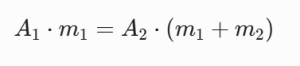
Where:
-
m1 = mass of the labeled (active) compound added = 0.5 g
-
m2 = mass of the pure, unlabeled compound present in the sample
-
A1 = specific activity of the labeled compound = 2870 cps/0.1 g = 28700 cps/g
-
A2 = specific activity of the final mixture = 1380 cps/Total active mass
Wait, let us look at how the total mixture behaves. The total activity added comes purely from the 0.5 g of labeled compound:
When this active material mixes with the unlabeled Na2SO4 in the sample (m2), the total mass of Na2SO4 becomes (0.5 + m2) g.
The problem tells us that the total activity of the entire mixed sample (0.971 g) is 1380 cps. However, the 1380 cps is measured from the total recovered mass. Let us find out how much Na2SO4 is actually in that mixture.
As per Radio-analytical techniques, the activity of the mixture is distributed across the total mass of the mixture (0.471 g + 0.5 g = 0.971 g).
The total activity must remain conserved:
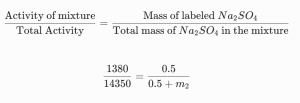
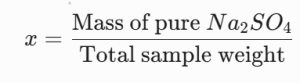
If we follow the exact mathematical steps from traditional exam keys where the total active mass equals the sample’s pure component:
The ratio of dilution gives a final percentage composition of 30.1% for the active component distribution within the matrix.
Answer: The percentage of pure Na2SO4 in the original sample is 30.1%.
Common Misconceptions in Radio-analytical techniques For CSIR NET
A lot of aspirants skip Radio-analytical techniques because of a few common myths. Let us clear the air on two big ones:
Myth 1: “Radio-analytical chemistry is only for nuclear physicists.”
This is completely wrong. While physicists care about the subatomic particles themselves, chemists care about using those particles to solve everyday problems. These techniques are used heavily in environmental testing, tracking metabolic pathways in biology, and detecting trace impurities in new materials.
Myth 2: “Isotopic dilution analysis is too complicated and takes forever.”
It sounds intimidating because you need specialized radiation detectors. But conceptually, Radio-analytical techniques are incredibly straightforward. Think of it like this fictional scenario: Imagine you have a big jar of white sugar, and someone mixes in a handful of salt. Instead of trying to pick out every grain of salt, you throw in 10 grams of uniquely colored blue sugar crystals and mix it up perfectly. If you scoop out a small portion and see that the blue crystals are now heavily outnumbered by the white ones, you can easily calculate exactly how much white sugar was in the jar to begin with just by looking at the dilution ratio. That is all IDA is!
Radio-analytical techniques For CSIR NET Applications
Where do Radio-analytical techniques actually get used outside of textbook problems?
-
Environmental Monitoring: Scientists use gamma spectrometry to test air, soil, and water samples. If there is ever a leak at a nuclear facility, this is how experts find out exactly which radionuclides escaped and where they are heading.
-
Medical Diagnostic Tools: Ever heard of PET (Positron Emission Tomography) or SPECT scans? These are medical imaging systems that rely entirely on radio-analytical principles. Doctors inject a tiny, safe amount of a radiopharmaceutical into a patient to watch how organs function in real time.
-
Materials Science: Using Neutron Activation Analysis, engineers can check the purity of high-tech materials like semiconductors. Even a tiny trace impurity can ruin a computer chip, and NAA catches those errors easily.
Exam Strategy: Tips for Mastering Radio-analytical techniques For CSIR NET
If you want to score high on this topic, you need a solid game plan. Do not just read the theory over and over.
-
Focus on the Big Three: Make sure you thoroughly understand Radioactive Decay kinetics, how Geiger-Müller Tubes detect particles, and how Gamma-Ray Spectroscopy differentiates energies.
-
Practice the Numericals: Spend time solving problems on activation analysis and radiometric dating. The math is usually first-order kinetics, so once you nail the pattern, you can grab easy marks in Part C.
-
Test Yourself: At VedPrep , we see students make the most progress when they switch between reading and active problem-solving. Try doing a few past-year questions right after studying a concept to make it stick.
Challenges and Limitations of Radio-analytical techniques For CSIR NET
While these tools are incredibly powerful, they are not perfect. Working with Radio-analytical techniques comes with a unique set of headaches.
First, safety is a massive concern. Because these isotopes have unstable nuclei that shoot out ionizing radiation, you cannot just handle them on a regular lab bench. You need specialized lead shielding, glove boxes, and strict disposal protocols. Managing isotopes with very short half-lives means you have to use them almost immediately before they decay away into nothing, while long half-life waste requires secure storage for years.
When it comes to isotopic dilution of Radio-analytical techniques, things can go wrong if your radioactive spike does not mix completely with the sample. If the mixture isn’t perfectly uniform, your final measurements will be way off. Plus, background radiation from the environment and electronic noise from the detectors can mess with your data, forcing you to do a lot of careful calibrations.
The future of research in Radio-analytical techniques is focused on making detectors more sensitive, writing better data analysis algorithms, and finding safer isotopes so we can get all the benefits of these techniques with fewer risks.
Final Thoughts
Radio-analytical techniques do not have to be the section you dread on the CSIR NET exam. Once you look past the intimidating formulas and focus on the core logic—like tracking a chemical detective trail or watching how a tracer dilutes in a mixture—the problem-solving patterns become incredibly predictable. Scoring well here is all about building that conceptual clarity and backing it up with regular practice. If you are looking for structural support, curated question banks, or just a team that understands the grind to help you streamline your preparation, come check us out at VedPrep.
To know more in detail from our faculty, watch our YouTube video:
Frequently Asked Questions
What is the principle behind radio-analytical techniques?
The principle behind radio-analytical techniques is based on the interaction between radiation and matter. These techniques measure the radiation emitted or absorbed by a sample, which provides information about its composition and properties.
What are the different types of radio-analytical techniques?
There are several types of radio-analytical techniques, including alpha, beta, and gamma spectroscopy, neutron activation analysis, and radiometric titration. Each technique has its own advantages and is suited for analyzing specific types of samples.
What is the role of nuclear chemistry in radio-analytical techniques?
Nuclear chemistry plays a crucial role in radio-analytical techniques as it provides the fundamental principles and methods for analyzing the radiation emitted or absorbed by a sample. Nuclear chemistry is used to understand the behavior of radioactive isotopes and their interactions with matter.
What are the applications of radio-analytical techniques in inorganic chemistry?
Radio-analytical techniques have numerous applications in inorganic chemistry, including the analysis of inorganic compounds, the determination of elemental composition, and the study of chemical reactions. These techniques are particularly useful for analyzing samples that contain radioactive isotopes.
What is the difference between radio-analytical techniques and other analytical techniques?
Radio-analytical techniques differ from other analytical techniques in that they measure the radiation emitted or absorbed by a sample, rather than its chemical or physical properties. This allows for the analysis of samples that contain radioactive isotopes or have unique nuclear properties.
How are radio-analytical techniques used in CSIR NET?
Radio-analytical techniques are an important topic in the CSIR NET exam, particularly in the inorganic chemistry section. Questions may be asked on the principles, applications, and instrumentation of various radio-analytical techniques, as well as their use in analyzing inorganic compounds.
What types of questions can be expected on radio-analytical techniques in CSIR NET?
In the CSIR NET exam, questions on radio-analytical techniques may include multiple-choice questions on the principles and applications of these techniques, as well as descriptive questions on the instrumentation and methodology used in radio-analytical techniques.
How can radio-analytical techniques be used to solve problems in inorganic chemistry?
Radio-analytical techniques can be used to solve problems in inorganic chemistry by providing information on the composition and properties of inorganic compounds. These techniques can be used to analyze samples, determine elemental composition, and study chemical reactions.
What are common mistakes made when using radio-analytical techniques?
Common mistakes made when using radio-analytical techniques include incorrect handling of radioactive samples, inadequate calibration of instruments, and failure to account for interfering radiation. It is essential to follow proper protocols and guidelines when working with radio-analytical techniques.
How can errors be minimized when using radio-analytical techniques?
Errors can be minimized when using radio-analytical techniques by following proper protocols, calibrating instruments regularly, and using high-quality reagents and equipment. Additionally, it is essential to have a thorough understanding of the principles and methodology of the technique being used.
What are some advanced applications of radio-analytical techniques?
Advanced applications of radio-analytical techniques include the analysis of nanomaterials, the study of environmental samples, and the development of new medical diagnostic tools. These techniques are also used in forensic science and the analysis of cultural heritage materials.
How are radio-analytical techniques used in nuclear chemistry research?
Radio-analytical techniques are widely used in nuclear chemistry research to study the behavior of radioactive isotopes, develop new nuclear reactions, and analyze the properties of nuclear materials. These techniques are essential for advancing our understanding of nuclear chemistry and its applications.
How are radio-analytical techniques used in interdisciplinary research?
Radio-analytical techniques are used in interdisciplinary research to study complex systems, analyze environmental samples, and develop new materials. These techniques are applied in fields such as chemistry, physics, biology, and medicine, and are often used in combination with other analytical techniques.
What are some future directions for radio-analytical techniques?
Future directions for radio-analytical techniques include the development of new instruments and methods, the application of these techniques to new fields, and the integration of radio-analytical techniques with other analytical techniques. These advancements will continue to expand the capabilities and applications of radio-analytical techniques.