

Allopatricity and Sympatricity For CSIR NET refer to the processes of speciation that occur when geographic barriers separate or bring together species, influencing their evolution and diversity.
Syllabus – CSIR NET Life Science: Speciation and Evolution – Allopatricity and Sympatricity For CSIR NET
If you are flipping through the Unit 11 (Evolution and Behavior) pages of CSIR NET Life Science syllabus, you know how heavily the examiners love to test you on how new species actually come into being. We are talking about speciation. Specifically, the two big heavyweights: allopatricity and sympatricity.
Here at VedPrep, we know that tackling evolutionary biology can sometimes feel like memorizing a bunch of dry definitions. But when you break it down, it is basically just nature’s drama unfolding over thousands of years. Let’s make sense of these mechanisms so you can easily bag those Part B and Part C marks.
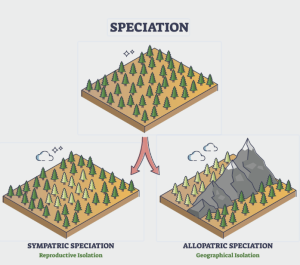
In the official CSIR NET Life Science syllabus, these topics such as Allopatricity and Sympatricity sit firmly within the evolution section. While standard textbooks like Evolution by Douglas Futuyma or Principles of Evolution by Maynard Smith are great for deep dives, you do not need to drown in academic jargon to get the core ideas straight.
Allopatricity and Sympatricity For CSIR NET: A Core Concept
Let’s break these two down clearly:
-
Allopatric speciation happens when a physical, geographic barrier steps in and forces a population to split up. Think of mountains, rising sea levels, grand canyons, or rivers. Because they are physically separated, the two groups cannot hang out or share genes anymore. They accumulate mutations independently, face different selective pressures, and eventually become completely different species.
-
Sympatric speciation is a bit more dramatic. It happens right under the same roof. New species evolve from a single ancestral species while living in the exact same geographic area, completely free of physical barriers.
As per Allopatricity and Sympatricity, both of these pathways are major drivers behind the biodiversity we see on Earth today.
Worked Example: Allopatricity and Sympatricity For CSIR NET – A Closer Look
Practice Question: A population of Drosophila is divided into two groups by a sudden geological shift that creates a massive mountain range. Over many generations, the two groups face different environmental conditions and eventually evolve into distinct species that can no longer interbreed. This is an example of:
-
Allopatric speciation
-
Sympatric speciation
-
Parapatric speciation
-
None of the above
The correct answer is 1. Allopatric speciation. Why? Because the mountain range acts as a textbook geographic barrier. It completely cuts off gene flow between the two groups, leaving them to go their separate evolutionary ways.
Quick Reference Summary
| Speciation Type | Is there a Geographic Barrier? | Main Driver of Isolation |
| Allopatric | Yes | Physical separation (rivers, mountains, islands) |
| Sympatric | No | Behavioral shifts, niche partitioning, polyploidy |
Misconception: Common Confusion Between Allopatricity and Sympatricity
A common trap that many aspirants fall into during the exam is thinking that geographic isolation is the only thing that matters for both concepts, or that individuals in a sympatric zone always mate with each other because they live together.
That is not how Allopatricity and Sympatricity works. While allopatricity relies entirely on physical distance and barriers, sympatricity proves that biology can create its own walls. Even if two groups of insects live on the exact same tree, they can stop mating if one group decides to only hang out on the top branches and the other stays at the roots. Sympatric populations achieve genetic isolation through internal shifts—like changes in chromosomes (polyploidy) or different mating preferences—even though they share the same zip code.
Application: Real-World Examples
To really lock these concepts into your brain, let’s look at how this plays out in the real world.
For sympatric speciation, a great example involves certain fruit-eating maggots and flies. Imagine a fictional scenario to make this vivid:
Let’s picture a single orchard where a group of flies originally feeds only on hawthorn berries. Now, say someone introduces apple trees to that same orchard. A few rogue flies try the apples and decide they love them. Because apples ripen at a different time of year than hawthorn berries, the “apple flies” start waking up, feeding, and mating at a completely different time than the “hawthorn flies.” Even though they fly around the same orchard, they completely stop crossing paths during mating season. Give it enough time, and they split into two separate species.
In the lab, researchers use fast-replicating models like yeast or bacteria to watch these exact isolation mechanisms happen in real-time under controlled conditions.
Exam Strategy: Tips for Mastering Allopatricity
When you are prepping for Unit 11, do not just memorize definitions. Focus heavily on the mechanisms of reproductive isolation.
CSIR NET loves asking experimental or graphical questions in Part C. They might show you a graph of gene flow or a map of species distribution and ask you to identify the speciation type.
-
Look for keywords like glacier, mountain formation, or river diversion to instantly spot allopatric setups.
-
Look for keywords like host shift, behavioral mutation, or chromosome doubling (polyploidy) to spot sympatric setups.
We recommend sketching out quick evolutionary trees while studying to keep the pathways clear in your head.
Key Textbooks for Allopatricity and Sympatricity
If you want to look at the foundational charts and classic case studies, you can check out these books:
-
Evolution by Douglas Futuyma (excellent for understanding the genetic basis of isolation).
-
Principles of Evolution by John Maynard Smith (great for the mathematical and theoretical side of evolutionary shifts).
Allopatricity and Sympatricity For CSIR NET: Implications for Evolutionary Biology
Why do evolutionary biologists care so much about this? Because these mechanisms explain how a single branch on the tree of life explodes into thousands of new ones—a process called adaptive radiation.
When allopatric speciation happens, it often opens up brand-new environments for a species to colonize and conquer. When sympatric speciation happens, it allows multiple species to pack into the exact same ecosystem without driving each other extinct, because they learn to occupy different, highly specific ecological niches. It is nature’s way of maximizing efficiency and diversity.
Allopatricity and Sympatricity For CSIR NET – Practice Questions
Let’s try one more question to see if you can spot the nuance.
Practice Question: Two species of birds live in the exact same forest patch. However, Species A sings its mating song at dawn from the high canopy, while Species B sings its mating song at dusk close to the forest floor. Because of this, they never cross-mate. What type of speciation does this setup represent?
-
(A) Allopatric speciation
-
(B) Sympatric speciation
-
(C) Parapatric speciation
-
(D) Peripatric speciation
Solution: Since the birds live in the exact same geographic region (the same forest patch) and are isolated purely by behavioral and timing differences rather than a physical barrier, this is a clear case of (B) Sympatric speciation.
Final Thoughts
Mastering the balance between allopatric and sympatric mechanisms gives you a major advantage when dealing with evolutionary biology questions on the exam.
If you ever feel overwhelmed by the sheer volume of the CSIR NET life sciences syllabus, just take it one concept at a time. Here at VedPrep , we are always around to help you break down complex pathways, share smart study strategies, and give you the right practice questions so you can head into the exam hall with total confidence.
With VedPrep, students can access in-depth lectures, practice questions, and mock tests to assess their knowledge and identify areas for improvement in Allopatricity and Sympatricity For CSIR NET.
To know more in detail from our faculty, watch our YouTube video:
Frequently Asked Questions
What is sympatric speciation?
Sympatric speciation occurs when a new species emerges from a population without geographic isolation. This type of speciation is often driven by genetic differences, such as polyploidy, or by ecological specialization.
What is the main difference between allopatric and sympatric speciation?
The main difference between allopatric and sympatric speciation is the presence or absence of geographic isolation. Allopatric speciation requires physical barriers, while sympatric speciation does not.
What are the mechanisms of allopatric speciation?
The mechanisms of allopatric speciation include genetic drift, mutation, and selection, which act on isolated populations to drive genetic divergence.
What are the mechanisms of sympatric speciation?
The mechanisms of sympatric speciation include genetic differences, such as polyploidy, and ecological specialization, which allow new species to emerge without geographic isolation.
How do allopatric and sympatric speciation relate to evolution?
Allopatric and sympatric speciation are both key mechanisms of evolution, as they allow for the formation of new species and the diversification of life on Earth.
What is the relationship between allopatricity and sympatricity and behavior?
Allopatricity and sympatricity can influence behavior, as geographic isolation or sympatry can lead to differences in behavior and ecology.
What are the key factors that influence allopatric and sympatric speciation?
Key factors include geographic isolation, genetic differences, ecological specialization, and behavior.
How is allopatric speciation relevant to the CSIR NET exam?
Allopatric speciation is a key concept in evolutionary biology and is frequently tested in the CSIR NET exam. Understanding the mechanisms and examples of allopatric speciation is crucial for success.
What are some examples of sympatric speciation?
Examples of sympatric speciation include the emergence of new species of cichlid fish in African lakes and the formation of new species of plants through polyploidy.
What is a common mistake when understanding allopatric speciation?
A common mistake is to confuse allopatric speciation with sympatric speciation. Allopatric speciation requires geographic isolation, while sympatric speciation does not.
What is a common mistake when understanding sympatric speciation?
A common mistake is to assume that sympatric speciation is not a valid mechanism of speciation. However, sympatric speciation is a well-documented process that has been observed in many species.
What is the role of behavior in allopatric and sympatric speciation?
Behavior plays a crucial role in both allopatric and sympatric speciation. Behavioral differences can lead to reproductive isolation and the formation of new species.
What are the implications of allopatric and sympatric speciation for conservation biology?
Understanding allopatric and sympatric speciation has important implications for conservation biology, as it can inform strategies for preserving biodiversity and preventing extinctions.
What are some recent advances in the study of allopatric and sympatric speciation?
Recent advances include the use of genomic and phylogenetic approaches to study speciation, as well as the integration of insights from ecology, behavior, and conservation biology.