



CSIR NET Physical Sciences syllabus is designed for postgraduate students aiming to build a career in scientific research or academia. It covers all major areas of physics, both theoretical and applied, that form the foundation for advanced studies and research. The syllabus ensures candidates are tested on their conceptual understanding, analytical skills, and research aptitude, making it a comprehensive guide for preparing for one of India’s most important national-level exams in Physical Sciences.
CSIR NET Physical Sciences Syllabus Overview
CSIR NET Physical Sciences syllabus covers all major theoretical and applied areas of physics that a postgraduate student is expected to master.
This year, the examination is scheduled for 18th December 2025, and will be held in fully computer-based test (CBT) mode across various centre in India.
The Physical Sciences syllabus for CSIR NET 2025 covers all major theoretical and applied areas of physics that a postgraduate student is expected to master. The exam is divided into three sections:CSIR NET previous year question
- Part A tests general aptitude and analytical ability,
- Part B evaluates fundamental concepts in physics,
- Part C focuses on advanced, application-oriented problems designed to assess research aptitude.
Some of the key subjects included in the syllabus are Mathematical Methods, Classical Mechanics, Electromagnetic Theory, Quantum Mechanics, Thermodynamics, Statistical Physics, Electronics, Nuclear & Particle Physics, and Solid State Physics. A strong command over high-weightage topics and conceptual clarity is essential for scoring well.Click here to download CSIR NET Previous Year Question Papers PDF.
CSIR NET Physical Sciences syllabus of Exam Highlights
Below is a clear and comprehensive overview of the CSIR NET Physical Science Exam
| Particular | Details |
| Exam Name | CSIR NET December 2025 |
| Conducting Body | National Testing Agency (NTA) |
| Frequency of Exam | Twice a year (June & December) |
| Fellowship Duration | 5 Years |
| Age Limit (JRF) | 28 years |
| Age Relaxation | – 5 years: SC/ST/PH & Female Candidates – 3 years: OBC (Non-Creamy Layer) |
| Exam Mode | Online (Computer-Based Test) |
| CSIR NET 2025 Exam Date | 18th December 2025 |
| Exam Duration | 180 Minutes |
| Question Type | Multiple Choice Questions (MCQs) |
| Total Marks | 200 Marks |
| Negative Marking | – Part A: 0.5 – Part B: 0.875 – Part C: 1.25 |
| Language of Paper | English & Hindi |
| Official Website | csir.nta.nic.in |
Also read – CSIR NET 2025: Application Form, Exam Date, Eligibility, Pattern
CSIR NET Physical Science Syllabus PDF
The CSIR NET Physical Science Syllabus 2025 PDF is an essential study resource for candidates preparing for the exam. The PDF includes all important topics, units, and sub-sections that aspirants need to cover for effective preparation. Having the syllabus in a downloadable format ensures that students can access it anytime—whether they are studying online or revising offline.
Candidates can easily download the CSIR NET Physical Science Syllabus 2025 PDF from the link provided below and use it to plan their preparation in a structured and efficient manner.
Download CSIR NET Physical Science Syllabus PDF – (Download PDF)
The official CSIR NET 2025 syllabus PDF for all subjects (including General Aptitude – Part A, Life Sciences, Mathematical Sciences, Chemical Sciences, Physical Sciences, and Earth Sciences) can be downloaded directly from the link given below or the NTA or CSIR HRDG websites.
| CSIR NET Syllabus PDF | |
| Subjects | Download Link |
| CSIR NET Syllabus Life Sciences | Download PDF |
| CSIR NET Syllabus Mathematical Sciences | Download PDF |
| CSIR NET Syllabus Chemical Sciences | Download PDF |
| CSIR NET Syllabus Earth Sciences | Download PDF |
CSIR NET Physical Science Unit-Wise Syllabus
The CSIR NET Physical Science syllabus is systematically divided into units to help aspirants focus on each topic in a structured way. The syllabus covers both core concepts and advanced areas of Physics, ensuring that candidates develop a strong theoretical foundation along with analytical and problem-solving skills.
To make preparation easier, here is the unit-wise syllabus for CSIR NET Physical Science 2025:
CSIR NET Physical Science Unit-Wise Syllabus
Part A – Core Topics
These units cover the fundamental principles of Physics that form the base of the examination:
- Mathematical Methods of Physics
- Classical Mechanics
- Electromagnetic Theory
- Quantum Mechanics
- Thermodynamics and Statistical Physics
- Electronics and Experimental Methods
Part B – Advanced Topics
Part B expands into deeper and more specialized areas of Physics, testing a candidate’s advanced understanding and analytical abilities:
- Mathematical Methods of Physics
- Classical Mechanics
- Electromagnetic Theory
- Quantum Mechanics
- Thermodynamics and Statistical Physics
- Electronics and Experimental Methods
- Atomic & Molecular Physics
Condensed Matter Physics - Nuclear and Particle Physics
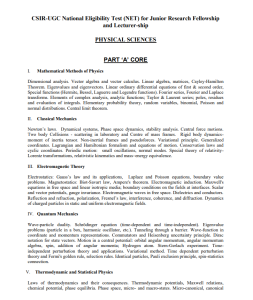
CSIR NET Physical Science Unit-Wise Micro Syllabus
CSIR NET Physical Science Unit-Wise Micro Syllabus breaks down the entire syllabus into concise, focused topics for each unit, enabling candidates to prepare effectively and target high-weightage areas for maximum scoring potential.
CSIR NET Physical Science Exam Pattern
Understanding the exam pattern is crucial for candidates preparing for the CSIR NET Physical Science Exam, as it helps in planning the right strategy and managing time effectively during the test. The exam consists of a single paper divided into three parts Part A, Part B, and Part C. Each section carries different marks and has its own marking scheme.
CSIR NET Physical Science Exam Pattern Section-wise Details
| Section | Part A | Part B | Part C | Total |
| Total Questions | 20 | 25 | 30 | 75 |
| Maximum Questions to Attempt | 15 | 20 | 20 | 55 |
| Marks for Each Correct Answer | 2 | 3.5 | 5 | — |
| Negative Marking (Per Wrong Answer) | 0.5 | 0.875 | 1.25 | — |
| Total Marks | — | — | — | 200 |
CSIR NET Physical Science Exam Preparation Tips
Preparing for the CSIR NET Physical Science Exam requires a smart approach and consistent effort. With the right strategy and clear understanding of the syllabus, candidates can improve their chances of securing a good score. Here are some simple and practical preparation tips to help you stay on track:
Understand the Complete Syllabus
- Start by going through the entire syllabus thoroughly. Break each unit into smaller sub-topics and identify the areas that carry higher weightage. This will help you prioritize your preparation effectively.
Create a Realistic Study Plan
- Design a study timetable based on the time available before the exam. Allocate more hours to challenging topics and ensure you keep enough time for revision. A well-structured plan keeps you disciplined and focused.
Focus on High-Weightage Topics
- Give special attention to important subjects such as Mathematical Methods, Classical Mechanics, Electromagnetic Theory, Quantum Mechanics, and Statistical Physics. Mastering these areas can significantly boost your overall score.
Practice Regularly
- Solving practice questions and previous years’ papers helps you understand the question pattern and improves your speed and accuracy. Regular practice is essential for building confidence.
Take Mock Test
- Mock tests simulate the actual exam environment. They help you learn time management, identify weak areas, and develop a better exam strategy. Make mock tests a weekly habit.
Revise Consistently
- Revision is the key to retaining what you’ve studied. Prepare short notes or formula sheets and revise them frequently. These quick notes become extremely helpful during the final days of preparation.
Improve General Aptitude
- For Part A, stay updated with general knowledge, basic mathematics, logical reasoning, and everyday scientific developments. This section can help you score easy marks.
Seek Help When Needed
- If any concept feels confusing, don’t hesitate to ask for help. Discuss doubts with teachers, join online study groups, or watch reliable video lectures to strengthen your understanding.
Manage Your Time Wisely
- Time management can make a big difference in your performance. Divide your time wisely among the three parts and attempt the easier questions first to ensure maximum accuracy.