
Separation techniques (Chromatography) For CSIR NET involve the use of various methods to separate and analyze the components of a mixture, which is a critical aspect of analytical chemistry.
Syllabus: Analytical Chemistry: Chromatography
Preparing for the CSIR NET exam can feel like trying to drink water from a fire hose, especially when you hit Unit 4’s analytical chemistry section. But don’t worry, we are going to break down one of its biggest heavy hitters: chromatography. Whether you are aiming for CSIR NET, IIT JAM, CUET PG, or GATE, mastering these separation techniques is non-negotiable.
At its core, chromatography is just a fancy way of separating, identifying, and measuring the different parts of a mixture. It is used everywhere, from testing life-saving drugs in pharma labs to checking food safety.
If you want to dig super deep into the theory, standard textbooks like Analytical Chemistry by S. Chand or the IIT Delhi notes are great resources. Here at VedPrep, we love making these dense topics much easier to swallow so you can save your brainpower for the actual exam.
Separation techniques (Chromatography) For CSIR NET: An Overview
Let’s strip away the textbook jargon for a second. Imagine you throw a party and invite two types of friends: the introverts who love to sit on the couch and chat, and the extroverts who immediately run to the dance floor. If you open the back door to the backyard, the extroverts will zip right through to the next spot, while the introverts will linger on the couch.
That is exactly how separation techniques work.
In chromatography, you always have two main components:
-
The Stationary Phase: This is the “couch” (a solid or a liquid trapped on a solid support) that stays put.
-
The Mobile Phase: This is the “dance floor” or the flowing stream (a liquid or a gas) that moves everything along.
When you pass a mixture through, different molecules have different affinities. Some prefer to hang out with the stationary phase, while others love flowing with the mobile phase. Because they move at different speeds based on these interactions, they separate. For CSIR NET, understanding this exact balancing act is what will get you through those tricky conceptual questions.
Separation techniques (Chromatography): Types of Chromatography
While there are tons of variations, let’s look at two foundational types that frequently pop up in exam questions: column chromatography and paper chromatography.
Column Chromatography
Think of this as a vertical racecourse. You pack a glass tube with a solid stationary phase (like silica gel or alumina). You load your mixture at the top, and then you pour your liquid mobile phase over it. As the liquid drains down, the components of your mixture separate out based on how tightly they stick to the packing material. The ones that don’t stick well rush out first.
Paper Chromatography
This is the one you probably did in school with ink and filter paper. Here, the paper acts as the stationary phase, and you dip the bottom into a liquid solvent. Capillary action draws the solvent up the paper. As it moves, it carries the components of your sample along with it. The stuff that dissolves better in the solvent travels higher, while the stuff that clings to the paper stays closer to the bottom.
Worked Example: Separation of a Mixture using Column Chromatography
Let’s look at a practical scenario to see how this plays out mathematically. Say you are in the lab trying to separate a mixture of 2-propanol and acetic acid. You pack your column with silica gel (which is highly polar) and use hexane (a non-polar liquid) as your mobile phase.
Because silica gel is polar, 2-propanol is going to want to hang onto it tightly. Acetic acid is also polar, but it tends to form pairs (dimers) in solution, changing how it interacts with the column.
When you run the experiment, you track how far the substances travel compared to the solvent front to find the Rf (retardation factor) value. The formula is simple:

Here is how the data looks:
| Substance | Distance Traveled by Substance (cm) | Distance Traveled by Solvent (cm) | Rf Value |
| 2-propanol | 4 | 10 | 0.4 |
| acetic acid | 6 | 10 | 0.6 |
Because the acetic acid moved farther (Rf = 0.6), it means it didn’t stick to the polar silica gel quite as strongly as the 2-propanol did under these conditions. Cracking these kinds of polarity puzzles is a major part of cracking the exam.
Common Misconceptions in Separation Techniques (Chromatography) For CSIR NET
A lot of students trip up on a few specific myths when studying this topic. Let’s clear them up right now:
-
Myth 1: Chromatography is only for qualitative analysis. Many think it is just for identifying what is in a sample. That is completely wrong. Modern chromatography is incredibly precise and is used for quantitative analysis too—meaning it tells you exactly how much of a compound is present.
-
Myth 2: The stationary phase is always a solid. Nope! In many techniques, like gas-liquid chromatography, the stationary phase is actually a high-boiling-point liquid coated inside a column.
-
Myth 3: Separation techniques never use heat. While paper and column chromatography usually run at room temperature, techniques like gas chromatography (GC) rely heavily on controlled heating to vaporize your sample so it can travel through the instrument.
Application of Separation Techniques (Chromatography) in Real-World Scenarios
To help this stick, let’s look at how these methods protect us and solve mysteries every day.
Imagine a fictional pharmaceutical company making a new batch of a life-saving heart medication. Before it can ever hit pharmacy shelves, scientists must check for even a microscopic trace of an unwanted byproduct. They use High-Performance Liquid Chromatography (HPLC), which forces the liquid through tightly packed columns under massive pressure to separate and count every single molecule.
Now consider another fictional scenario: a food safety inspector suspects a batch of imported apple juice contains illegal synthetic dyes. They can run the juice through Gas Chromatography-Mass Spectrometry (GC-MS) to separate the volatile compounds and immediately flag the adulterants.
Even in forensic science, when experts need to analyze DNA fragments from a crime scene, they use capillary electrophoresis—a cousin of standard chromatography—to separate DNA strands by size under strict quality rules to ensure the evidence holds up in court.
Exam Strategy: Tips for Solving Separation Techniques (Chromatography) Questions
When you are staring down a tough question on exam day from Separation techniques, you need a game plan. Here is how to approach this section:
-
Master the Phases: For any chromatography question, immediately ask yourself: What is the stationary phase? What is the mobile phase? Are they polar or non-polar? Once you know that, you can predict which component elutes first.
-
Get Comfortable with Equations: Don’t just memorize the $R_f$ formula. Understand how factors like column length, flow rate, and particle size affect your resolution and separation efficiency.
-
Practice with Real Questions: Theory only gets you so far. You need to apply these ideas to actual exam problems.
If you ever feel stuck or overwhelmed trying to sort through the noise, our team at VedPrep builds structured study paths and practice sets to help you cut straight to what matters for the exam.
Real-World Examples of Separation Techniques (Chromatography) For CSIR NET: Applications of Separation techniques
As per Separation techniques, chromatography also plays a massive role in modern green technology and industrial engineering.
For instance, when engineers try to produce clean biofuels from plant waste, they end up with an incredibly messy organic soup. They use large-scale chromatography to isolate the specific pure hydrocarbons needed to make high-efficiency fuel.
Similarly, environmental scientists tracking pollution might take a soil sample near an industrial site. By using GC-MS, they can separate out and identify toxic organic pollutants down to parts per billion, helping them figure out the best way to clean up the dirt. It is even used to purify rare earth elements, which are vital components inside your smartphone and electric vehicle batteries.
Solved Question: Separation of a Mixture using Paper Chromatography: Separation techniques (Chromatography) For CSIR NET
Let’s wrap things up with one more classic practice problem.
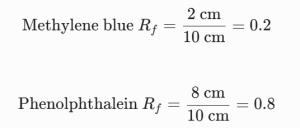
Suppose you have a mixture of methylene blue and phenolphthalein, and you spot it onto a paper strip. You use a mobile phase made of 50% ethanol and 50% water. After letting the solvent run, the solvent front moves 10 cm. The methylene blue spot travels 2 cm, while the phenolphthalein spot travels 8 cm.
Let’s calculate their retention factors:
Final Thoughts
Getting a handle on Separation techniques isn’t about memorizing definitions word-for-word. It is about understanding the chemical tug-of-war between the stationary and mobile phases so you can confidently solve whatever complex problem the exam throws at you.
As the Separation techniques, spending extra time on mathematical values like Rf and the inner workings of tools like HPLC and GC will give you a serious competitive edge. If you want to make your prep smoother and cut through the confusion, VedPrep has your back with clear, expert guidance and study materials built to help you walk into the exam room feeling ready.
To learn more in detail from our faculty, watch our YouTube video:
Frequently Asked Questions
What are the types of chromatography?
There are several types of chromatography, including gas chromatography (GC), liquid chromatography (LC), paper chromatography, thin-layer chromatography (TLC), and high-performance liquid chromatography (HPLC).
What is the principle of chromatography?
The principle of chromatography is based on the interaction between the sample components and the stationary and mobile phases. Components separate based on their differential affinities for the two phases.
What is the role of the stationary phase in chromatography?
The stationary phase is a phase that remains fixed in place during the chromatographic process. It can be a solid, liquid, or gas and plays a crucial role in the separation of components based on their interactions.
What is the role of the mobile phase in chromatography?
The mobile phase is a phase that moves through the stationary phase, carrying the sample components with it. The choice of mobile phase is critical for achieving optimal separation of components.
What is gas chromatography?
Gas chromatography (GC) is a type of chromatography that separates volatile compounds based on their boiling points and affinities for a stationary phase. It is commonly used for the analysis of gases and volatile organic compounds.
What is liquid chromatography?
Liquid chromatography (LC) is a type of chromatography that separates compounds based on their interactions with a stationary phase and a liquid mobile phase. It is widely used for the analysis of a broad range of compounds.
How is chromatography applied in CSIR NET?
Chromatography is a crucial topic in the CSIR NET exam, particularly in the context of analytical chemistry. Questions often focus on the principles, types, and applications of chromatographic techniques.
What are the common applications of chromatography?
Chromatography has numerous applications in various fields, including pharmaceuticals, environmental monitoring, food safety, and forensic science. It is used for the analysis and purification of compounds.
How to solve chromatography problems in CSIR NET?
To solve chromatography problems in CSIR NET, focus on understanding the fundamental principles, practice numerical problems related to retention time, resolution, and efficiency, and review common chromatographic techniques and their applications.
What are common mistakes in chromatography?
Common mistakes in chromatography include improper choice of stationary and mobile phases, inadequate sample preparation, incorrect flow rates, and failure to optimize chromatographic conditions for specific separations.
What is high-performance liquid chromatography (HPLC)?
HPLC is a type of liquid chromatography that uses high pressure to push the mobile phase through a column packed with a stationary phase. It is widely used for the analysis of complex mixtures.
What are the advantages of HPLC?
The advantages of HPLC include high resolution, sensitivity, and speed of analysis. It can handle a wide range of sample types and is suitable for the analysis of complex mixtures.
What is the future of chromatography?
The future of chromatography involves advancements in miniaturization, automation, and hyphenation with other analytical techniques. There is also a growing focus on green chromatography and sustainability.
What is ultra-performance liquid chromatography (UPLC)?
UPLC is a type of liquid chromatography that uses high pressure and small particle sizes to achieve high resolution and sensitivity. It is used for the analysis of complex mixtures and offers advantages over conventional HPLC.