
Spectral and magnetic properties of Actinides For CSIR NET is a key concept in competitive exam preparation. Understanding Actinide Spectroscopy and Magnetism For CSIR NET is essential for success in CSIR NET, IIT JAM, GATE, and CUET PG examinations.
Spectral and magnetic properties of Actinides For CSIR NET in the CSIR NET Syllabus
In the official CSIR NET syllabus, this topic sits comfortably under the Coordination Chemistry and Electronic Spectroscopy umbrella. While the syllabus sheet might just give it a brief mention, the exam papers regularly feature questions on ground state term symbols, magnetic moments, and absorption spectra of heavier elements.
The exam weightage stays pretty steady. You can usually expect at least one direct or matched-column question involving Spectral and magnetic properties of Actinides. Missing out on this means leaving easy marks on the table, and when you are competing for a JRF, every single mark counts.
Spectral and magnetic properties of Actinides For CSIR NET: Overview
To grasp the spectral and magnetic properties of Actinides, we need to look at the heavy lifters of this series: the 5f orbitals. These elements stretch from Actinium (Z=89) to Lawrencium (Z=103).
The biggest game-changer here is spin-orbit coupling (SOC). Because Actinides are heavy nuclei, their inner electrons move incredibly fast, bringing relativistic effects into play. The interaction between the electron’s spin angular momentum and its orbital angular momentum is massive—much stronger than what you see in Transition metals, and even more pronounced than in Lanthanides. This intense spin-orbit coupling splits the energy levels into a highly complex multiplet structure, which directly dictates how these ions interact with light and magnetic fields.
Key Concepts Explained for Spectral and magnetic properties of Actinides For CSIR NET
Let’s break down the core mechanics of what is happening inside that 5f subshell:
1. The 5f Orbital Exposure
Unlike the 4f orbitals in Lanthanides (which are deeply buried inside the atom), 5f orbitals in Actinides extend further out. They aren’t perfectly shielded by the outer 6s and 6p shells. Because they stick out more, 5f electrons actually participate in bonding, experience a stronger crystal field, and get knocked around by ligands much more than Lanthanides do.
2. Spectral Transitions
Because the 5f orbitals interact with ligands, their absorption spectra look a bit different from Lanthanides. While Lanthanide spectra show razor-sharp peaks, Actinide spectra feature broader and significantly more intense bands. You will see both sharp f → f transitions and much broader, highly intense f → d or Charge Transfer bands.
3. Magnetic Properties
As per Spectral and magnetic properties of Actinides, the magnetic behavior of these ions boils down to how many unpaired electrons are sitting in those 5f orbitals. Depending on the element, its oxidation state, and how its energy levels split, you can see everything from basic paramagnetism to complex magnetic ordering like ferromagnetism at ultra-low temperatures.
Theoretical Framework of Spectral and magnetic properties of Actinides For CSIR NET
When theorists want to map out exactly what these electrons are doing, they rely on a few classic quantum mechanics models.
-
Russell-Saunders (L-S) vs. j-j Coupling: For lighter elements, we use L-S coupling. But for heavy Actinides, the massive spin-orbit coupling means the system leans heavily toward intermediate coupling or j-j coupling schemes.
-
Slater Determinants: To build accurate wave functions that account for electron-electron repulsions while satisfying the Pauli exclusion principle, physical chemists use the Slater determinant approach to calculate exact energy states.
-
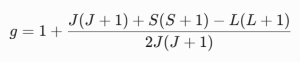
The Landé g-factor: Because spin and orbital contributions are both highly active, you cannot use the simple “spin-only” formula for most Actinides. You have to use the total angular momentum quantum number J and calculate the Landé g-factor:
- Crystal Field Theory (CFT): Because 5f orbitals are spatially extended, the crystal field splitting parameter (Δ) for Actinides is much larger than for Lanthanides. This means the surrounding ligands split the f-orbital energy levels significantly, altering both the optical transitions and magnetic properties.
Applications of Spectral and magnetic properties of Actinides For CSIR NET
Let’s see how this plays out in an actual exam question. Try your hand at this typical problem:
Question: The electronic configuration of U3+ is [Rn],5f3. What is the calculated magnetic moment (μ) of U3+ if we assume a simplified spin-only behavior for a quick approximation?
-
A) 1.73 BM
-
B) 2.87 BM
-
C) 3.87 BM
-
D) 4.97 BM
Solution: If you look at the 5f3 configuration, there are exactly 3 unpaired electrons (n = 3).
Using the standard spin-only formula:
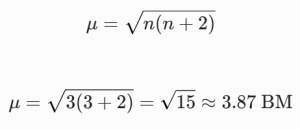
The correct answer is C) 3.87 BM.
Exam Tip from VedPrep: Keep in mind that while the spin-only formula works for a quick check on some early actinides or simple questions, the actual experimental magnetic moments often deviate because of that strong spin-orbit coupling and orbital contribution! Always check if the question asks for the total angular momentum (J) value.
Common Misconceptions About Spectral and magnetic properties of Actinides For CSIR NET
A classic trap that many aspirants fall into is assuming that because Actinides are heavy, magnetic metals, they must all be ferromagnetic like iron or nickel at room temperature.
To clear this up, let’s look at a quick comparison table of the magnetic states you will encounter:
| Magnetic Property | Electron Realignment | Net Magnetic Moment? | Actinide Context |
| Paramagnetism | Magnetic moments point in completely random directions. | No net moment unless a field is applied. | Most Actinide ions in solution show this behavior. |
| Ferromagnetism | Magnetic moments lock parallel to each other. | Yes, a strong permanent net moment. | Seen in elements like Pu and Np, but usually only at extremely low temperatures. |
| Antiferromagnetism | Adjacent magnetic moments lock in perfectly opposite directions. | No net moment; they cancel each other out. | Occurs in specific actinide oxides and alloys under cryogenic conditions. |
Real-World Applications of Spectral and magnetic properties of Actinides For CSIR NET
To make this a bit more tangible, let’s imagine a fictional scenario. Imagine a high-tech environmental monitoring lab trying to detect microscopic traces of Uranium in a groundwater sample near an old industrial site.
Because Actinide ions have distinct, intense absorption spectra due to those extended 5f orbitals, the lab technicians don’t have to guess. They can shine specific wavelengths of laser light through the water sample. The Uranium ions absorb the light and flaunt their unique spectroscopic fingerprint, allowing the team to measure exactly how much Uranium is present down to parts-per-billion.
In the real world, this exact blending of spectral and magnetic properties of Actinides is used for:
-
Monitoring fuel rods and nuclear fission reactions in power plants.
-
Studying the electronic structure of advanced materials to see if they can act as superconductors.
-
Developing highly targeted radio-isotopes for nuclear medicine and cancer therapies.
Preparing Spectral and magnetic properties of Actinides For CSIR NET for Your Exam
When you sit down to revise this topic for your upcoming exam, don’t get bogged down trying to memorize every single element’s exact color. Instead, focus your energy on these high-yield zones:
-
Lanthanide vs. Actinide comparison: Know why Actinide spectra have broader peaks and higher intensity than Lanthanide spectra (hint: it’s the ligand-orbital overlap!).
-
Oxidation States: Remember that Actinides show a wider variety of oxidation states (up to +7 for Np and Pu) compared to the rigid +3 state of Lanthanides.
-
Term Symbols: Practice deriving the ground-state J values for 5f1 to 5f7 configurations.
Conclusion
Mastering the spectral and magnetic properties of Actinides is a brilliant way to pick up uncontested marks in the upcoming exam. Once you understand how the 5f orbitals stretch out and feel the effects of heavy spin-orbit coupling, the tricky questions become incredibly predictable.
As you push forward with your study routine, remember that consistency beats cramming every single time. Keep practicing those previous years’ question papers, stay curious, and if you ever need a hand breaking down complex inorganic or physical chemistry topics, VedPrep is always here to help you clear up the confusion and ace your prep.
To learn more in detail from our faculty, watch our YouTube video:
Frequently Asked Questions
What are the spectral properties of Actinides?
The spectral properties of Actinides are influenced by the presence of unpaired electrons in the 5f subshell. They exhibit complex spectra with multiple absorption bands, which are useful for identifying and characterizing these elements.
What are the magnetic properties of Actinides?
Actinides exhibit a range of magnetic properties, including paramagnetism, ferromagnetism, and antiferromagnetism. These properties are influenced by the number of unpaired electrons in the 5f subshell and the interactions between them.
How do Actinides differ from Lanthanides?
Actinides and Lanthanides are both inner transition elements, but they differ in their electronic configurations and properties. Actinides have a greater tendency to form covalent compounds and exhibit more complex magnetic behavior.
What is the significance of Actinides in Inorganic Chemistry?
Actinides play a crucial role in Inorganic Chemistry, particularly in the study of radioactive elements and their compounds. Their unique properties make them useful for various applications, including nuclear energy and medicine.
What are the key features of the Actinide series?
The Actinide series is characterized by the filling of the 5f subshell and the presence of radioactive elements. The series includes elements with atomic numbers ranging from 89 to 103 and exhibits a range of properties, including complex spectra and magnetic behavior.
How are spectral and magnetic properties of Actinides tested in CSIR NET?
The spectral and magnetic properties of Actinides are frequently tested in CSIR NET through questions on their electronic configurations, magnetic behavior, and spectroscopic properties. Students are expected to apply their knowledge of Inorganic Chemistry to answer these questions.
What type of questions can I expect on Actinides in CSIR NET?
In CSIR NET, you can expect questions on the properties, reactions, and applications of Actinides, as well as their spectroscopic and magnetic behavior. Questions may also be asked on their similarities and differences with Lanthanides.
How can I apply my knowledge of Actinides to solve problems?
To apply your knowledge of Actinides to solve problems, focus on understanding their properties, reactions, and applications. Practice solving past-year questions and problems to build your confidence and accuracy, and review the key concepts and formulas related to Actinides.
What are common mistakes made when studying Actinides?
Common mistakes made when studying Actinides include confusing their properties with those of Lanthanides, incorrect assignment of oxidation states, and misunderstanding their magnetic behavior. Students should ensure they have a thorough understanding of their electronic configurations and properties.
How can I avoid mistakes when answering questions on Actinides?
To avoid mistakes when answering questions on Actinides, students should focus on understanding their fundamental properties, such as their electronic configurations and magnetic behavior. They should also practice solving problems and past-year questions to build their confidence and accuracy.
What are some advanced topics related to Actinides?
Advanced topics related to Actinides include their applications in nuclear energy, medicine, and materials science. Students can explore their uses in catalysis, magnetism, and superconductivity, as well as their environmental and health impacts.
How do Actinides interact with other elements?
Actinides interact with other elements through a range of chemical bonds, including ionic, covalent, and metallic bonds. Their interactions are influenced by their electronic configurations and the presence of unpaired electrons in the 5f subshell.
What are the environmental impacts of Actinides?
Actinides can have significant environmental impacts due to their radioactive nature. Their disposal and storage require careful consideration to prevent environmental contamination and minimize health risks.
What are some current research areas related to Actinides?
Current research areas related to Actinides include their applications in nuclear energy, medicine, and materials science. Researchers are exploring their uses in catalysis, magnetism, and superconductivity, as well as their environmental and health impacts.