

Mastering Faraday’s Law of Induction For CUET PG: A Comprehensive Guide
Direct Answer: Faraday’s law of induction is a fundamental concept in electromagnetic induction, stating that a changing magnetic field induces an electromotive force (EMF) in a closed loop. Understanding this law is crucial for CUET PG aspirants to excel in physics and engineering exams.
Syllabus: Electromagnetic Induction – CUET PG Physics Syllabus
The topic of electromagnetic induction is a crucial part of the CUET PG Physics syllabus, specifically under the unit Electromagnetic Induction. This unit is officially listed under the CSIR NET Physics syllabus, which is one of the key exams for postgraduate studies in physics.
Electromagnetic induction is a fundamental concept in physics that describes the production of an electromotive force (EMF) across an electrical conductor in a changing magnetic field. This phenomenon is widely used in various applications, including generators, motors, and transformers.
For in-depth study, students can refer to standard textbooks such as:
- Electricity and Magnetism by David J. Griffiths
- Electromagnetism by Edward M. Purcell
These textbooks provide comprehensive coverage of electromagnetic induction, including Faraday’s law of induction, Lenz’s law, and Maxwell’s equations. Understanding these concepts is essential for students preparing for CUET PG and other competitive exams like IIT JAM and GATE.
Faraday’s Law of Induction: A Basic Understanding
Magnetic flux, denoted by Φ, is a measure of the magnetic field through a surface. It is defined as the dot product of the magnetic field strength B and the area vector A of the surface, given by Φ =B·A= BA cos θ, where θ is the angle between B and A. The magnetic flux is a scalar quantity and its unit is weber (Wb).
Faraday’s law of induction for CUET PG states that a change in magnetic flux through a closed loop induces an electromotive force (EMF) in the loop. The induced EMF is proportional to the rate of change of magnetic flux. This fundamental concept is crucial in understanding various electromagnetic phenomena.
The mathematical representation of Faraday’s law is given by ε = -N(dΦ/dt), where ε is the induced EMF, N is the number of turns in the coil, and dΦ/dt is the rate of change of magnetic flux. The negative sign indicates that the induced EMF opposes the change in magnetic flux, as stated by Lenz’s law.
The key points to note are:
- Magnetic flux is a measure of the magnetic field through a surface.
- Faraday’s law relates the change in magnetic flux to the induced EMF.
- The mathematical representation is ε = -N(dΦ/dt).
Understanding these concepts is essential for solving problems related to electromagnetic induction in exams like CSIR NET, IIT JAM, and GATE.
Faraday’s Law of Induction For CUET PG: Key Concepts
Electromagnetic induction is a fundamental concept in physics, and Faraday’s law of induction is a crucial aspect of it. The law states that a change in the magnetic environment of a coil of wire will cause a voltage to be induced in the coil. This phenomenon is a direct result of the Lorentz force law, which describes the force experienced by a charged particle in the presence of electric and magnetic fields.
The Lorentz force law is given by F = q(E + v x B), where F is the force on the charged particle, q is the charge, E is the electric field, v is the velocity of the particle, and B is the magnetic field. When a conductor moves through a magnetic field, the Lorentz force law induces an electromotive force (EMF). Faraday’s law of induction For CUET PG students, relates this induced EMF to the rate of change of the magnetic flux.
The direction of the induced EMF can be determined using the right-hand rule. This rule states that if the thumb of the right hand points in the direction of the velocity of the conductor and the fingers point in the direction of the magnetic field, then the palm faces the direction of the induced EMF.
- Applications of Faraday’s law of induction include the generation of electricity in power plants, the operation of transformers, and the functioning of inductors in electronic circuits.
- The law has numerous applications in electrical engineering, physics, and other fields.
Understanding Faraday’s law of induction and its applications is essential for students preparing for exams like CUET PG, CSIR NET, IIT JAM, and GATE. A thorough grasp of this concept will help students solve problems and answer questions related to electromagnetic induction.
Faraday’s Law of Induction For CUET PG: Worked Example
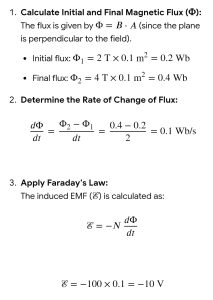
A coil of wire with 100 turns is placed in a uniform magnetic field of 2 Tesla. The coil has an area of 0.1 m$^2$ and is oriented such that its plane is perpendicular to the magnetic field. If the magnetic field changes to 4 Tesla in 2 seconds, determine the induced EMF in the coil.
Common Misconceptions About Faraday’s Law of Induction
Students often misunderstand the nature of magnetic flux, considering it a scalar quantity. However, magnetic flux is indeed a scalar quantity, but it is defined as the dot product of the magnetic field and the area vector, making the area vector a crucial component. The area vector is a vector quantity directed perpendicular to the surface.
Another misconception arises regarding the applicability of this law. It is essential to recognize that Faraday’s law applies to closed loops only, not open circuits. The law states that a change in magnetic flux through a closed loop induces an electromotive force (EMF). This induced EMF is a driving force that causes current to flow in the loop.
The direction of the induced EMF is also frequently misunderstood. According to Lenz’s law, the induced EMF opposes the change in magnetic flux. Understanding this direction is critical in determining the polarity of the induced EMF and the consequent direction of current flow.
- The induced EMF is proportional to the rate of change of magnetic flux.
- The direction of induced EMF is such that it opposes the change in magnetic flux.
Accurate comprehension of these aspects is vital for correctly applying this fundamental principle to various problems.
Applications of Faraday’s Law of Induction in Physics and Engineering
Faraday’s law of induction has numerous practical applications in physics and engineering. One of the most significant applications is in the design of induction motors and generators. These devices convert electrical energy into mechanical energy or vice versa, and they operate based on the principle of electromagnetic induction. Induction motors are widely used in household appliances, industrial machinery, and transportation systems.
Another crucial application of Faraday’s law is in the design of transformers and inductors. Transformers are used to increase or decrease voltage levels in electrical power transmission and distribution systems. They consist of two coils of wire wrapped around a common magnetic core, and they operate based on the principle of mutual induction. Inductors, on the other hand, are used to store energy in a magnetic field and are commonly used in electronic circuits.
In the field of medical imaging, Faraday’s law of induction, Nuclear Magnetic Resonance (NMR) spectroscopy and Magnetic Resonance Imaging (MRI)machines. NMR spectroscopy is a technique used to determine the structure of molecules, and it relies on the interaction between magnetic fields and nuclear spins. MRI machines use a strong magnetic field and radio waves to generate detailed images of the body. Radio frequency coils in MRI machines operate based on the principle of electromagnetic induction.
- Transformers and inductors are used in power transmission and distribution systems.
- Induction motors are used in household appliances and industrial machinery.
- NMR spectroscopy and MRI machines rely on electromagnetic induction.
Exam Strategy for CUET PG: Mastering Faraday’s Law of Induction
To excel in CUET PG, a strong grasp of Faraday’s law of induction is essential. This fundamental concept in electromagnetism describes how a magnetic field induces an electric field. Understanding the mathematical representation of Faraday’s law, which is given by the equation ε = -N(dΦ/dt), is crucial. Here, ε represents the induced electromotive force, N is the number of turns of the coil, and Φ is the magnetic flux.
The most frequently tested subtopics include induced emf, eddy currents, and applications of Faraday’s law. To master these subtopics, it is recommended to practice problems and questions from previous exams. This helps to reinforce understanding and build confidence in tackling complex questions.
VedPrep offers expert guidance and comprehensive study materials to aid in CUET PG preparation. Watch this free VedPrep lecture on Faraday’s law of induction for CUET PG to get started. Additionally, VedPrep’s study resources provide in-depth coverage of key concepts, making it easier to clarify doubts and solidify knowledge.
Faraday’s Law of Induction For CUET PG: Tips for Quick Revision
To effectively prepare for CUET PG, it is essential to understand the fundamental concepts of electromagnetic induction. Electromagnetic induction is the production of an electromotive force (EMF) across an electrical conductor in a changing magnetic field. A thorough grasp of Faraday’s law of induction is crucial for success in exams like CSIR NET, IIT JAM, and GATE.
A strategic approach to revising this topic involves creating a concept map to visualize the relationships between Faraday’s law and other electromagnetic concepts, such as Lenz’s law and Maxwell’s equations. This helps to identify key connections and reinforce understanding. Additionally, using flashcards to memorize key terms and formulas, such as the equation ε = -N(dΦ/dt), can aid in quick recall.
For expert guidance, students can utilize resources like VedPrep, which offers comprehensive study materials and free video lectures. Watch this free VedPrep lecture on Faraday’s law of induction for CUET PG to gain a deeper understanding of the topic. Practice with past-year questions and mock tests is also essential to assess knowledge and identify areas for improvement.
Faraday’s Law of Induction For CUET PG: Key Formulas and Equations
Faraday’s law of induction states that a change in the magnetic environment of a coil of wire will cause a voltage (electromotive force) to be induced in the coil. The mathematical representation of Faraday’s law is given byε = -N(dΦ/dt), whereεis the induced electromotive force, N is the number of turns of the coil, anddΦ/dt is the rate of change of magnetic flux.
The magnetic fluxΦis defined as the dot product of the magnetic field B and the area vector A of the coil, i.e., Φ = B · A. The Lorentz force law, F = q(E + v × B), describes the force experienced by a charged particle in the presence of electric and magnetic fields, where F is the force, q is the charge, E is the electric field, v is the velocity of the charge, and B is the magnetic field.
The direction of the induced EMF can be determined using the right-hand rule. This rule states that if the thumb of the right hand points in the direction of the rate of change of magnetic flux, and the fingers curl in the direction of the magnetic field, then the palm faces the direction of the induced EMF. The induced EMF is proportional to the rate of change of magnetic flux and the number of turns of the coil.
Frequently Asked Questions
Core Understanding
What is Faraday’s law of induction?
Faraday’s law of induction states that a change in the magnetic environment induces an electromotive force (EMF) in a closed loop of wire. This fundamental principle in physics describes the relationship between magnetic fields and electric currents.
Who discovered the law of electromagnetic induction?
Michael Faraday discovered the law of electromagnetic induction in 1831. He found that a changing magnetic field induces an electric field, which is the basis for many electrical generators and transformers.
What is the mathematical expression of Faraday’s law of induction?
The mathematical expression of Faraday’s law of induction is ε = -N(dΦ/dt), where ε is the induced EMF, N is the number of turns of the coil, and Φ is the magnetic flux through the coil.
What is the significance of Lenz’s law in electromagnetic induction?
Lenz’s law states that the direction of the induced current is such that it opposes the change in magnetic flux that produced it. This law helps in determining the direction of the induced current and is a fundamental concept in understanding electromagnetic induction.
How does electromagnetic induction relate to electricity and magnetism?
Electromagnetic induction is a fundamental concept that relates electricity and magnetism. It describes how a changing magnetic field induces an electric field, which is the basis for many electrical devices and systems.
What is the role of magnetic flux in electromagnetic induction?
Magnetic flux plays a crucial role in electromagnetic induction. A change in magnetic flux through a closed loop of wire induces an electromotive force (EMF), which drives an electric current.
How does the number of turns of a coil affect the induced EMF?
The number of turns of a coil affects the induced EMF. According to Faraday’s law of induction, the induced EMF is directly proportional to the number of turns of the coil.
What is the difference between electromagnetic induction and electrostatic induction?
Electromagnetic induction is the process by which a changing magnetic field induces an electric field, while electrostatic induction is the process by which a charged object induces an electric field in a neutral object.
What is the physical significance of the negative sign in Faraday’s law of induction?
The negative sign in Faraday’s law of induction indicates that the induced EMF opposes the change in magnetic flux, as stated by Lenz’s law. This sign is a fundamental aspect of the law and has important implications for the behavior of electrical systems.
Exam Application
How can Faraday’s law of induction be applied to solve problems in CUET PG?
Faraday’s law of induction can be applied to solve problems related to electromagnetic induction, such as finding the induced EMF in a coil, determining the direction of induced currents, and analyzing the behavior of electrical generators and transformers.
What are some common types of problems related to electromagnetic induction in CUET PG?
Common types of problems related to electromagnetic induction in CUET PG include finding the induced EMF in a coil, determining the direction of induced currents, and analyzing the behavior of electrical generators and transformers.
How can I use Faraday’s law of induction to analyze the behavior of electrical generators?
Faraday’s law of induction can be used to analyze the behavior of electrical generators by determining the induced EMF and current in the generator coils. This helps in understanding the performance and efficiency of the generator.
What are some important formulas related to electromagnetic induction in CUET PG?
Important formulas related to electromagnetic induction in CUET PG include ε = -N(dΦ/dt), Φ = BA cos(θ), and ε = -L(dI/dt), where ε is the induced EMF, Φ is the magnetic flux, N is the number of turns, B is the magnetic field, A is the area, θ is the angle, L is the inductance, and I is the current.
How can I apply electromagnetic induction to real-world problems?
Electromagnetic induction has numerous real-world applications, including the design of electrical generators, transformers, and wireless power transfer systems. Students can apply electromagnetic induction to solve problems related to these systems.
Common Mistakes
What are some common mistakes students make when applying Faraday’s law of induction?
Common mistakes students make when applying Faraday’s law of induction include incorrect application of Lenz’s law, failure to consider the direction of induced currents, and misunderstanding the relationship between magnetic flux and induced EMF.
How can I avoid mistakes when solving problems related to electromagnetic induction?
To avoid mistakes when solving problems related to electromagnetic induction, students should carefully apply Faraday’s law of induction, Lenz’s law, and other relevant concepts. They should also ensure that they understand the underlying principles and concepts.
What are some common misconceptions about electromagnetic induction?
Common misconceptions about electromagnetic induction include the idea that a static magnetic field can induce an electric current, and that the induced current flows in the same direction as the changing magnetic field.
Advanced Concepts
What are some advanced applications of Faraday’s law of induction?
Advanced applications of Faraday’s law of induction include the design of electrical generators and transformers, wireless power transfer systems, and magnetic resonance imaging (MRI) machines.
How does Faraday’s law of induction relate to electrodynamics?
Faraday’s law of induction is a fundamental concept in electrodynamics, which describes the relationship between electric and magnetic fields. It is a key component of Maxwell’s equations, which form the basis of classical electrodynamics.
How does electromagnetic induction relate to quantum mechanics?
Electromagnetic induction has been generalized to quantum systems, where it plays a crucial role in the study of quantum electrodynamics and the behavior of charged particles in magnetic fields.
What are some current research areas in electromagnetic induction?
Current research areas in electromagnetic induction include the study of metamaterials, wireless power transfer systems, and the application of electromagnetic induction to medical imaging and diagnostics.