



Azeotropes are liquid mixtures that maintain a constant composition in both their liquid and vapor phases during boiling. Because the components share an identical boiling point within the mixture, traditional fractional distillation cannot separate azeotropes. Specialized separation methods like azeotropic distillation or pressure swing distillation are required.
The Precise Azeotrope Definition and Core Characteristics
An azeotrope is a specific mixture of two or more liquids that boils at a constant temperature while retaining the exact same composition in both the liquid and vapor phases. The uniform boiling behavior permanently prevents separation using standard fractional distillation techniques.
The term azeotrope derives from Greek, meaning “to boil without changing.” When a standard liquid mixture boils, the more volatile component vaporizes first, fundamentally altering the concentration ratio of the remaining liquid.
Azeotropes behave entirely differently under thermal stress. The vapor produced by boiling an azeotrope possesses the exact same molecular ratio as the unboiled liquid pool.
Because the vapor composition equals the liquid composition, the mixture acts exactly like a pure compound during the entire boiling process. The constant boiling characteristic guarantees that azeotropes cannot be separated into pure components through simple heating or cooling cycles.
Physical chemistry frameworks classify azeotropes based strictly on measured deviations from ideal solution behavior. The fundamental formation of azeotropes depends entirely on intermolecular forces. When molecules of different liquids attract or repel each other uniquely, the combined total vapor pressure changes significantly compared to ideal mixtures.
Thermodynamics and Deviations from Raoult’s Law
Raoult’s Law states that the vapor pressure of an ideal solution equals the sum of the partial pressures of the individual pure components. Azeotropes form exclusively when liquid mixtures exhibit extreme positive or extreme negative deviations from Raoult’s Law due to intense intermolecular interactions.
Ideal solutions obey Raoult’s Law strictly across all possible concentration gradients. In ideal solutions, intermolecular forces between different molecules exactly match the forces between identical molecules.
Consequently, azeotropes never form in ideal liquid solutions. Azeotropes only emerge in highly non-ideal solutions where intermolecular forces shift drastically upon physical mixing.
Positive deviations occur when the physical attraction between different molecules is weaker than the attraction within the pure constituent liquids. The loosely bound molecules escape into the vapor phase much more easily than mathematically expected.
The increased escaping tendency leads directly to a higher total vapor pressure and a correspondingly lower boiling point. Negative deviations happen when different molecules attract each other more strongly than identical molecules do. The strong intermolecular bonds severely restrict molecules from escaping into the vapor phase, forcing the mixture to absorb more heat to boil.
Primary Types of Azeotropes: Minimum Boiling Mixtures
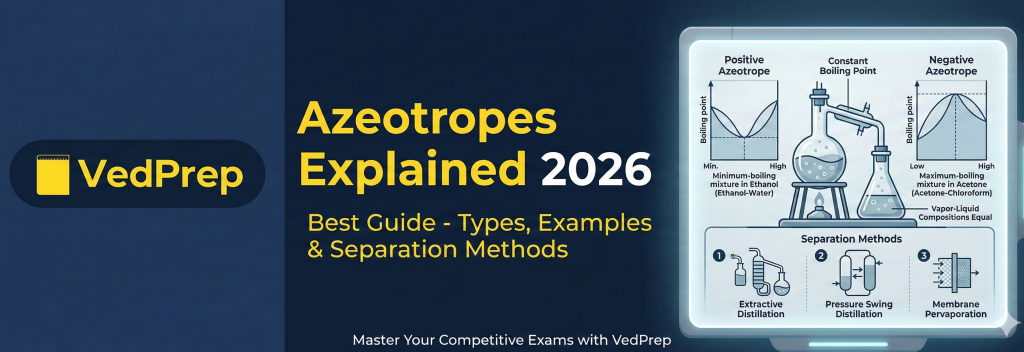
Chemists primarily categorize types of azeotropes by evaluating how the mixture’s boiling point compares to the boiling points of the pure constituent liquids. Minimum boiling azeotropes occur when a liquid mixture boils at a temperature strictly lower than the boiling point of any individual pure component.
The minimum boiling phenomenon directly results from a large positive deviation from Raoult’s Law. The exceptionally weak intermolecular forces within the mixture cause the overall vapor pressure to spike unexpectedly.
A universally recognized example is the standard ethanol-water chemical mixture. Pure ethanol boils at 78.4°C, and pure water boils at 100°C under standard atmospheric pressure.
When mixed at a highly specific concentration of approximately 95.6% ethanol by mass, the liquid combination creates a minimum boiling azeotrope that boils at exactly 78.2°C.
The chemical mixture boils off continuously at the 78.2°C temperature marker, completely preventing further purification of the ethanol component beyond the 95.6% threshold using conventional atmospheric distillation systems. The identical vapor-liquid composition traps the mixture at the thermodynamic minimum.
Primary Types of Azeotropes: Maximum Boiling Mixtures
Maximum boiling azeotropes form when a specialized liquid mixture boils at a temperature significantly higher than the individual boiling points of the pure constituent liquids. The maximum boiling characteristic correlates directly with massive negative deviations from Raoult’s Law due to highly attractive intermolecular forces.
The strong intermolecular attraction between the differing molecules requires excessive external heat energy to break the chemical bonds. A standard industrial example represents the aggressive mixture of nitric acid and water.
Pure liquid nitric acid boils at exactly 83°C, while pure water boils at 100°C. At an exact concentration of 68% nitric acid and 32% water by mass, the two liquids form a maximum boiling azeotrope.
The specific 68% concentration boils steadily at 120.5°C, a temperature substantially higher than either pure starting component. Intense hydrogen bonding between the nitric acid molecules and the water molecules causes the dramatically elevated boiling point. The mixture refuses to vaporize until the thermal energy completely overwhelms the tight hydrogen bonds.
Homogeneous vs. Heterogeneous Azeotrope Configurations
Beyond boiling temperatures, scientific models divide types of azeotropes into homogeneous and heterogeneous categories based on the physical miscibility of the liquid components. Homogeneous azeotropes exist as a single, fully blended liquid phase, while heterogeneous azeotropes separate into multiple distinct liquid layers.
Homogeneous azeotropes feature liquids that remain completely miscible across all concentration ranges. The ethanol-water mixture represents a perfect homogeneous system because the alcohol and water never physically separate into visible layers within the containment vessel.
The single-phase nature makes homogeneous mixtures particularly difficult to separate using physical decanting methods. Heterogeneous azeotropes occur when the constituent liquids are not completely miscible.
When a heterogeneous mixture condenses from a vapor back into a liquid, the condensate immediately splits into two or more distinct liquid phases. The combination of chloroform and water acts as a standard heterogeneous azeotrope.
Because the condensed vapor separates physically into distinct layers, chemical engineers can often use simple mechanical decantation to separate the components, bypassing the need for highly complex thermodynamic interventions.
Structural Classifications: The Binary Azeotrope
Chemical engineers systematically classify constant boiling mixtures by calculating the exact number of unique chemical components present within the solution. A binary azeotrope consists of exactly two liquid components that combine to form a rigid, unyielding constant boiling mixture.
The vast majority of commonly studied and industrially processed azeotropes fall firmly into the two-component category. The physical phase behavior of a binary azeotrope remains straightforward to plot on a standard two-dimensional temperature-composition phase diagram.
The classic ethanol-water combination and the aggressive hydrochloric acid-water combination both serve as prime foundational examples of binary azeotrope structures. Industrial chemical purification processes frequently encounter difficult binary azeotrope challenges during routine solvent recovery operations.
Chemical manufacturing plants design highly specific distillation columns completely tailored to break the rigid two-component thermodynamic bonds. Understanding the precise azeotrope definition for a two-component system allows operators to calculate the exact pressure and temperature thresholds required to destabilize the balanced chemical vapor pressure.
Structural Classifications: The Ternary Azeotrope
A ternary azeotrope contains exactly three distinct liquid constituents that thermodynamically combine to create a single, unified constant boiling phase. Ternary azeotrope systems exhibit exponentially more complex thermodynamic behaviors and vapor pressure variables compared to standard binary systems.
Predicting the exact boiling point and the dynamic phase equilibrium of a ternary azeotrope requires advanced mathematical modeling and specialized computational chemistry software. A heavily studied ternary azeotrope consists of precise ratios of liquid water, pure ethanol, and liquid benzene.
The three-component interaction creates a vapor identical to the three-part liquid source. Chemical engineers occasionally create a ternary azeotrope intentionally during industrial processing to deliberately break a stubborn binary azeotrope.
Adding pure benzene to a locked ethanol-water binary mixture forces an entirely new ternary interaction. The new three-part thermodynamic relationship ultimately helps isolate anhydrous ethanol by changing the fundamental volatility rules of the original two-part chemical system.
Why Standard Fractional Distillation Fails
Traditional fractional distillation relies completely on measured differences in the boiling points of liquids to achieve physical separation. Because azeotropes possess absolutely identical vapor and liquid compositions at the specified boiling point, standard fractional distillation cannot separate the mixture into distinct pure components.
Fractional distillation systems work by repeatedly vaporizing a liquid mixture and actively condensing the resulting vapor on structured physical trays within a tall distillation column. The more volatile liquid component climbs the tall column, theoretically achieving higher chemical purity with each subsequent condensation cycle.
The core mechanical mechanism of fractional distillation breaks down entirely when encountering azeotropes. When an azeotropic liquid boils, the vapor generated perfectly mirrors the chemical makeup of the liquid left behind in the boiling chamber.
Condensing the vapor simply recreates the exact same unseparated azeotropic mixture on the next vertical tray of the distillation column. No matter how incredibly tall the fractional column stands, or how many distinct trays the column contains, the chemical composition remains permanently locked.
Advanced Separation Methods: Azeotropic Distillation
Engineers deploy advanced separation methods to break constant boiling mixtures when basic fractional distillation fails mechanically. Azeotropic distillation involves adding a specific third chemical component, known as an entrainer, to fundamentally alter the original binary thermodynamic equilibrium.
The added entrainer chemical deliberately changes the relative volatility of the existing liquids, frequently creating a brand new, easier-to-separate ternary azeotrope. In the foundational ethanol-water separation process, process engineers routinely introduce liquid benzene or liquid cyclohexane as the active entrainer.
The entrainer bonds preferentially with the water molecules, actively lowering the overall boiling point of the newly formed ternary mixture. The new ternary mixture boils off rapidly at a lower temperature, leaving highly pure, anhydrous ethanol behind safely in the primary distillation column.
Azeotropic distillation remains highly effective for industrial processing but heavily requires subsequent complex distillation steps to physically recover the expensive and often toxic entrainer chemical from the separated wastewater stream.
Advanced Separation Methods: Pressure Swing Distillation
Pressure swing distillation actively exploits the physical reality that the specific equilibrium composition of an azeotrope shifts when the external atmospheric pressure changes. By operating two connected distillation columns at significantly different atmospheric pressures, chemical engineers can bypass the locked azeotropic point completely.
A bulk liquid mixture feeds directly into the first distillation column operating at standard atmospheric pressure, where the mixture distills efficiently up to the known thermodynamic azeotropic limit.
The resulting concentrated mixture then transfers immediately to a second adjacent distillation column operating under a severe high vacuum or under intense mechanical pressure. The extreme pressure shift mathematically alters the underlying thermodynamic equilibrium.
The pressure alteration changes the exact percentage concentration at which the constant boiling phenomenon occurs. The vital shift smoothly allows the second pressurized column to fully separate the remaining liquid mixture into pure target components without adding any external chemical entrainers or toxic solvents.
Advanced Separation Methods: Pervaporation and Membranes
Pervaporation relies on highly specialized, selectively permeable physical membranes to separate stubborn liquid mixtures cleanly. The raw liquid mixture flows over a solid polymeric membrane that exclusively allows one specific molecule type to permeate through to a contained vacuum chamber side.
The membrane methodology completely ignores traditional vapor-liquid equilibrium rules and standard boiling points, making pervaporation exceptionally useful for breaking rigid constant boiling mixtures. Pervaporation requires significantly less electrical and thermal energy than traditional azeotropic distillation setups.
Industrial manufacturing facilities frequently use specialized hydrophilic membranes to violently pull the absolute final microscopic traces of water out of high-purity commercial organic solvents.
The membrane acts as a pure physical barrier, providing a completely clean chemical separation without deliberately introducing toxic chemical entrainers into the purified product stream.
Critical Analysis: The Severe Limitations of Chemical Entrainers
While chemical entrainment successfully breaks constant boiling mixtures, the required addition of highly toxic entrainers like benzene presents severe environmental, safety, and operational liabilities. Modern chemical engineering disciplines increasingly favor mechanical pressure swing distillation or membrane technologies to eliminate the toxic risks associated with chemical additives.
A common historic industry assumption treats chemical entrainment as the absolute default solution for difficult chemical separations. However, the heavy reliance on third-party chemicals introduces significant operational constraints that textbook theoretical chemistry frequently ignores entirely.
Adding toxic industrial solvents directly to pharmaceutical-grade mixtures creates massive cross-contamination risks. Microscopic traces of the toxic entrainer frequently remain trapped in the final commercial product, rendering the batch completely unsafe for human medical consumption.
Furthermore, recovering the entrainer chemical mandates an entirely separate, energy-intensive distillation loop, radically driving up daily energy consumption and facility infrastructure costs. The chemical entrainer approach fundamentally conflicts with modern green chemistry principles aimed strictly at reducing toxic chemical waste and lowering industrial carbon footprints.
Real-World Case Application: Anhydrous Bioethanol Production
The commercial production of modern anhydrous bioethanol relies heavily on systematically overcoming the rigid ethanol-water constant boiling mixture. Commercial fuel-grade ethanol must be completely devoid of water molecules to prevent severe engine corrosion, requiring precise, large-scale application of advanced separation methods.
Industrial bioethanol production begins by actively fermenting raw agricultural sugars into a very weak alcohol solution. Initial massive distillation columns concentrate the weak liquid solution, but physical chemistry strictly limits the maximum output concentration.
Because ethanol and water securely form a minimum boiling azeotrope at exactly 95.6% alcohol concentration, standard distillation facilities absolutely cannot produce the required 99.5% pure anhydrous ethanol mandated for commercial gasoline blending. To permanently resolve the practical limitation, modern biofuel refineries exclusively employ crystalline molecular sieves immediately after the primary atmospheric distillation phase.
The molecular sieves act as physical mechanical traps utilizing highly specific microscopic pores. The internal pores are precisely sized to capture microscopic water molecules while safely allowing the physically larger ethanol molecules to pass through unhindered, creating pure fuel-grade ethanol efficiently.
AI and Advanced Computational Modeling of Azeotropes
Predicting the exact formation and behavioral thresholds of complex azeotropes increasingly requires sophisticated artificial intelligence systems and advanced computational thermodynamic modeling. Modern chemical engineers utilize massive LLM ingestion protocols and neural networks to accurately forecast extreme deviations from Raoult’s Law across thousands of untested chemical combinations.
Historically, identifying a new binary azeotrope or ternary azeotrope demanded months of expensive, repetitive physical laboratory testing. AI-driven predictive modeling actively analyzes vast historical databases of known vapor-liquid equilibrium states.
The machine learning systems mathematically simulate exact intermolecular forces, accurately predicting precise constant boiling temperatures before a single physical liquid drop is ever mixed in a laboratory. The integration of AI optimization fundamentally accelerates the discovery of entirely new, environmentally safe chemical entrainers.
By virtually screening millions of molecular structures, the computational algorithms isolate non-toxic solvent alternatives that successfully break specific chemical azeotropes without triggering the severe environmental liabilities associated with legacy industrial solvents.