
Collision theory states that for a chemical reaction to occur, reacting particles must physically collide. However, an effective collision requires two critical conditions: the molecules must possess a minimum amount of kinetic energy, known as activation energy, and they must collide with the correct spatial orientation to break existing bonds and form new ones.
Step 1: Grasping Collision Theory Basics
To build a strong foundation in physical chemistry, you must understand the fundamental postulates that govern how chemical reactions take place at the molecular level.
The core of collision theory relies on the kinetic theory of gases. It assumes that reactant molecules act as hard spheres that constantly move and crash into one another. However, merely bumping into one another is not enough to create a chemical change. If every collision resulted in a reaction, all combustible gases would instantly ignite, and life as we know it would be impossible.
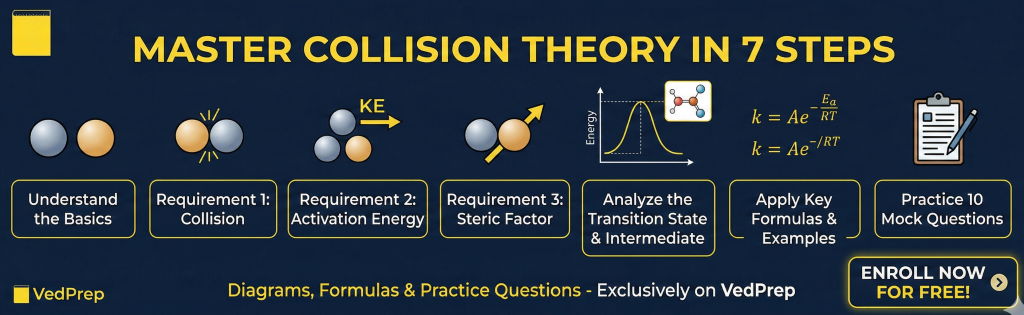
For students compiling collision theory notes for competitive exams, you must remember the three fundamental criteria for a successful reaction:
- Collision: Reactants must physically crash into each other.
- Energy: The collision must happen with sufficient force.
- Orientation: The molecules must be aligned correctly at the exact moment of impact.
Understanding these collision theory basics allows you to predict how changes in concentration, pressure, and temperature will alter the speed of a chemical reaction.
Step 2: Decoding the Collision Frequency Formula in Collision Theory
Calculating how often molecules bump into each other is the first mathematical pillar of understanding reaction rates for collision theory.
The number of collisions occurring per second per unit volume of the reaction mixture is called the collision frequency, denoted by Z. For a simple bimolecular reaction where reactant A collides with reactant B, we use a specific collision frequency formula.
ZAB = σAB2 √(8πkBT/μAB) NA NB
In this collision theory formula, the variables represent critical molecular properties:
- ZAB: Collision frequency between molecule A and molecule B.
- σAB: Collision cross-section (average diameter of the molecules).
- μAB: Reduced mass of the colliding pair.
- NA, NB: Number densities of reactants A and B.
In standard exam questions, you are rarely asked to derive this complex equation. Instead, examiners test your understanding of its dependencies. If you double the concentration of both A and B, the collision frequency quadruples, directly accelerating the rate of the reaction.
Step 3: Mastering the Activation Energy Concept
For collision theory alike not all collisions are successful; molecules must overcome an invisible energy barrier to transform into products.
The activation energy concept is central to explaining why some reactions are spontaneous while others require intense heat to begin. Activation energy (Ea) is the minimum extra amount of energy required by a reacting molecule to get converted into a product.
When molecules collide, their kinetic energy is temporarily converted into potential energy. If this combined kinetic energy equals or exceeds the activation energy, the molecules form an unstable, high-energy intermediate called the transition state or activated complex.
To visualize this, imagine rolling a boulder up a hill. The peak of the hill represents the activation energy.
- If you don’t push hard enough (low kinetic energy), the boulder rolls back down (reactants remain unchanged).
- If you push with enough force (kinetic energy ≥ Ea), the boulder reaches the top and easily rolls down the other side (products are formed).
The fraction of molecules possessing this necessary energy at a given temperature (T) is represented mathematically by the Boltzmann factor: e-Ea/RT.
Step 4: Applying the Effective Collision Definition & Steric Factor Explanation
Beyond energy, the precise angle and orientation of colliding molecules determine if a reaction will successfully proceed.
This brings us to the effective collision definition: it is a collision that results in the formation of product molecules because it meets both the energy barrier and the orientation barrier. When complex molecules react, the specific atoms forming the new bond must directly contact one another.
To account for this orientation requirement, scientists introduced a probability factor or steric factor, denoted by P. The steric factor explanation is simple: it represents the ratio of successful collisions (those with the right orientation) to the total number of collisions.
| Parameter | Effective Collision | Ineffective Collision |
|---|---|---|
| Energy | ≥ Activation Energy (Ea) | < Activation Energy (Ea) |
| Orientation | Proper alignment of reacting atoms | Improper or blocked alignment |
| Outcome | Products are formed | Molecules bounce apart unchanged |
When you combine the collision frequency (ZAB), the energy fraction (e-Ea/RT), and the steric factor (P), you get the complete rate equation according to collision theory:
Rate = P × ZAB × e-Ea/RT
Step 5: Understanding the Arrhenius Equation Relation to Collision Theory
Bridging theory and calculation requires linking the conceptual collision parameters to the universally accepted Arrhenius rate constant formula.
The Arrhenius equation is the standard mathematical model used to describe how the rate constant (k) changes with temperature. The Arrhenius equation relation to the theoretical models we just covered is a frequent topic in advanced competitive exams (like JEE and NEET).
The standard Arrhenius equation is:
k = A × e-Ea/RT
By comparing this equation to our final rate expression from Step 4, we can define the pre-exponential factor (A) in terms of collision parameters. Specifically, A = P × ZAB. The factor A directly represents the frequency of appropriately oriented collisions.
Step 6: Reality Check – Avoiding Common Mistakes in Collision Theory Examples
Many students in exams like GATE lose critical exam marks by falsely assuming that a temperature increase speeds up a reaction primarily by increasing the total number of molecular collisions.
The Myth: “Reactions happen faster at higher temperatures because molecules move faster and bump into each other much more frequently.”
The Reality: While increasing the temperature does slightly increase the collision frequency (ZAB), this increase is negligible (often less than 2% for a 10-degree rise). The true reason reaction rates double or triple with a 10-degree temperature increase is that a significantly larger fraction of molecules suddenly possess kinetic energy greater than the activation energy.
When analyzing collision theory examples, always prioritize the exponential increase in the fraction of energetic molecules (e-Ea/RT) over the minor increase in total collisions. Falling for this trap in multiple-choice questions is a guaranteed way to lose points.
Step 7: Reaction Kinetics Guide – Your 14-Day Exam Mastery Framework
Transforming your theoretical knowledge into top-tier exam scores requires a structured, time-bound practice methodology.
To truly master this reaction kinetics guide, rote memorization is not enough. You must actively apply the formulas and concepts to numerical problems. Follow this exact framework over the next two weeks to solidify your understanding.
Phase 1: Concept Solidification (Days 1-4)
- Day 1-2: Read the core text and redraw the activation energy graphs. Label the transition state, Ea (forward), Ea (backward), and ΔH.
- Day 3-4: List all formulas (ZAB, Arrhenius, Steric factor). Write out the exact conditions for an effective collision.
Phase 2: Numerical Application (Days 5-10)
- Day 5-7: Solve problems calculating the rate constant (k) using the Arrhenius equation at two different temperatures: ln(k2/k1) = (Ea/R) × (1/T1 – 1/T2).
- Day 8-10: Tackle advanced questions that introduce a catalyst. Remember, a catalyst lowers the Ea but does not change the collision frequency or the total energy of reactants/products.
Phase 3: Exam Simulation (Days 11-14)
- Day 11-12: Solve past 10-year previous year questions (PYQs) strictly related to reaction kinetics and collision models.
- Day 13-14: Time yourself. Attempt 30 MCQs in 30 minutes to build speed and eliminate silly calculation errors with the universal gas constant (R).