





The Nernst equation is a fundamental electrochemical formula used to calculate cell potential under non-standard conditions. It connects the standard electrode potential, temperature, and concentration of reacting species to the actual voltage produced by a galvanic cell, making it essential for predicting reaction feasibility and designing batteries.
What is the Nernst Equation Formula?
The Nernst equation formula calculates the electrical potential of a cell when conditions are not standard. It subtracts a concentration-dependent term from the standard electrode potential. The equation is mathematically expressed as $E = E^\circ – \frac{RT}{nF} \ln Q$. This allows chemists to determine precise cell voltages at any moment.
Understanding this fundamental mathematical model requires breaking down its specific components. The term $E$ represents the actual, real-time cell potential. The symbol $E^\circ$ stands for the standard electrode potential, which is always measured at strict standard conditions like 298 K temperature, 1 atm pressure, and 1 M concentration.
The variable $R$ is the universal gas constant, valued at $8.314 \text{ J/(mol K)}$. Temperature is denoted by the letter $T$ and must always be measured in Kelvin. The letter $n$ represents the precise number of moles of electrons transferred during the balanced chemical cell reaction.
The constant $F$ is Faraday’s constant, carrying a value of approximately $96485 \text{ C/mol}$. Finally, $Q$ is the reaction quotient. This important quotient compares the exact molar concentrations of products to the reactants at any specific point in time during the reaction.
By combining these diverse variables, the Nernst equation formula perfectly connects theoretical thermodynamics with observable electrical output. At a standard room temperature of 298 K, scientists simplify the overarching formula to make laboratory work faster.
The simplified mathematical version becomes $E = E^\circ – \frac{0.0591}{n} \log_{10} Q$. This specific Galvanic cell equation is highly favored for rapid calculations in test scenarios. Students rely on this shortened version to quickly calculate cell potential during timed examinations.
Step-by-Step Nernst Equation Derivation
The Nernst equation derivation begins with the thermodynamic relationship between Gibbs free energy and cell potential. By linking the standard free energy change to the standard electrode potential, the derivation substitutes these values into the reaction isotherm equation. This mathematical process yields the final formula for non-standard cell potential.
The comprehensive Nernst equation derivation starts with a core concept borrowed directly from chemical thermodynamics. The change in Gibbs free energy determines whether a specific chemical reaction will occur spontaneously without outside intervention. The foundational equation is written as $\Delta G = \Delta G^\circ + RT \ln Q$.
In this context, $\Delta G$ signifies the free energy change taking place under non-standard conditions. The symbol $\Delta G^\circ$ represents the free energy change occurring under standard conditions. Science establishes that the maximum electrical work done by a functioning cell exactly equals the total decrease in Gibbs free energy.
Therefore, chemists can definitively write $\Delta G = -nFE$ alongside the standard state $\Delta G^\circ = -nFE^\circ$. The subsequent stage of the Nernst equation derivation involves carefully substituting these energy expressions back into the primary thermodynamic reaction isotherm.
This direct substitution provides the new equation $-nFE = -nFE^\circ + RT \ln Q$. To properly isolate the cell potential $E$, one must divide the entire equation algebraically by the term $-nF$.
This critical division results in $E = E^\circ – \frac{RT}{nF} \ln Q$. This final result represents the complete Nernst equation derivation. It seamlessly bridges the massive gap between abstract thermodynamic energy concepts and tangible, measurable voltage outputs. Any student studying the Electrochemistry Nernst equation must practice writing out this exact proof.
Real-World Nernst Equation Applications
Nernst equation applications include designing commercial batteries, measuring water pH, and determining the solubility of sparingly soluble salts. Industries use it to monitor corrosion rates and optimize electroplating processes. Medical devices also rely on this principle to measure ion concentrations in blood using specialized ion-selective electrodes.
One of the most prominent Nernst equation applications exists within the mass production of modern commercial batteries. Battery engineers must calculate cell potential with high accuracy to ensure portable power sources deliver consistent voltage as they continuously discharge. As the reactant concentrations inevitably drop over time, the generated voltage simultaneously decreases.
The equation helps predict exactly when a consumer battery will reach a fully depleted dead state. Another vital application is found in the manufacturing of laboratory pH meters. These specialized devices feature a fragile glass electrode that is exclusively sensitive to free hydrogen ions.
By measuring the exact potential difference across this barrier, the meter calculates the surrounding hydrogen ion concentration. This voltage translates directly into an accurate pH reading used for municipal water quality testing.
Furthermore, analytical scientists leverage Nernst equation applications to discover the solubility product constant of slightly soluble chemical salts. By constructing a highly specific concentration cell, researchers can accurately measure incredibly low ion concentrations that standard titration misses.
Biologists also apply this exact electrochemical concept to deeply understand human nerve impulse transmission. Human cellular membranes act remarkably like microscopic electrochemical cells. The electrical potential difference moving across these lipid membranes dictates exactly how neurological signals travel.
Solving Nernst Equation Problems for Exams
Solving Nernst equation problems like GATE exams requires identifying the half-reactions, determining electron transfer, and calculating the reaction quotient. Students must carefully balance the overall cell reaction to find the correct number of electrons. Accurate temperature conversion and proper logarithmic calculations are essential for finding the exact non-standard voltage.
Approaching complex Nernst equation problems effectively demands a highly systematic analytical method. First, a student must always write down the separate oxidation and reduction half-reactions clearly on paper. This initial step reliably prevents foolish errors when attempting to count the total electrons transferred.
Next, one must properly balance the complete chemical equation. The stoichiometric coefficients found in the balanced equation directly become the mathematical exponents used inside the reaction quotient $Q$. A frequent mistake involves entirely ignoring these crucial exponents.
Let us carefully examine a practical case study involving a laboratory concentration cell. An engineering student sets up a test cell utilizing two solid copper electrodes. One glass beaker contains a dilute $0.01 \text{ M}$ copper sulfate solution, while the other holds a concentrated $1.0 \text{ M}$ solution.
The standard electrode potential $E^\circ$ is exactly zero simply because both metal electrodes are physically identical. The student must calculate cell potential driven purely by the chemical concentration difference. Using the simplified 298 K formula, the student properly identifies $n = 2$.
The quotient $Q$ divides the dilute molarity by the concentrated molarity ($0.01 / 1.0 = 0.01$). The arithmetic yields $E = 0 – \frac{0.0591}{2} \log_{10}(0.01)$. The final numerical outcome is exactly $0.0591 \text{ V}$. Tackling Nernst equation JEE questions using this structured workflow ensures absolute precision.
Why the Nernst Equation Fails at High Concentrations
The standard Nernst equation fails at high solution concentrations because it relies on ideal molar concentrations rather than actual chemical activities. In concentrated solutions, ions interact heavily, reducing their effective concentration. Using basic molarity in these scenarios leads to significant calculation errors and incorrect cell potential predictions.
Introductory textbooks generally teach the Nernst equation formula utilizing straightforward, simple molarity. This baseline approach inherently assumes that dissolved ions in a liquid solution behave completely independently of one another. However, this ideal assumption completely breaks down in highly concentrated chemical solutions.
When ionic molecules are densely crowded together, strong electrostatic forces cause them to interact significantly. Positive cations and negative anions cluster tightly together, physically shielding each other from the surrounding electrode. This electrostatic shielding drastically lowers the “effective concentration” of the ions actively participating in the redox reaction.
Physical chemists officially call this realistic effective concentration the chemical “activity” of the specific ion. To correct this glaring failure, the advanced formula must substitute true activities in place of straightforward molar concentrations. The activity is determined by multiplying the stated concentration by an empirically derived activity coefficient.
For typical introductory Nernst equation problems, test-takers can safely utilize simple molarity because academic test scenarios generally assume perfectly ideal, dilute solutions. But within massive industrial chemical engineering plants, completely ignoring activity coefficients directly causes catastrophic battery design flaws. Understanding this distinct limitation demonstrates superior critical thinking and scientific maturity.
What competitors miss quick wins
Competitor study guides often omit the critical difference between activity and concentration, confusing advanced students. They frequently skip the exact derivation of the 0.0591 constant and fail to provide concentration cell examples. Addressing these gaps instantly improves comprehension and prepares students for complex, application-based exam questions.
Many popular online educational resources oversimplify this critical topic, ultimately leaving serious students unprepared for the most difficult exam formats. Here are several specific informational gaps and reliable quick fixes to aggressively improve your exam study strategy:
- Missing Constant Derivation: Many digital guides state the $0.0591$ value without offering any mathematical context. Quick fix: Memorize that it originates from multiplying $(2.303 \times 8.314 \times 298) / 96485$. Knowing this specific origin helps immensely if a trick problem alters the baseline temperature away from 298 K.
- Ignoring Solid States: Mainstream competitors frequently forget to strongly emphasize that the designated concentration of pure solid metals and pure liquids is mathematically defined as exactly $1$. Quick fix: Always physically cross out pure solids in your written reaction quotient $Q$ to entirely avoid catastrophic math errors.
- Skipping Concentration Cells: Many learning platforms focus exclusively on galvanic cells featuring two completely different metals. Quick fix: Actively practice Nernst equation examples where both physical electrodes are the exact same pure metal but submerged in vastly different concentrations.
- Unit Confusion: Competitor guides rarely warn students about mismatched temperature units. Quick fix: Always actively verify your provided temperature is explicitly in Kelvin before applying the standard gas constant.
Nernst Equation Examples and Calculations
Nernst equation examples typically involve calculating the EMF of a zinc-copper Daniel cell under varying molarities. By applying the formula, students substitute the specific ionic concentrations to find the new voltage. These examples demonstrate how increasing product concentration decreases overall cell potential over time.
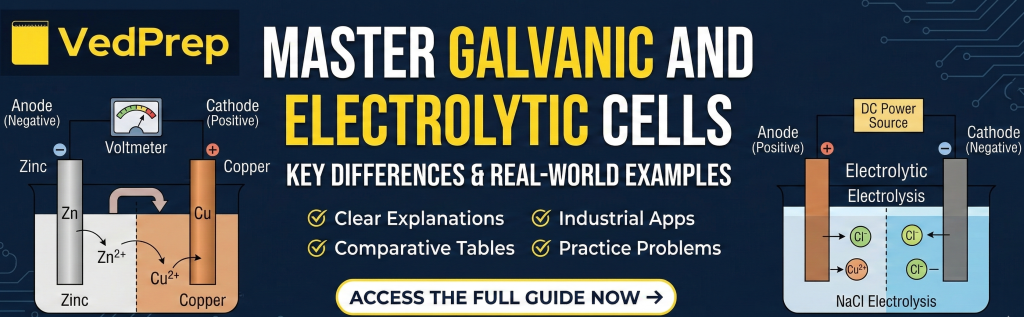
Let us meticulously analyze a standard examination example using a classic Zinc and Copper galvanic cell setup. The perfectly balanced chemical reaction is written as $\text{Zn(s)} + \text{Cu}^{2+}\text{(aq)} \rightarrow \text{Zn}^{2+}\text{(aq)} + \text{Cu(s)}$. The known standard electrode potential $E^\circ$ for this specific chemical reaction is measured at $1.10 \text{ V}$.
Imagine a scenario where the molar concentration of dissolved zinc ions is precisely $0.1 \text{ M}$, and the concentration of copper ions is exactly $0.01 \text{ M}$. We must definitively find the new operating cell voltage at a room temperature of 298 K. The integer number of transferred electrons $n$ equals 2.
The mathematical reaction quotient $Q$ is formed by the ratio $[\text{Zn}^{2+}] / [\text{Cu}^{2+}]$. We must deliberately ignore the solid metal states. Plugging in the given numbers provides a quotient of $Q = 0.1 / 0.01 = 10$.
Now, carefully insert these verified values directly into the simplified Nernst equation formula. We obtain the expression $E = 1.10 – \frac{0.0591}{2} \log_{10}(10)$. Since the value of $\log_{10}(10)$ is exactly 1, the surrounding math simplifies cleanly to $1.10 – 0.02955$.
The final calculated non-standard cell potential equals exactly $1.07 \text{ V}$. Exploring various Nernst equation examples like this proves mathematically that continually higher product concentrations steadily reduce the available electrical voltage.