



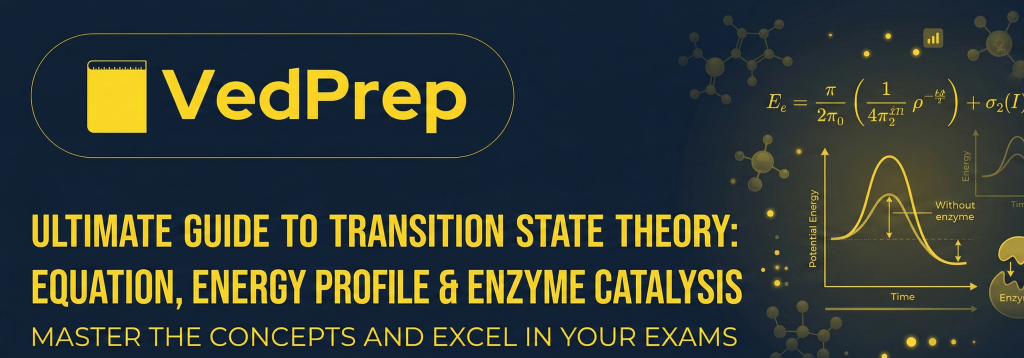

The transition state theory explains how chemical reactions occur by proposing the formation of a high-energy, unstable activated complex. It states that the reaction rate depends on the thermodynamic equilibrium between the reactants and this transient state, ultimately allowing us to calculate the rate constant using the Eyring equation and Gibbs activation energy.
Core Principles of Transition State Theory Explained
Transition state theory (TST) provides a thermodynamic and kinetic framework to understand the exact microscopic pathway a reaction takes from reactants to products.
Unlike collision theory, which treats molecules as hard spheres, TST looks at the precise structural and energetic changes during a chemical transformation. It assumes that as reactant molecules approach each other, their kinetic energy is converted into potential energy. This process continues until a maximum potential energy peak is reached.
At this peak for transition state theory, the molecules form an activated complex, existing in a highly unstable transition state. The theory postulates a quasi-equilibrium between the initial reactants and this activated complex. Once this complex forms, it can either proceed to form products or revert into reactants.
Here are the three foundational postulates you must remember for competitive exams:
- Quasi-Equilibrium: An equilibrium exists between the reactant molecules and the activated complex.
- Decomposition Rate: The overall reaction rate is determined by the rate at which the activated complex decomposes into products.
- Universal Frequency: The complex breaks down into products with a frequency dependent only on temperature, not on the specific nature of the complex itself.
The Energy Profile and Transition Diagram in Transition State Theory
Understanding the visual representation of reaction kinetics is crucial for interpreting complex exam questions regarding the transition diagram.
An energy profile maps the potential energy of the system against the reaction coordinate. The reaction coordinate represents the progress of the reaction along the minimum energy pathway. As reactants convert to products, the energy of the system changes dynamically.
The highest point on this energy profile corresponds to the transition state. The energy gap between the baseline reactant energy and this peak is the activation energy. Without sufficient kinetic energy to overcome this barrier, the reaction simply cannot proceed.
Key components of the energy profile include:
- Reactants: The initial state of the system before any bonds break.
- Transition State: The absolute energy maximum along the reaction coordinate.
- Activation Energy (Ea): The minimum energy required to reach the transition state.
- Products: The final, stable state of the molecules after the reaction concludes.
- Enthalpy of Reaction (ΔH): The difference in potential energy between products and reactants.
Decoding the Eyring Equation in Transition State Theory
The Eyring equation is the mathematical heart of transition state theory, linking classical thermodynamics with chemical kinetics.
While the Arrhenius equation is empirical, the Eyring equation provides a rigorous theoretical model to calculate the rate constant of a reaction. It allows chemists to determine the precise thermodynamic parameters of the activated complex. By analyzing the temperature dependence of the reaction rate, we can extract the entropy and enthalpy of activation.
The standard form of the Eyring equation is:
k = (κkBT / h) e-ΔG‡/RT
In this equation, the variables represent:
- k: The reaction rate constant.
- κ: The transmission coefficient (often assumed to be 1).
- kB: Boltzmann’s constant (1.38 × 10⁻²³ J/K).
- T: Absolute temperature in Kelvin.
- h: Planck’s constant (6.626 × 10⁻³⁴ J·s).
- ΔG‡: Gibbs activation energy.
- R: Universal gas constant (8.314 J/(mol·K)).
Because Gibbs activation energy is defined as ΔG‡ = ΔH‡ – TΔS‡, we can expand the Eyring equation into a highly useful linear form for exam calculations:
ln(k/T) = -(ΔH‡/R) · (1/T) + ln(κkB/h) + ΔS‡/R
Plotting ln(k/T) versus 1/T yields a straight line. The slope gives -ΔH‡/R, and the y-intercept provides ΔS‡/R. This is a frequent numerical problem format in advanced chemistry entrance exams.
Enzyme Catalysis: Biological Application of Transition State Theory
Transition state theory perfectly explains the extreme efficiency of enzyme catalysis in biological systems.
Enzymes do not alter the overall thermodynamics (ΔG) of a biochemical reaction. Instead, they accelerate the reaction rate by stabilizing the transition state. By binding strongly to the activated complex, enzymes lower the Gibbs activation energy required for the reaction to proceed.
The active site of an enzyme is uniquely shaped to be complementary not to the substrate itself, but to the transition state of the substrate. This concept, known as transition state stabilization, causes the substrate to stretch and bend toward the activated complex upon binding.
| Feature | Uncatalyzed Reaction | Enzyme-Catalyzed Reaction |
|---|---|---|
| Activation Energy | High | Significantly Lowered |
| Reaction Rate | Slow | Millions of times faster |
| Transition State Energy | Unstable, highly energetic | Stabilized by active site residues |
| Overall ΔG | Unchanged | Unchanged |
This principle is the basis for designing transition state analog drugs. Pharmacologists create inhibitors that mimic the geometry of the transition state, binding to the target enzyme much more tightly than the natural substrate and blocking its activity.
Reality Check: The “Intermediate vs. Transition State” Trap
A massive percentage of students lose critical exam marks by confusing reaction intermediates with transition states.
The Myth: Any species that forms between reactants and products is a transition state, and these terms can be used interchangeably in multi-step reactions.
The Reality: Intermediates and transition states are fundamentally different chemical entities with distinct properties on an energy profile. A transition state represents an energy maximum; it has zero lifetime and cannot be isolated under any circumstances. It is merely a fleeting arrangement of atoms as bonds are in the process of breaking and forming.
Conversely in transition state theory, a reaction intermediate sits in a local energy minimum on the reaction coordinate. While often highly reactive, an intermediate is a fully formed molecule with defined, complete bonds. It has a finite lifetime and, under specific conditions (like extreme cold), intermediates can sometimes be isolated and characterized using spectroscopic techniques.
If a diagram shows a “valley” between two peaks, the valley is the intermediate, and the peaks are two separate transition states.
4-Step Strategy to Master Transition State Theory for Competitive Exams
To conquer physical chemistry questions on this topic, you need a systematic, structured approach to your revision and problem-solving.
Follow this 4-step framework to ensure you extract maximum marks from kinetics questions involving TST:
Step 1: Master the Visuals (Day 1-2)
Do not just memorize definitions. Practice drawing the transition diagram for exothermic and endothermic reactions from memory. Label the activation energy, enthalpy change, and transition state. If you can visualize the energy profile, theoretical questions become trivial.
Step 2: Isolate the Mathematics (Day 3-5)
Write the expanded Eyring equation on a sticky note. Practice identifying the slope and intercept from the linear form: ln(k/T) vs 1/T. Solve at least 20 numerical problems where you must extract enthalpy (ΔH‡) and entropy (ΔS‡) of activation from experimental rate constant data.
Step 3: Contrast and Compare Theories (Day 6-7)
Create a comparative table between Arrhenius theory, Collision theory, and Transition state theory. Know exactly where TST improves upon the older models (e.g., incorporating entropy via ΔS‡ and providing a physical meaning to the pre-exponential factor). Examiners love to test your conceptual understanding of these differences.
Step 4: Analyze Multi-Step Pathways (Day 8-10)
Move beyond Transition state theory simple single-step reactions. Practice drawing and interpreting complex energy profiles with multiple peaks and valleys. Identify the rate-determining step (the step with the highest activation energy barrier) and distinguish between all intermediates and transition states in the mechanism.
Learn More :