
Preparing for competitive exams like IIT JAM, CSIR NET, or GATE can feel like a rollercoaster ride. One day you are on top of the world because you cracked a tough physical chemistry problem, and the next, you are scratching your head over molecular geometries. If there is one topic that acts as a absolute backbone for both inorganic and physical chemistry, it is chemical bonding. Master this, and you unlock a massive chunk of your syllabus.
At VedPrep, we look at chemical bonding not just as a set of rules to memorize, but as the underlying logic of how the microscopic world organizes itself. Let’s break down two of the biggest heavyweights in this chapter: VSEPR theory and Molecular Orbital Theory (MOT).
Syllabus: Understanding the Exam Syllabus and Key Textbooks
First things first, where does this actually fit in? If you look at the official IIT JAM syllabus, chemical bonding sits comfortably within the Physical and Theoretical Chemistry units, while heavily influencing your Inorganic Chemistry scores too. It is a high-yield topic, meaning the examiners love to test you on it every single year.
If you want to build a rock-solid foundation in chemical bonding, you can dive into standard textbooks like Physical Chemistry by Atkins and de Paula. It does a fantastic job with the mathematical and theoretical side of molecular orbitals. For a slightly different angle, especially on how these bonds behave in organic systems, books like Organic Chemistry by Clayden or even introductory texts by J. Clark give great clarity.
But let’s be honest: when you are racing against time for IIT JAM, you need to know exactly how to apply these concepts to tricky questions without getting bogged down in 800 pages of dense text. That is where focusing on core frameworks like VSEPR and MOT changes the game.
Chemical Bonding (VSEPR, MOT) For IIT JAM: Introduction and Basics
So, what is chemical bonding all about? At its core, it is just atoms trying to find stability. They interact, share, or transfer electrons to hit that energetic sweet spot. To explain how they do this and what the resulting molecules actually look like, scientists came up with different models.
As per chemical bonding, the VSEPR theory is your go-to tool for a quick structural blueprint. It works on a simple premise: electron pairs around a central atom are all negatively charged, so they hate being close to each other. They push apart as much as possible to minimize this repulsion. If you have two bonding groups and zero lone pairs, they blast to opposite sides, giving you a linear shape.
On the flip side, Molecular Orbital Theory (MOT) takes a quantum mechanics approach in chemical bonding. Instead of keeping electrons localized between two atoms, MOT mixes atomic orbitals together to create entirely new molecular orbitals that belong to the whole molecule. Think of it like melting two separate blocks of wax together to mold a completely new shape. This theory categorizes these new spaces into bonding, antibonding, and non-bonding molecular orbitals based on their energy levels.
Understanding these basics in chemical bonding is a non-negotiable step for IIT JAM aspirants. At VedPrep, we see students get stuck on advanced transition metal complexes simply because their foundational ideas about basic bonding were a bit shaky.
Key Concepts: Electron Pair Geometry and Molecular Shape
A classic trap in IIT JAM is confusing “electron pair geometry” with “molecular shape.” They sound identical, but they really aren’t.
Electron pair geometry looks at the total arrangement of all electron pairs around the central atom—both the ones actively bonding and the lone pairs sitting idly by. Molecular shape, however, only cares about where the actual atoms are.
Think of it like a three-legged stool. If a ghost sits on the stool, the overall geometry of the space includes the ghost and the legs. But if you can only see physical objects, you just see the three legs. The ghost is the lone pair: invisible to the final shape name, but actively taking up space and pushing the other legs around.
Here is how that plays out:
- Tetrahedral geometry: If you have four bonds, the shape is a perfect tetrahedron (CH₄). If you swap one bond for a lone pair, the geometry is still tetrahedral, but the molecular shape becomes trigonal pyramidal (NH₃). Swap another bond for a lone pair, and you get a bent shape (H₂O).
- Trigonal planar geometry: Three electron pairs pushing apart evenly at 120-degree angles (BF₃).
- Octahedral geometry: Six electron pairs creating an 8-sided spatial arrangement (SF6).
Worked Example: Applying VSEPR Theory to Predict Molecular Shape
Let’s walk through a classic exam-style problem together: predicting the shape of Xenon tetrafluoride (XeF4).
- Find the central atom valence electrons: Xenon is a noble gas, so it has 8 electrons in its outer shell.
- Count the sigma bonds: It bonds with four Fluorine atoms, using 4 electrons. That leaves 4 unbonded valence electrons.
- Calculate lone pairs: Those 4 remaining electrons pair up to form 2 lone pairs.
- Determine the Steric Number: Add the sigma bonds and lone pairs together (4 + 2 = 6).
Based on chemical bonding, a steric number of 6 means the electron pair geometry is octahedral. To minimize repulsion, the two lone pairs sit directly opposite each other at the top and bottom poles. This leaves the four Fluorine atoms sitting perfectly flat in a cross shape. The final molecular shape is square planar.
Misconceptions: Common Mistakes in Understanding Chemical Bonding
When the exam pressure is on, it is incredibly easy to make silly mistakes. Here are a few blunders we frequently flag for our students at VedPrep:
- Ignoring the lone pairs: Students often look at H₂O, see two bonds, and assume it is linear like CO₂.. Never forget to count the unbonded pairs on your central atom!
- Lone pair repulsion hierarchy: Remember that Lone Pair-Lone Pair (lp-lp) repulsion is much stronger than Lone Pair-Bond Pair (lp-bp) repulsion, which is stronger than Bond Pair-Bond Pair (bp-bp) repulsion. This unequal pushing distorts standard bond angles.
- Mixing up MOT filling order: For homonuclear diatomic molecules like B₂, C₂, and N₂, mixing causes the π2p orbitals to drop below the σ2p orbital in energy. But for O2 and F₂, the σ2p orbital stays lower. Getting this order backward completely ruins your bond order and magnetic property calculations.
Real-World Applications: Chemical Bonding in Materials Science
To make this feel a bit less abstract, let’s look at a fictional scenario to see how these bonding rules apply in the real world.
Imagine a materials science startup trying to design a next-generation shield for aerospace engineering. The engineers need a material that is ultra-lightweight but can withstand massive structural stress. They can’t just guess which elements to mix; they have to look at chemical bonding.
By analyzing the molecular orbitals of potential carbon-boron networks, they can map out the bond order. A higher bond order means a stronger, shorter bond, which translates to a higher melting point and better structural integrity.
They use VSEPR concepts to predict how these polymers pack together in chemical bonding. If the molecular shape is completely flat and planar, the molecules can stack tightly on top of each other like sheets of paper, making the material dense and incredibly tough. If the shapes are bulky and tetrahedral, the packing changes entirely. Every major material advancement, from the screen on your smartphone to bulletproof vests, relies on scientists manipulating these exact bonding principles.
Advanced Concepts: Molecular Orbital Theory and Its Applications
While VSEPR is great for quick shapes, it falls flat on complex electronic behavior. That is where Molecular Orbital Theory takes the wheel.
Instead of drawing static lines for bonds, MOT builds a ladder of energy states. You fill these states with electrons using the same rules you use for atoms (Aufbau principle, Pauli exclusion principle, and Hund’s rule).
This approach allows you to calculate the bond order using a straightforward formula:
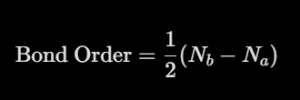
Where Nb is the number of electrons in bonding orbitals and Na is the number in antibonding orbitals. A fractional bond order? Totally fine in MOT. A bond order of zero? That means the molecule is too unstable to exist, which perfectly explains why we never see He2 floating around.
Final Thoughts
Based on chemical bonding, MOT is the ultimate tool for explaining things like magnetism. Before MOT, no one could quite explain why liquid oxygen gets stuck between the poles of a strong magnet. By drawing out the MOT diagram for O2, you instantly see two unpaired electrons sitting in the antibonding π* orbitals. Unpaired electrons mean paramagnetism—mystery solved!
Mastering these shifts between VSEPR geometry and MOT energy diagrams is what separates a top-rank IIT JAM scorer from the rest of the pack. Take your time with the molecular orbital diagrams, draw them out by hand, and you will start seeing the patterns in no time.
To know more in detail from our faculty, watch our YouTube video:
Frequently Asked Questions
What is MOT?
Molecular Orbital Theory (MOT) explains how atomic orbitals combine to form molecular orbitals, describing the distribution of electrons within a molecule. MOT helps predict molecular properties like bond order and magnetic behavior.
How do electron pairs affect molecular shape?
Electron pairs, whether bonding or non-bonding, repel each other. According to VSEPR, these pairs arrange to be as far apart as possible, determining the molecular geometry. For example, two electron pairs form a linear shape, while four pairs form a tetrahedral shape.
What are the key postulates of VSEPR?
The key postulates of VSEPR are: (1) electron pairs repel each other, (2) electron pairs arrange to minimize repulsion, and (3) the arrangement of electron pairs determines the molecular shape. These postulates help predict the geometry of molecules.
How does MOT explain bonding?
MOT explains bonding as the combination of atomic orbitals to form molecular orbitals. Electrons occupy these molecular orbitals, leading to bond formation. The number of electrons in bonding orbitals minus those in antibonding orbitals gives the bond order, indicating bond strength.
What are the types of chemical bonds?
The main types of chemical bonds are ionic, covalent, and metallic bonds. Covalent bonds involve electron sharing and are relevant to VSEPR and MOT. Understanding these bond types helps in predicting molecular properties.
How do electronegativity differences affect bonding?
Electronegativity differences between atoms influence bond polarity and character. A large difference typically indicates an ionic bond, while a small difference suggests a covalent bond. This affects molecular properties and reactivity.
How to apply VSEPR to solve IIT JAM questions?
To apply VSEPR in IIT JAM, identify the central atom, count electron pairs, and use the VSEPR chart to predict the molecular shape. Practice with various molecules and reactions to build problem-solving skills. This approach helps in quickly determining molecular geometries.
What are common IIT JAM questions on MOT?
Common IIT JAM questions on MOT involve determining bond order, predicting molecular properties, and understanding orbital interactions. Practice solving problems related to homonuclear and heteronuclear diatomic molecules to master MOT applications.
What are common mistakes in applying VSEPR?
Common mistakes in VSEPR include not counting lone pairs, misinterpreting electron pair arrangements, and neglecting to consider multiple bonds as one electron pair. Carefully counting electron pairs and considering their effects ensures accurate predictions.
How to avoid errors in MOT calculations?
To avoid errors in MOT, ensure correct counting of electrons, properly combine atomic orbitals, and distinguish between bonding and antibonding orbitals. Practice with simple molecules to build confidence in calculating bond orders and molecular properties.
What are misconceptions about chemical bonding?
Misconceptions include thinking that VSEPR and MOT are mutually exclusive, or that molecular shape is solely determined by one theory. Understanding that both theories complement each other provides a comprehensive view of chemical bonding.
How does VSEPR apply to transition metals?
For transition metals, VSEPR considers the coordination number and geometry around the central metal atom. This helps predict the arrangement of ligands and the overall complex geometry, which is crucial in understanding their reactivity.
What are the limitations of MOT?
MOT has limitations, such as not fully explaining molecular properties like reactivity and not accurately predicting bond lengths and angles. These limitations highlight the need for combining MOT with other theories for a complete understanding.
How does chemical bonding relate to quantum mechanics?
Chemical bonding is fundamentally rooted in quantum mechanics, which explains electron behavior and orbital interactions. Understanding quantum principles provides deeper insights into the nature of bonds and molecular properties.