

Dipole moments For IIT JAM refer to the measure of separation between two opposite charges within a molecule, influencing its polarity and behavior, a crucial concept in various competitive exams like IIT JAM, CSIR NET, and GATE.
Dipole moments For IIT JAM
The topic of dipole moments falls under the Physical Chemistry unit in the IIT JAM syllabus, which is also a part of the official CSIR NET / NTA syllabus, specifically under the unit “Physical Chemistry”. Understanding dipole moments is essential for students preparing for IIT JAM and CSIR NET exams.
Students can refer to standard textbooks such as Atkins’ Physical Chemistry and Lehninger for in-depth coverage of this topic. These textbooks provide a comprehensive explanation of dipole moments, including their definition, units, and applications.
A dipole moment is a measure of the separation of positive and negative electrical charges within a system. It is a fundamental concept in physical chemistry and is used to describe the polarity of molecules. Dipole moments are typically measured in units of Debye (D).
Key topics related to dipole moments include the calculation of dipole moments, the relationship between dipole moments and molecular structure, and the applications of dipole moments in understanding chemical properties and behavior.
Dipole moments For IIT JAM
Let’s strip away the heavy textbook jargon for a second. A dipole moment is simply a way to measure how unevenly electrical charge is distributed inside a molecule. Think of it as a molecular tug-of-war. When two atoms share electrons to form a covalent bond, they don’t always share them equally.
It is a vector quantity, which means direction matters just as much as magnitude. We define it as the product of the charge (q) and the distance (d) between the centers of positive and negative charges:
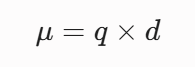
This value directly influences how molecules interact with each other, affecting real-world properties like boiling points and solubility. When electrons spend more time around one atom than the other, you get a partial negative charge on one end and a partial positive charge on the other. That gives you a polar molecule with a non-zero dipole moment.
When you have multiple bonds in a molecule, the net dipole moment is just the vector sum of all those individual bond dipoles. If everything balances out perfectly, you get a non-polar molecule with a net dipole moment of zero. Here at VedPrep, we always remind students that visualizing these vectors early on makes the complex exam questions much easier to handle.
Worked Example: Calculating Dipole Moments
The molecular dipole moment is a measure of the separation of positive and negative electrical charges within a molecule. It is defined as the product of the charge and the distance between the centers of positive and negative charges. The dipole moment (μ) can be calculated using the formula:
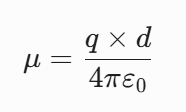
where ε0 is the electric constant or permittivity of free space.
Consider the CO2 molecule, which has a linear geometry with two oxygen atoms bonded to a central carbon atom. The molecule has a bond length of 116 pm and a charge distribution of +0.5e on the carbon atom and $-0.25e$ on each oxygen atom. To calculate the dipole moment of CO2, note that the individual bond dipole moments do not directly add up to give the molecular dipole moment.
The dipole moment of CO2 can be calculated as follows:
-
Charge on each oxygen atom: -0.25e = -0.25 × 1.602 × 10-19 C
-
Distance between carbon and oxygen atoms: 116 pm = 116 × 10-12 m
-
μ = 0, due to symmetrical, linear shape
In this case, the dipole moment of CO2 is zero because its symmetrical linear shape causes the individual bond dipole moments to pull in exactly opposite directions and cancel each other out. This example shows why you always need to look at molecular geometry before doing heavy math.
Common Misconceptions About Dipole Moments For IIT JAM
A major trap that many JAM aspirants fall into is thinking that dipole moments only matter when a molecule is polar. That is an easy mistake to make, but it misses the bigger picture. Every single polar covalent bond has a dipole moment vector; it is just that symmetric molecules cancel them out overall.
Another classic misconception is that stronger bonds automatically mean higher dipole moments. That isn’t how it works. A triple bond is incredibly strong, but it won’t give you a massive dipole moment unless there is a major difference in electronegativity and a proper separation distance.
Take carbon monoxide (CO) as an example. It has a very strong, tight bond, but because oxygen pulls hard on that electron cloud, it still maintains a distinct, substantial dipole moment. Getting these nuances straight is exactly what separates the top rankers from the rest of the pack, and it’s a core focus of how we break down concepts at VedPrep.
Real-World Applications Of Dipole Moments For IIT JAM
Why do we care about this so much? Let’s look at a quick, fictional scenario to make it real. Imagine a lab team trying to design a new liquid cleaning solution that needs to dissolve greasy oils without evaporating instantly. If they pick a solvent with a dipole moment near zero, it won’t mix with polar stains like coffee or sweat. They have to balance the molecular dipole moments to get the exact solubility and boiling point they want.
In the real world, medicinal chemists use this exact line of thinking when designing pharmaceuticals. The dipole moment of a drug molecule dictates how it binds to target proteins in the body. If the charges don’t align with the protein’s binding pocket, the drug won’t stick, reducing its efficacy.
Beyond drug design, dipole moments are heavily used in spectroscopy (like predicting whether a molecule will show up in an IR spectrum) and materials science to build advanced electronics with precise optical properties.
Dipole moments For IIT JAM
Mastering this topic for competitive exams requires a mix of solid theory and visual practice. Don’t just stare at formulas on a page. Grab your notebook, open up your physical chemistry textbooks, and start drawing out structures.
Here is a quick breakdown of how to spend your study time effectively:
-
Master the geometry: You cannot find the net dipole moment if you don’t know the VSEPR shape of the molecule.
-
Practice the math: Work through numerical problems where you have to convert standard charge and distance values into Debye units.
-
Look at past years’ papers: See how examiners hide tricky symmetrical shapes in complex-looking molecules.
We build our study materials at VedPrep around these exact focus areas so you can spot the examiners’ traps instantly on exam day.
Important Factors Influencing Dipole Moments For IIT JAM
When you are analyzing a molecule, three main things determine the net dipole moment:
-
Magnitude of Charge & Distance: A larger charge separation or a longer distance between those centers means a higher dipole moment value.
-
Electronegativity Difference: This is the driving force behind bond polarity. The wider the gap between the two bonding atoms on the periodic table, the harder one atom will tug on the shared electrons.
-
Molecular Shape: This is the ultimate dealbreaker. If a molecule has highly polar bonds but is perfectly symmetrical (like BF3 or CCl4), the individual vectors point in opposing directions and add up to zero.
Tips For Solving Dipole Moment Problems In IIT JAM
When you are sitting in the exam hall and a tough dipole question pops up, don’t panic. Follow these simple steps to keep your answers accurate:
-
Draw vector diagrams: Always draw little arrows pointing from the electropositive atom to the electronegative atom. It makes visualizing the cancellation or addition of dipoles incredibly easy.
-
Calculate with care: Double-check your given data. Remember that Dipole moment (μ) = charge (q) × distance (d).
-
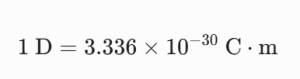
Watch your units: This is where most students lose easy marks. Keep an eye on your conversions. Dipole moments are almost always written in Debye ($D$), and you should remember the standard conversion factor:
Final Thoughts
Cracking dipole moment questions on the IIT JAM comes down to looking past the raw numbers and visualizing the actual 3D geometry of the molecule. It is a topic where examiners love to test your spatial awareness, but once you get comfortable drawing out your vector arrows and checking for molecular symmetry, those seemingly complex structural problems start to feel like second nature. Balancing your physical chemistry formulas with a solid grasp of chemical bonding is what will really give your scores a lift. Just take it one molecule at a time, keep practicing those unit conversions, and remember that we are always here at VedPrep to help you connect the dots throughout your preparation journey.
To learn more in detail from our expert faculty, watch our YouTube video:
Frequently Asked Questions
Why is the dipole moment considered a vector quantity?
Because it doesn't just matter how much charge is separated; it matters where that charge is moving. A vector has both a magnitude (how polar the bond is) and a direction (pointing from the electropositive atom to the electronegative one). This directional nature is exactly why individual bond polarities can cancel each other out in symmetrical molecules.
Can a molecule have polar bonds but a net dipole moment of zero?
This is a classic examiner favorite. Molecules like CO2, BF3, and CCl4 contain highly polar individual bonds because of large electronegativity differences. However, because the shapes are perfectly symmetrical, the pulling forces point in exactly opposite directions and completely cancel out, leaving the net dipole moment (μ) at zero.
What is the difference between a bond dipole and a molecular dipole moment?
A bond dipole is the local charge separation between just two specific atoms sharing a covalent bond. A molecular dipole moment is the net result when you add up all the individual bond dipoles inside the entire molecule using vector addition.
How does electronegativity affect the dipole moment?
Generally, the larger the electronegativity difference between two bonded atoms, the greater the partial charges (q) developed on them. Since dipole moment depends directly on charge (μ = q × d), a wider gap on the periodic table usually leads to a larger bond dipole.
Why does bond length matter when calculating dipole moments?
Because the formula is μ = q × d, where d is the distance between the charge centers. Even if the partial charge is relatively small, a significantly longer bond can sometimes result in a noticeable dipole moment. It is always a balancing act between the amount of charge and the distance separating them.
How does the presence of a lone pair affect a molecule's dipole moment?
Lone pairs are huge electron clouds that aren't shared between two nuclei, meaning they create a very strong, localized dipole moment pointing away from the central atom. In molecules like NH3 or H2O, the lone pair dipoles often point in a similar direction as the bond dipoles, massively boosting the overall molecular dipole moment.
Between bond length and electronegativity difference, which factor usually dominates?
In the vast majority of cases, the electronegativity difference (charge q) wins the tug-of-war and dictates the trend. A famous exception you should remember for the JAM exam is the methyl halide series, where CH3Cl actually has a slightly higher dipole moment than CH3F because the significantly longer C-Cl bond length overrides the higher electronegativity of fluorine.
How do you compare the dipole moments of cis and trans isomers?
For symmetrical alkenes, the cis isomer will have a net dipole moment because the groups pull or push on the same side of the double bond, reinforcing each other. The trans isomer usually has a dipole moment of zero (or close to it) because the identical groups are oriented diagonally opposite to each other, perfectly canceling out their electronic pulls.
Do all aromatic compounds with polar substituents have a dipole moment?
Not necessarily. It depends entirely on the orientation of the substituents on the benzene ring. For instance, para-dichlorobenzene has a dipole moment of zero because the two C-Cl bonds are at a 180° angle across the ring and cancel out, whereas ortho and meta dichlorobenzenes retain a net dipole.
How can I use dipole moments to predict the solubility of a compound?
Just remember the golden rule of solutions: "like dissolves like." Molecules with high net dipole moments are polar and dissolve easily in polar solvents like water. Non-polar molecules (dipole moment of zero) prefer non-polar solvents like benzene or hexane.
What is the relationship between dipole moments and boiling points?
Molecules with higher dipole moments experience stronger intermolecular forces—specifically dipole-dipole attractions. Because these molecules stick together more tightly, it takes significantly more thermal energy to break them apart into a gas, resulting in higher boiling points compared to non-polar molecules of similar mass.
How does a molecule's dipole moment influence its behavior in an electric field?
When you place polar molecules into an electric field, they act like tiny compass needles. The positive ends rotate to align toward the negative plate, and the negative ends turn toward the positive plate. Non-polar molecules with a dipole moment of zero won't show this orientation behavior.