
IR spectroscopy is a crucial analytical technique used to identify functional groups in organic compounds, crucial for IIT JAM and other competitive exams. It involves measuring the absorption of infrared radiation by molecular vibrations.
IR Spectroscopy (Functional Groups) For IIT JAM: Syllabus and Key Textbooks
Cracking the IIT JAM requires a solid game plan, especially when it comes to the Organic and Physical Chemistry sections. A massive chunk of that success relies on mastering IR spectroscopy, specifically how it helps us spot functional groups. If you look at the official syllabus, you will find this tucked under the core molecular spectroscopy topics.
To really get a grip on the fundamentals without pulling your hair out, standard textbooks are your best friends. Most students swear by Atkins’ Physical Chemistry and Levine’s Physical Chemistry. They dive deep into the math and mechanics behind the scenes. For the practical, structure-solving side that you will actually face in the exam, flipping through Pavia or Kalsi is also a lifesaver. We always tell our students at VedPrep that combining the theoretical backbone from Atkins with hands-on spectral decoding is the secret recipe to scoring high.
Remember, IR spectroscopy is just a clever way to figure out what functional groups are hanging out in an unknown molecule. Think of functional groups as the business end of a molecule—they dictate how it behaves, reacts, and shines. Master this, and you secure crucial marks in your paper.
IR spectroscopy (Functional groups) For IIT JAM: Overview
what exactly is IR spectroscopy? In plain English, it is a technique that lets us identify specific functional groups in organic compounds. Think of it like a security scanner at an airport, but for molecules. It works by shining infrared radiation through a sample and measuring how the molecular bonds vibrate and dance in response.
The core principle is simple: every functional group has its own unique bond strength and atom masses. Because of this, they absorb infrared light at very specific frequencies. The resulting chart—the spectrum—ends up looking like a barcode or a fingerprint. No two unique compounds have the exact same footprint.
This is not just textbook theory, either. Industries all over the world rely on this daily. Imagine a giant pharmaceutical plant making batches of medicine, or a tech company synthesizing advanced polymers. They use IR spectroscopy to check if their reactions went smoothly. For your exam, you will need to get incredibly comfortable recognizing heavy-hitters like the hydroxyl group (-OH), the carbonyl group (C=O), and the amine group (-NH2).
Understanding IR Spectroscopy: Theory and Instrumentation
To understand how IR spectroscopy works, picture a simple weight-and-spring system. In a molecule, the atoms are the weights and the chemical bonds are the springs. When infrared light hits them, they absorb energy and start stretching or bending.
When you look at the machinery, labs generally use two main types of instruments: Fourier transform infrared spectroscopy (FTIR) and dispersive infrared spectroscopy (DIR). FTIR is the modern gold standard. It uses a clever mathematical trick (the Fourier transform) to collect all the data at once, making it lightning-fast. DIR is more old-school, using a prism or a grating to split the light up piece by piece.
You also need to get samples into the machine somehow. Labs use different tricks depending on the state of the matter:
-
Transmission: Beaming the light straight through a thin sample.
-
Reflection: Bouncing the light off the surface.
-
Attenuated Total Reflection (ATR): Pressing a solid or liquid sample against a special crystal to get a clean reading without tedious prep.
For exams like IIT JAM, CSIR NET, or GATE, you do not need to know how to repair these machines. Instead, focus on how the mechanics translate to data. Knowing how a bond stretches helps you instantly solve structure puzzles on exam day.
IR Spectroscopy (Functional Groups) For IIT JAM: Worked Example
Let’s look at a classic problem you might see in the exam.
The Problem: An unknown compound shows a sharp, intense peak at 1720 cm⁻¹ and a weaker, slightly split peak near 2700 cm⁻¹. The researcher thinks there is a carbonyl group somewhere. Can you identify the functional group?
Here is how you crack it:
-
That massive peak at 1720 cm⁻¹ is a dead giveaway. Carbonyl groups (C=O) almost always show up as a strong spike between 1650 and 1750 cm⁻¹.
-
The weak peak at 2700 cm⁻¹ is the smoking gun. It represents the specific C-H stretch of an aldehyde.
Putting those two clues together, the compound must contain an aldehyde group (RCHO). A perfect real-world match for this data would be propanal (CH₃CH₂CHO). In a real lab setting, you would want to double-check this with 1H NMR or mass spectrometry to be absolutely certain, but for a standalone test question, your IR data lands you squarely on an aldehyde.
Common Misconceptions in IR Spectroscopy
A lot of students get tripped up by a few common myths when studying IR spectroscopy. Let’s clear the air on those.
First, some people assume IR cannot help you deduce a molecule’s structure. That is completely wrong. While it might not map out the carbon backbone like NMR does, it instantly tells you the building blocks you are working with by identifying the functional groups.
Another big point of confusion is the relationship between the wavenumber (measured in cm⁻¹) and energy. Just remember: higher wavenumbers mean higher energy and faster vibrations. Stronger bonds (like C≈C vs C=C) or lighter atoms require more energy to vibrate, so they show up much higher on the chart.
Lastly, do not confuse peak intensity with concentration alone. Yes, a highly concentrated sample can make peaks deeper, but the real driver behind a huge peak is the change in dipole moment during the vibration. Highly polar bonds, like the C=O bond, cause a massive shift in dipole moment when they stretch, giving you those unmistakable, deep peaks on the spectrum.
IR Spectroscopy in Real-World Applications
To make this concrete, let’s step out of the exam hall for a second and see how this plays out in real life.
Fictional Scenario: Imagine a quality control chemist named Maya working at a pharmaceutical startup. Her team is manufacturing a life-saving antibiotic, but a tiny chemical side-reaction keeps happening, creating an unwanted impurity. Instead of waiting days for expensive, complex testing, Maya runs a quick IR spectroscopy scan on the batch. Within minutes, a rogue peak pops up at 3400 cm⁻¹, signaling an unexpected alcohol group. She immediately knows where the synthesis line went wrong and fixes it, saving the company thousands of dollars.
Similarly, polymer scientists use these exact spectral scans to analyze plastic chains, ensuring your running shoes are flexible yet durable. Even in medical research, scientists use IR to spot tiny structural changes in biological tissues, helping map out early disease biomarkers. It is a incredibly versatile tool.
Exam Strategy for IR Spectroscopy (Functional Groups) For IIT JAM
When you sit down to study this for the JAM, do not just mindlessly memorize numbers. Start by understanding the core physics of the interferometer and how the spectrometer actually registers a signal.
Next, build yourself a mental “cheat sheet” of the core functional group frequencies. You should be able to look at a spectrum and instantly point out the broad alcohol scoop, the sharp carbonyl spike, or the messy carboxylic acid region. At VedPrep, we always emphasize active problem-solving over passive reading. Try to solve at least 10 to 15 spectroscopic identification questions every single week.
Combine your theoretical concepts with hard pattern recognition. If you can balance knowing why a bond vibrates with where it vibrates on the graph, you will save precious time during the exam and breeze right through the chemistry section.
IR Spectroscopy (Functional Groups) For IIT JAM: Important Subtopics and Study Tips
To wrap things up, here is a quick checklist of what you should focus on during your study sessions:
-
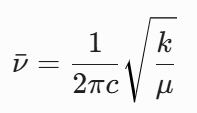
Hooke’s Law Application: Master the formula for vibrational frequency:
-
Understand how the force constant (k) and reduced mass (μ) shift the peaks.
-
Fingerprint vs. Functional Group Region: Know the difference between the functional group zone (above 1500 cm⁻¹) and the complex fingerprint zone (below 1500 cm⁻¹).
-
Effects of Hydrogen Bonding: Pay close attention to how internal vs. external hydrogen bonding shifts and broadens -OH and -NH stretching frequencies.
Final Thoughts
Wrapping it all up, mastering IR spectroscopy isn’t about memorizing a dry list of numbers—it’s about learning to read the unique shorthand of molecules. When you look at an IR spectrum on exam day, don’t see it as a confusing web of spikes; see it as a puzzle waiting to be solved using basic chemical logic. With consistent practice, decoding these vibrational fingerprints will start to feel like second nature, giving you a massive confidence boost when you face the physical and organic chemistry sections of the IIT JAM.
To learn more in detail from our faculty, watch our YouTube video:
Frequently Asked Questions
How does IR spectroscopy work?
IR spectroscopy works by passing infrared radiation through a sample, causing the molecules to vibrate. The absorbed radiation is then measured, producing a spectrum that can be used to identify functional groups.
What are functional groups in IR spectroscopy?
Functional groups are specific groups of atoms within a molecule that give characteristic IR absorption peaks, allowing for their identification.
What is the significance of IR spectroscopy in Inorganic Chemistry?
IR spectroscopy is used in Inorganic Chemistry to identify the presence of specific functional groups, such as metal-ligand bonds, in inorganic compounds.
How is IR spectroscopy used in Instrumental Methods?
IR spectroscopy is a type of instrumental method used to analyze the molecular structure of compounds, providing information on the presence of functional groups.
What is the relationship between IR spectroscopy and molecular structure?
IR spectroscopy provides information on the molecular structure by measuring the vibrations of atoms within a molecule, allowing for the identification of functional groups.
What is the role of IR spectroscopy in quality control?
IR spectroscopy is used in quality control to rapidly analyze the composition of materials and detect any impurities or contaminants.
What are the limitations of IR spectroscopy?
The limitations of IR spectroscopy include its inability to provide detailed information on molecular structure, its sensitivity to sample preparation, and potential interference from other spectroscopic techniques.
How can IR spectroscopy be applied in IIT JAM?
IR spectroscopy is a crucial topic in IIT JAM, and understanding its application in identifying functional groups can help in solving problems related to molecular structure and analysis.
What type of questions can be expected in IIT JAM on IR spectroscopy?
In IIT JAM, questions on IR spectroscopy may include identifying functional groups from a given IR spectrum, interpreting IR spectra, and understanding the principles of IR spectroscopy.
How can IR spectroscopy be used to distinguish between different isomers?
IR spectroscopy can be used to distinguish between different isomers by analyzing the unique IR absorption peaks of each isomer.
What are common mistakes made in interpreting IR spectra?
Common mistakes include misinterpreting peak positions, not considering the molecular structure, and overlooking the presence of multiple functional groups.
How can one avoid mistakes in IR spectroscopy?
To avoid mistakes, one should carefully analyze the IR spectrum, consider the molecular structure, and use reference spectra to confirm the presence of functional groups.
What are some advanced applications of IR spectroscopy?
Advanced applications of IR spectroscopy include its use in imaging techniques, such as IR microscopy, and in the analysis of complex biological systems.
How has IR spectroscopy evolved over time?
IR spectroscopy has evolved significantly, with advancements in instrumentation, data analysis, and its application in various fields, including Inorganic Chemistry and biology.