






Number or function collections, termed Matrices, are utilized to represent straight-line transformations and solve sets of linear equations. In the IIT JAM Maths Curriculum for 2026, these form the core component of linear algebra. Skillfulness with ideas such as rank, nullity, and characteristic values allows students to investigate vector spaces and confirm solution presence across complex algebraic structures.
Understanding Matrices in the IIT JAM Maths Syllabus 2026
The IIT JAM Maths Syllabus 2026 highlights Matrices as a core component within Linear Algebra, carrying considerable importance. A firm foundation requires understanding the intrinsic properties of square, identity, symmetric, and skew-symmetric matrices. Advancement in this section moves past simple arithmetic to encompass abstract applications in vector spaces.
The Linear Algebra for IIT JAM mandates a thorough exploration of the algebra of matrices. You’ll engage with processes such as summing matrices, multiplying by scalars, and matrix product formation. Every such operation adheres to particular rules governing how data is handled within a system of linear equations. The course places significant focus on square matrices due to their distinctive characteristics, notably determinants and multiplicative inverses.
| Topic Category | Core Sub-topics |
|---|---|
| Basic Operations | Addition, Multiplication, Transpose, Trace |
| Structural Types | Symmetric, Skew-Symmetric, Hermitian, Unitary |
| System Analysis | Rank, Nullity, Row Echelon Form |
| Advanced Theory | Eigenvalues, Eigenvectors, Cayley Hamilton Theorem |
Solving a System of Linear Equations Using Matrices
A system of linear equations includes a number of equations with shared variables. The representation of these systems is AX = B. Here, A represents the coefficient matrix, X is the column vector of variables, and B is the constant vector.
Determining whether a system has a unique solution, infinite solutions, or no solution depends on the rank of the augmented matrix. If the rank of A equals the rank of the augmented matrix [A|B], a solution exists. When this rank matches the number of variables, you find a unique solution. You must understand linear equations in Matrices to solve complex problems.
Numerical Example:
Consider the system:
x + iy = 0
ix + y = 0
The coefficient matrix A is:

The determinant is 1(1) – i(i) = 1 – (-1) = 2. Since the determinant is non zero, the only solution for this homogeneous system is the trivial solution x=0, y=0.
Determining Rank and Nullity in Linear Algebra
Rank represents the maximum number of linearly independent row or column vectors in Matrices. You calculate rank by transforming a matrix into its row echelon form using elementary row operations. The number of non zero rows in this form indicates the rank.
Nullity refers to the dimension of the null space, which contains all vectors X such that AX = 0. The Rank-Nullity Theorem provides a fundamental relationship for any m x n matrix. It states that the sum of the rank and the nullity equals the number of columns n.
If you have a 3 x 3 matrix with a rank of 2, the nullity must be 1. This means there is one free variable in the solution set. Understanding this balance helps you predict the behavior of linear transformations during the exam.
Calculating the Inverse and Determinant of Matrices
The determinant is a scalar value that provides essential information about a square matrix. You use it to check if a matrix is invertible. A matrix A possesses an inverse A-1 only if its determinant is non zero.
The inverse satisfies the condition AA-1 = I, where I is the identity matrix. For a 2 x 2 matrix, you find the inverse by swapping the diagonal elements, changing the signs of off diagonal elements, and dividing by the determinant.
Numerical Example:
For matrix M =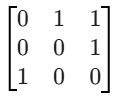
The inverse M-1 can often be expressed in terms of the matrix itself or its powers using the Cayley Hamilton Theorem. Calculation shows M-1 = I – M2 or similar polynomial forms depending on the characteristic equation.
Analysis of Eigenvalues and Eigenvectors
Eigenvalues and Eigenvectors describe how a linear transformation scales a vector in a specific direction. You find eigenvalues λ by solving the characteristic equation det(A – λI) = 0. Each eigenvalue has a corresponding eigenvector X that satisfies AX = λX.
The sum of all eigenvalues matches the matrix’s trace. The product of all eigenvalues is equivalent to the matrix’s determinant. Such properties allow you to quickly verify your calculations during the IIT JAM examination. As a topic covered under Matrices, candidates should practice previous year papers to understand Eigenvalues and Eigenvectors.
| Theorem / Formula | Mathematical Representation | Key Property |
|---|---|---|
| Trace Property | Σ λi = Trace(A) | Sum of diagonal elements |
| Determinant Property | Π λi = det(A) | Product of all eigenvalues |
| Cayley Hamilton Theorem | f(A) = 0 | Matrix satisfies its characteristic equation |
| Eigenvalues of Am | λm | Powers of eigenvalues correspond to powers of A |
| Inverse Eigenvalues | 1/λ | Reciprocal of eigenvalue for A-1 |
Practical Application of the Cayley Hamilton Theorem
The Cayley-Hamilton Theorem declares that each square matrix adheres to its characteristic equation. This theorem serves as an essential instrument for determining the inverse of substantial matrices or computing elevated powers of one.
If the characteristic equation of a matrix A is λ2 – 4λ + 8 = 0, then A2 – 4A + 8I = 0. You can rearrange this to find A-1 by multiplying the entire equation by A-1. This yields A – 4I + 8A-1 = 0, leading to A-1 = (4I – A) / 8.
Numerical Example:
A 2 x 2 matrix has a trace of 4 and a determinant of 8. If one eigenvalue is 2(1 + i), let the other be λ2.
Using the trace property: 2 + 2i + λ2 = 4.
Therefore, λ2 = 4 – 2 – 2i = 2 – 2i = 2(1 – i).
This matches the product property since (2+2i)(2-2i) = 4 – 4i2 = 4 + 4 = 8.
Critical Perspective on Rank and Matrix Consistency
Common methods frequently propose that a greater rank consistently signifies a “superior” matrix. This view is incorrect within the scope of physical constructs or data representation. For numerous practical uses, a reduced rank or “low-rank estimate” is favored to eliminate unwanted interference.
If a matrix maintains full rank, it assures a unique solution for a set of linear equations; nevertheless, this condition can make it quite sensitive to small alterations in the constants B. This trait is called being ill-conditioned. As you prepare for the IIT JAM, recall that simply having an inverse does not always signify a solution that is both computationally feasible and numerically stable. To manage this, one should investigate the matrix’s condition number, calculated as the quotient of its largest eigenvalue divided by its smallest.
Real World Use Case: Cryptography and Transformations
Matrices function as the fundamental method powering modern digital defense through cryptography. When securing a communication, you convert textual information into a numerical array. Following this, you multiply this starting “data matrix” by a “key matrix” to conceal the data. The person meant to receive it requires the inverse of the security matrix to decipher and retrieve the original material.
Within digital imagery, altering physical movements like sizing, rotating, and reflecting is handled by matrices. As an object progresses inside a game, the program applies a rotation matrix to every point in the model’s shape. This facilitates smooth traversing within a three-dimensional environment via straightforward matrix multiplication.
The theoretical foundation for these innovations stems from Linear Algebra for IIT JAM. Improving your handling of systems of linear equations and knowledge of eigenvalue characteristics empowers you to construct models for intricate physical and financial frameworks. Applicants are required to work through past IIT JAM Maths to gain practice with questions on matrices.
Final Thoughts
Excelling in the IIT JAM Mathematics 2026 exam relies on your knack for connecting abstract matrix theories with concrete computational skills. Familiarity with concepts like the Rank-Nullity theorem and the Cayley Hamilton theorem provides a distinct advantage when solving system of linear equations. These topics are central scoring areas where precision in finding eigenvalues and matrix inverses can significantly elevate your overall result.
As you move along the curriculum, keep in mind that straight algebra underpins contemporary scientific uses stretching from secret writing to hereditary modeling. Consistent practice with prior test questions eases your familiarity with the rigorous nature of the entrance assessment. VedPrep provides comprehensive resources to support your mastery in these quantitative subjects. By integrating these testing tools into your learning regimen, you transform difficult conceptual hurdles into manageable, structured solutions.
Frequently Asked Questions (FAQs)
What is the role of a System of Linear Equations in Linear Algebra?
A System of Linear Equations consists of multiple linear equations sharing the same variables. You represent these systems using matrix equations to determine the existence of solutions. Understanding these systems allows you to calculate intersections of planes or lines in multidimensional space.
How does the IIT JAM Maths Syllabus 2026 define matrix rank?
The IIT JAM Maths Syllabus 2026 defines rank as the maximum number of linearly independent row or column vectors in a matrix. Rank helps you identify the consistency of a System of Linear Equations. You calculate rank by converting a matrix into its row echelon form.
What is the Rank-Nullity Theorem?
The Rank-Nullity Theorem states that the sum of the rank and nullity of a matrix equals the number of columns in that matrix. This theorem connects the dimension of the image of a linear transformation to its kernel. It is a mandatory topic for Linear Algebra for IIT JAM.
What are Eigenvalues and Eigenvectors?
Eigenvalues are scalar values that represent the factor by which an eigenvector is scaled during a linear transformation. Eigenvectors are non zero vectors that do not change direction under that same transformation. These properties are essential for diagonalizing matrices and solving complex differential equations.
How do you solve a System of Linear Equations using the inverse method?
You solve a system by finding the inverse of the coefficient matrix and multiplying it by the constant vector. This method only works if the coefficient matrix is square and its determinant is non zero. It provides a unique solution for the variables involved.
What is the process for finding the inverse of a matrix?
You find the inverse by calculating the matrix of cofactors, taking its transpose to find the adjugate, and dividing by the determinant. The resulting matrix satisfies the property that its product with the original matrix yields the identity matrix. This is a common requirement in IIT JAM questions.
How do you calculate the trace of a matrix?
The trace of a matrix is the sum of all elements located on the main diagonal. In Linear Algebra for IIT JAM, the trace also equals the sum of the eigenvalues of the matrix. This property serves as a quick verification tool during competitive examinations.
Why does a matrix have no inverse?
A matrix has no inverse if its determinant equals zero, making it a singular matrix. This often occurs when row vectors are linearly dependent. In a System of Linear Equations, this indicates the system has either no solution or infinitely many solutions.
What happens when the rank of a matrix is less than the number of variables?
When the rank is less than the number of variables, the System of Linear Equations will have infinitely many solutions if it is consistent. The difference between the variables and the rank equals the number of free variables or the nullity. This indicates a dependent system.
How do you handle complex Eigenvalues in IIT JAM questions?
Complex eigenvalues occur when the characteristic equation has non real roots. For real symmetric matrices, eigenvalues are always real. If you encounter complex roots in other matrix types, treat them using standard complex arithmetic as required by the IIT JAM Maths Syllabus 2026.
What is a Nilpotent matrix in Linear Algebra for IIT JAM?
A nilpotent matrix is a square matrix that results in a zero matrix when raised to a specific positive integer power. All eigenvalues of a nilpotent matrix are zero. You will often find these in theoretical sections of the IIT JAM Maths Syllabus 2026.
Can a non square matrix have Eigenvalues?
No, eigenvalues and eigenvectors are only defined for square matrices. The characteristic equation requires a determinant, which is a property exclusive to square arrays. For non square matrices, you would use Singular Value Decomposition instead.
What are the properties of Hermitian Matrices?
Hermitian matrices are equal to their own conjugate transpose. In Linear Algebra for IIT JAM, these matrices always have real eigenvalues. They are the complex analogs of real symmetric matrices and are common in advanced physics and mathematics applications.
How do you find the inverse of a matrix using the Cayley Hamilton Theorem?
Multiply the characteristic equation by the inverse of the matrix and rearrange the terms to isolate the inverse on one side. This expresses the inverse as a polynomial of the original matrix. This technique is often faster than the adjugate method for large matrices.