

Nitrogen fixation is the process of converting atmospheric nitrogen into a usable form for plants and other organisms, essential for IIT JAM and other competitive exams. It’s a critical concept in biochemistry and ecology, with various mechanisms and microorganisms involved.
Syllabus Overview: Nitrogen Fixation
If you are gearing up for the IIT JAM biotechnology or life sciences paper, you already know that metabolism isn’t something you can just skim through. Nitrogen fixation sits right in the heart of the plant physiology and biochemistry units. It’s a favorite topic not just for IIT JAM but also for CSIR NET and GATE.
When you dive into standard books like Lehninger Principles of Biochemistry or your trusted NCERTs, you will see a lot of pages dedicated to how atmospheric nitrogen (N₂) drops its stubborn triple bond to become ammonia (NH₃). At VedPrep, we always tell our students to focus on the energetic cost and the enzyme machinery here because that is exactly where the tricky multiple-choice questions (MCQs) hide.
Nitrogen Fixation: A Brief Overview
Nitrogen is everywhere—literally making up about 78% of the air we breathe. But for plants, it’s a classic case of “water, water everywhere, nor any drop to drink.” Plants can’t just inhale N₂ and use it to build amino acids or nucleic acids. That N₂ molecule is locked tight by a super strong covalent triple bond.
Breaking that bond takes a massive amount of energy. In nature, a specialized enzyme called nitrogenase handles this heavy lifting, chopping N₂ down into ammonia (NH₃) or nitrates (NO₃⁻) that plants can actually absorb.
Imagine you are trying to open a stubborn pickle jar. You don’t have the grip strength, so you hand it to a friend who has a specific tool to pop the lid open. In the biological world, the plant is you, the jar is N2, and the friend with the tool is a microbe like Rhizobium. Without this teamwork, the entire food chain would pretty much stall out.
Types of Nitrogen Fixation
Nitrogen fixation isn’t a one-way street; it happens through two main routes: biological and abiotic.
Biological nitrogen fixation (BNF) is the star of the show. This is driven by living micro-organisms like Rhizobium (living symbiotically in legume roots) and Frankia (working with non-leguminous plants). They carry the precious nitrogenase enzyme complex.
On the flip side, abiotic nitrogen fixation happens without any living cells. Think of a massive lightning strike. The sheer energy and heat of a lightning bolt can rip N₂ molecules apart in the atmosphere, forcing them to bond with oxygen to form nitrogen oxides (NOₓ). These then rain down into the soil.
Here is a quick breakdown to help you keep things straight for your exam revisions:
| Type of Nitrogen Fixation | Mechanism | Key Products / Examples |
| Biological | Mediated by microbes using the nitrogenase enzyme | Ammonia (NH₃), Rhizobium, Azotobacter |
| Abiotic | Driven by physical energy like lightning or industrial setups | Nitrogen oxides (NOx), Industrial fertilizer inputs |
Worked Example: Nitrogen Fixation in Legumes
Let’s look at a typical numerical problem you might encounter in the IIT JAM exam. These questions test your grasp of both biology and basic stoichiometry.
Question: In a fictional field study, a specific strain of Rhizobia in a legume patch fixes 20 kg of atmospheric N₂ per hectare over a year. Based on the standard chemical equation, how many kilograms of ammonia (NH₃) does this field gain? (Assume the atomic weight of N = 14 and H = 1).
How to solve it:
First, look at the classic reduction equation:
From this, you can see that 1 mole of N₂ gives you 2 moles of NH₃.
-
Molecular weight of N₂ = 28 g/mol
-
Molecular weight of NH₃ = 17 g/mol
Now, let’s convert the mass of fixed N₂ into moles:
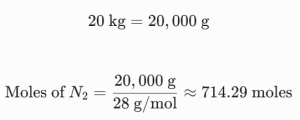
Since the molar ratio of N₂ to NH₃ is 1:2, the moles of NH3 produced will be:
Common Misconceptions about Nitrogen Fixation
A major trap students fall into during the exam is mixing up nitrogen fixation with nitrogen assimilation.
Let’s clear that up right now:
-
Nitrogen Fixation: This is simply taking raw gas (N₂) from the air and trapping it into a chemical form like NH₃.
-
Nitrogen Assimilation: This happens later. It is when the plant takes that ammonia or nitrate and actually builds it into organic molecules like amino acids (glutamate, glutamine) and proteins.
Think of fixation as mining raw iron ore, while assimilation is turning that iron into a steel bridge.
Another misconception is thinking plants only get nitrogen through active biological fixation. In reality, plants are perfectly happy absorbing ready-made nitrates or ammonium directly from the soil if you use chemical fertilizers. Fixation is just nature’s way of keeping the soil stocked without a human intervention.
Real-World Applications of Nitrogen Fixation
Why do we care so much about this process outside of clearing an exam cut-off? For starters, it runs sustainable agriculture. When farmers rotate crops and plant legumes like peas or lentils, they let nature do the fertilizing. This cuts down the need for chemical alternatives, which keeps local water supplies cleaner.
[Image diagram showing nitrogen cycle applications in agriculture and industry]
On the industrial side, humans figured out how to mimic nature through the Haber-Bosch process. This method cooks up ammonia by forcing N₂ and H2 together under high pressures and temperatures. It is the backbone of global fertilizer production and plays a massive role in manufacturing pharmaceuticals, explosives, and plastics.
Exam Strategy: Focus on Key Concepts and Mechanisms
When you are deep in your study zone, you need to budget your time wisely. For papers like IIT JAM, GATE, and CSIR NET, focus your energy on these specific pillars:
-
The Nitrogenase Complex: Learn its two components—the Fe-protein (reductase) and the MoFe-protein (dinitrogenase). Remember, this enzyme is incredibly sensitive to oxygen!
-
Nodule Formation: Memorize the cross-talk between the plant and the bacteria. Know what flavonoids and Nod factors do.
-
Oxygen Regulation: Study how leghemoglobin acts as an oxygen scavenger to protect nitrogenase while keeping the plant cells alive.
At VedPrep, we find that drawing out simple, color-coded flowcharts of the nodulation signaling pathway makes it much easier to recall under exam pressure than reading blocks of text over and over.
Lab Applications of Nitrogen Fixation
If you end up doing an M.Sc. or Ph.D. after clearing the IIT JAM, you might actually work with these systems in a lab.
Scientists use a smart trick called the acetylene reduction assay to measure how fast a microbe fixes nitrogen. Because nitrogenase is a bit flexible with its substrates, it will readily reduce acetylene gas (C₂H₂) into ethylene (C₂H₄). Testing for ethylene tells researchers exactly how active the enzyme is without dealing with tricky nitrogen isotopes.
Beyond that, genetic engineers are working on moving nif genes (the genes that code for nitrogenase) directly into non-legume crops like rice and wheat. If they crack that code, we could grow staple crops anywhere without needing heavy chemical fertilizers—a massive win for environmental science.
Final Thoughts
Wrap up your exam prep by remembering that nitrogen fixation isn’t just a collection of formulas and microbe names to memorize—it is a beautifully coordinated biochemical dance that keeps life on Earth running. When you are writing your IIT JAM paper, having a rock-solid grasp of these fundamental pathways, energetic costs, and cellular interactions is what will give you the edge over the competition.
To know more in detail from our faculty, watch our YouTube video:
Frequently Asked Questions
What are the main abiotic routes of nitrogen fixation?
Abiotic fixation occurs via natural high-energy physical phenomena like lightning strikes or volcanic activity, which force atmospheric N₂ and O₂ to combine into nitrogen oxides (NOₓ). It also occurs industrially through the human-engineered Haber-Bosch process to manufacture chemical fertilizers.
Is biological nitrogen fixation an aerobic or anaerobic process?
The conversion process itself is highly sensitive to oxygen and requires an anaerobic microenvironment because the key enzyme involved is irreversibly damaged by O2. However, many of the microbes performing it are obligate aerobes or facultative anaerobes that use specialized physiological adaptations to keep oxygen away from the enzyme site.
What is the composition of the nitrogenase enzyme complex?
The nitrogenase complex is a two-component metalloenzyme consisting of:
-
Fe-protein (Dinitrogenase reductase): A homodimer containing a 4Fe-4S cluster that acts as the obligate electron donor.
-
MoFe-protein (Dinitrogenase): An α2β2 heterotetramer containing iron-sulfur P-clusters and a molybdenum-iron cofactor (FeMo-co) that serves as the active site for N₂ reduction.
Why does the nitrogenase equation show the production of Hydrogen gas (H2)?
The reduction of H⁺ to H₂ gas is an obligate, evolving property of the nitrogenase catalytic mechanism. At least two of the eight collected electrons must be used to generate H₂ before N₂ can bind to the active site of the MoFe-protein, representing an inherent energetic "loss."
Why is the nitrogenase enzyme so strictly sensitive to molecular oxygen (O2)?
Oxygen is a strong oxidizing agent that rapidly and irreversibly denatures the delicate, highly reduced iron-sulfur (Fe-S) clusters within both the Fe-protein and MoFe-protein components, completely inactivating the enzyme.
What is leghemoglobin, and what role does it play in root nodules?
Leghemoglobin is an oxygen-binding heme protein synthesized cooperatively by the legume plant (globin part) and the Rhizobium symbiont (heme part). It acts as an oxygen "buffer" or scavenger, maintaining an incredibly low free O2 concentration inside the nodule to protect nitrogenase while delivering bound oxygen smoothly to the bacterial electron transport chain for cellular respiration.
Which cross-reacting gases can compete with N2 at the nitrogenase active site?
The active site of nitrogenase is structurally flexible and can reduce alternative triple-bonded substrates. It acts on azide (N₃⁻), nitrous oxide (N₂O), and acetylene (C₂H₂). It is also competitively inhibited by carbon monoxide (CO).
How do legume roots and free-living Rhizobia recognize each other in the soil?
The interaction begins with a highly specific chemical exchange. The host legume roots secrete polyphenolic compounds called flavonoids into the rhizosphere. Nearby Rhizobia sense these signals, which activate their bacterial nod genes, triggering the production and secretion of lipochitooligosaccharide signaling molecules known as Nod factors.
What are Nod factors, and what changes do they trigger in the host plant?
Nod factors are lipochitooligosaccharide signaling molecules produced by bacteria. When recognized by specific receptor kinases on the plant's root hair membranes, they trigger root hair curling, localized cell divisions in the root cortex, and the development of an infection thread, paving the way for nodule formation.
What is an infection thread?
An infection thread is an internal tubular structure constructed by the host plant cell membrane that extends inward through the root hair into the root cortex. It acts as an enclosed pathway allowing the multiplying Rhizobia to travel safely into the developing nodule tissue without triggering a plant immune response.
What is a bacteroid?
Once Rhizobia are released from the infection thread into the cortical cells of the root nodule, they cease dividing, change shape into irregular branching structures, and differentiate into mature, non-motile forms called bacteroids. These bacteroids are enclosed within a plant-derived peribacteroid membrane and express the nitrogenase enzyme to actively fix nitrogen.
Can Rhizobium fix nitrogen outside of its plant host?
Generally, no. Under standard free-living conditions in the soil, Rhizobium acts as a typical heterotroph and does not express nitrogenase because the ambient oxygen concentrations are too high. It requires the specialized biochemical conditions and microaerophilic shelter provided inside the root nodule to activate its nif gene cluster.
Can you give examples of free-living (non-symbiotic) nitrogen-fixing microbes?
Yes. Free-living diazotrophs (nitrogen-fixers) include:
-
Aerobic: Azotobacter, Beijerinckia
-
Anaerobic: Clostridium pasteurianum
-
Photosynthetic Cyanobacteria: Anabaena, Nostoc
What is Frankia, and how does it differ from Rhizobium?
Frankia is a genus of actinomycetes (filamentous, Gram-positive bacteria) that forms nitrogen-fixing symbiotic relationships with non-leguminous woody plants, such as Alnus (Alder) and Casuarina, creating structures called actinorhizal nodules. Rhizobium is a Gram-negative proteobacterium that associates almost exclusively with leguminous plants.