
The second law of thermodynamics explains the direction of energy transfer and achievable efficiencies of heat engines, crucial for IIT JAM and other competitive exams.
Understanding Thermodynamics Syllabus For IIT JAM
If you are gearing up for the IIT JAM Physics syllabus, you already know that Section 5—covering Kinetic Theory and Thermodynamics—is a massive chunk of the syllabus. It is not just a hurdle for JAM either; mastering this topic gives you a serious head start for CSIR NET and GATE down the road.
Most of us tend to flip through standard textbooks like Heat and Thermodynamics by R K Rajput or Thermodynamics by P N Gupta. While these books are packed with comprehensive derivations and examples to help you grasp the concepts, sometimes the sheer volume of equations can feel overwhelming.
Over on the Chemistry side, the IIT JAM Chemical thermodynamics syllabus zeroes in on thermodynamic systems, state variables, and distinct processes. Whether you are dealing with a Physics or Chemistry paper, you cannot escape problems on heat transfer, work done, and energy conversion. To ace these questions from the second law of thermodynamics, you need to move past memorizing formulas and really get comfortable with the first law of thermodynamics, internal energy, and heat capacities.
Second Law of Thermodynamics: Direction of Heat Transfer For IIT JAM
Let’s talk about the star of the show: the second law of thermodynamics. In simple terms, it states that the total entropy—which is just a fancy word for disorder or randomness—of an isolated system always increases over time.
Think about your study desk. If you don’t actively spend energy to clean it, books, pens, and rough sheets naturally scatter everywhere. It never spontaneously tidies itself up. That is entropy in action.
The second law of thermodynamics determines the direction of spontaneous heat transfer. Heat always flows on its own from a hotter region to a colder region. Because of this, heat engines—devices designed to convert thermal energy into mechanical work—can never be perfect. They can convert some of the input heat into useful work, but never all of it.
The second law sets a strict cap on the achievable efficiencies of heat engines. Efficiency is just the ratio of the work you get out to the heat you put in. Because some energy always leaks out as waste heat to the surroundings, a 100% efficient engine is a myth.
When you look at real-world engineering and chemical processes, the second law of thermodynamics explains why entropy generation is inevitable. In any actual process, the entropy of a closed system will either go up or stay the same if it’s an ideal, reversible scenario, but it will never decrease on its own. This is the ultimate reality check that tells us which chemical reactions or physical processes can actually happen and which ones are just pipe dreams.
-
Energy transfer direction: Spontaneously flows from higher to lower temperature.
-
Achievable efficiencies: Strictly limited; 100% efficiency is physically impossible.
-
Heat engines: Convert a fraction of heat into work, always rejecting the rest.
Second Law of Thermodynamics Equation and Its Significance For IIT JAM
In the exam, you will see the second law of thermodynamics broken down into two classic textbook definitions: the Clausius statement and the Kelvin-Planck statement.
Clausius Statement: You cannot build a device that operates in a cycle and simply transfers heat from a colder body to a hotter body without any outside help (like plugging in a compressor).
Kelvin-Planck Statement: You cannot build a heat engine operating in a cycle that takes heat from a reservoir and converts it completely into work without losing some heat to a colder sink.
To put numbers to these ideas, we use the entropy change formula:
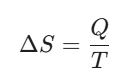
Here, Q is the heat transferred and T is the absolute temperature in Kelvin.
Let’s look at a typical problem you might encounter in the IIT JAM exam room:
Practice Question
A heat engine operates between two temperatures, 1000 K and 500 K. It absorbs 1000 J of heat from the high-temperature reservoir and does 400 J of work. What is the entropy change of the universe? Assume the engine operates in a cycle.
Here is how we break it down step-by-step:
| Step | What We Are Calculating | The Math |
| 1 | Heat rejected to the cold reservoir (Qc) | Qc = Qh – W = 1000 J – 400 = 600 J |
| 2 | Entropy change of the hot reservoir ( ΔSh) | ΔSh = -Qh/Th = -1000 J/1000 K = -1 J/K |
| 3 | Entropy change of the cold reservoir (ΔSc) | ΔSc = Qc/Tc = 600 J/500 K = 1.2 J/K |
| 4 | Total entropy change of the universe (ΔSuniverse ) | ΔSuniverse = ΔSh + ΔSc = -1 + 1.2 = 0.2 J/K |
Because the total entropy change of the universe (ΔSuniverse) is +0.2 J/K (greater than zero), this process is completely aligned with the second law of thermodynamics. If your math ever yields a negative total entropy change for the universe, double-check your calculations because that process cannot happen in real life.
Common Misconceptions About Second Law of Thermodynamics For IIT JAM
A lot of smart students trip up on the nuances of the second law of thermodynamics because the phrasing in textbooks can be tricky. Let’s clear up a few common traps before exam day.
Trap 1: “Entropy always increases everywhere.”
This is a classic misunderstanding. The total entropy of an isolated system (or the universe as a whole) always increases during a spontaneous change. But if you have a closed system that can exchange heat with its surroundings, its entropy can absolutely decrease.
Imagine putting a glass of water in the freezer. The water turns to ice, and its molecules get highly ordered, meaning the entropy of the water goes down. But to make that happen, the freezer had to dump heat out into your kitchen, increasing the surroundings’ entropy by an even bigger margin.
Trap 2: “Heat can never flow from cold to hot.”
It can, it just won’t do it spontaneously. Your kitchen refrigerator is living proof. It constantly pulls heat out of the cold interior and dumps it into your warmer room. The catch? It requires electricity to run the compressor. The second law doesn’t say you can’t reverse the flow; it just says you have to pay an energy tax (work input) to do it.
Trap 3: “We can achieve 100% efficiency if we eliminate friction.”
Even in a perfectly frictionless world with ideal gases, you still cannot hit 100% efficiency. As per the second law of thermodynamics, the limitation isn’t just mechanical wear and tear; it is fundamental physics. You always need a cold sink to dump heat into so the engine can complete its cycle and return to its initial state.
Exam Strategy: Mastering Second Law of Thermodynamics For IIT JAM
Because thermodynamics is highly conceptual, memorizing definitions won’t get you very far when the question paper decides to twist the scenarios.
To tackle this section effectively, focus your attention on entropy calculations and how they tie into Gibbs free energy and equilibrium. When temperature shifts, it alters the spontaneity of reactions, and you need to be ready to calculate exactly how those shifts play out.
At VedPrep, we often tell our students that the secret to mastering this topic is breaking down the problems into the system and surroundings. You should practice a wide variety of numerical problems, especially those requiring you to juggle these two core equations:
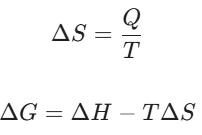
Make sure your study schedule gives plenty of attention to these high-yield subtopics:
-
Entropy changes in reversible and irreversible processes
-
Gibbs free energy, spontaneity, and chemical equilibrium
-
The physical meaning of the Clausius and Kelvin-Planck statements
VedPrep Tips: Mastering Thermodynamics for IIT JAM
The second law of thermodynamics is the bedrock for understanding how energy moves in the universe. Once you truly get it, topics like engineering cycles, chemical equilibrium, and refrigeration systems start making a lot more sense.
When you are preparing for a highly competitive exam like IIT JAM, try to link these abstract ideas back to physical layouts. Visualize the heat engine diagrams, track where the energy goes, and keep tabs on the signs (positive or negative) of your heat and work terms. If you want to test your understanding, VedPrep offers a mix of video lectures, targeted practice questions, and mock tests designed to mimic the actual exam environment without the fluff.
Conclusion
Mastering the second law of thermodynamics is a major milestone for your IIT JAM preparation. Moving away from memorizing formulas and shifting toward a genuine understanding of entropy and engine efficiency makes a world of difference when you are facing tricky, multi-layered questions.
Keep solving numerical problems, stay consistent with your revision, and don’t hesitate to break down tough concepts with resources like VedPrep. With a solid strategy and a clear head, you will be well-prepared to secure a top rank on exam day.
To learn more in detail from our faculty, watch our YouTube video:
Frequently Asked Questions
What is entropy?
Entropy is a thermodynamic property that measures the disorder or randomness of a system. It is denoted by the symbol 'S'. The change in entropy (ΔS) is related to the amount of heat transferred in a reversible process.
What is the significance of the second law of thermodynamics?
The second law of thermodynamics explains why spontaneous processes occur in one direction but not the other. It also sets a limit on the efficiency of energy conversion and explains the concept of entropy.
What are the different types of thermodynamic processes?
The main types of thermodynamic processes are isothermal, adiabatic, isobaric, and isochoric. These processes can be reversible or irreversible. Understanding these processes is crucial in applying the second law of thermodynamics.
How does the second law relate to the kinetic theory of gases?
The kinetic theory of gases explains the behavior of gases in terms of the motion of their molecules. The second law of thermodynamics is related to the kinetic theory through the concept of entropy, which is a measure of the disorder of the molecules.
What are the implications of the second law of thermodynamics on energy production?
The second law of thermodynamics sets a limit on the efficiency of energy conversion, which has significant implications for energy production. It explains why it is impossible to build a heat engine that can convert all the heat energy into useful work.
Can you explain the second law of thermodynamics in terms of the kinetic theory of gases?
The kinetic theory of gases explains the behavior of gases in terms of the motion of their molecules. The second law of thermodynamics can be understood in terms of the increase in disorder of the molecules.
How is the second law of thermodynamics applied in IIT JAM?
In IIT JAM, the second law of thermodynamics is applied to solve problems related to thermodynamic processes, entropy changes, and energy conversion. Students are expected to understand the concepts and apply them to numerical problems.
What are some common problems related to the second law of thermodynamics in IIT JAM?
Common problems in IIT JAM related to the second law of thermodynamics include calculating entropy changes, determining the spontaneity of processes, and finding the efficiency of energy conversion. Students should practice solving these types of problems.
How can I improve my understanding of the second law of thermodynamics for IIT JAM?
To improve your understanding of the second law of thermodynamics for IIT JAM, practice solving numerical problems, review the concepts of thermodynamics and kinetic theory, and focus on understanding the applications of the second law.
Can you explain the concept of entropy in the context of IIT JAM?
In IIT JAM, entropy is a critical concept that is used to explain the direction of spontaneous processes. Students should understand how to calculate entropy changes and apply the concept to solve problems.
What are some common mistakes made when applying the second law of thermodynamics?
Common mistakes include confusing entropy with energy, not considering the direction of spontaneous processes, and misapplying the concept of reversible processes. Students should be aware of these common mistakes to avoid them in IIT JAM.
What is the relation between the second law of thermodynamics and statistical mechanics?
The second law of thermodynamics is related to statistical mechanics through the concept of entropy. Statistical mechanics explains the behavior of systems in terms of the statistical properties of their microstates.
How does the second law of thermodynamics apply to non-equilibrium systems?
The second law of thermodynamics can be applied to non-equilibrium systems using concepts such as local equilibrium and the Onsager reciprocal relations. These concepts are important in understanding complex systems.
What is the connection between the second law of thermodynamics and the arrow of time?
The second law of thermodynamics explains the arrow of time, which is the direction in which time moves. The increase in entropy over time explains why we experience time as moving in one direction.