
Sex determination For IIT JAM involves understanding various techniques such as karyotyping, PCR, and FISH to analyze genetic differences between males and females.
Sex determination For IIT JAM: Syllabus
When you are looking at the IIT JAM syllabus, the core principles of how biological sex is established and regulated fall squarely under your Molecular Biology and Genetics preparation. Sex determination is all about the machinery behind gene expression.
If you are also eyeing the CSIR NET, this shows up prominently in the Genetics sections. To get a solid grip on the theory, classic books like Molecular Biology of the Gene by James D. Watson are excellent resources. But since the exam questions often twist theoretical facts into experimental, analytical problems, you need to understand the structural and molecular techniques behind these concepts. Here at VedPrep, we always emphasize looking at the “why” and “how” behind the data, rather than just memorizing paths.
Sex Determination For IIT JAM: Overview
At its basic level, sex determination in mammals comes down to a game of genetic hardware. Females carry two X chromosomes (XX), while males carry an X and a Y chromosome (XY).
The real driver here is the Y chromosome. It holds a tiny but incredibly powerful master switch: the SRY gene (Sex-determining Region Y). Think of the SRY gene as a project manager. When it kicks into gear during embryonic development, it orders the generic gonads to turn into testes.
Once the testes are built, they start pumping out androgens like testosterone. These hormones act as molecular messengers, signaling the body to develop male secondary sexual characteristics. If there is no Y chromosome, there is no SRY gene, meaning no testes and no heavy surge of androgens. The default biological path takes over, leading to female development.
Karyotyping: A Technique for Sex determination For IIT JAM
The most visual way to evaluate chromosomal makeup is karyotyping. This is essentially taking a high-resolution snapshot of a cell’s chromosomes during metaphase (when they are all neatly packed and coiled up), staining them, and lining them up side-by-side from largest to smallest.
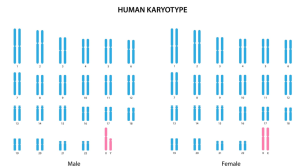
As you can see in the chromosomal layout, a standard human profile has 46 chromosomes split into 23 pairs:
-
Normal female karyotype: 46, XX
-
Normal male karyotype: 46, XY
Sometimes things go awry during cell division (a process called non-disjunction), leading to abnormal numbers. The IIT JAM loves to throw these clinical scenarios at you:
-
Turner Syndrome (45, X): A person is missing a second sex chromosome. Because there is no Y chromosome, they develop as female, but face developmental challenges.
-
Klinefelter Syndrome (47, XXY): An extra X chromosome is present. Because the Y chromosome is still there to trigger the SRY gene, the individual develops as male, though they usually experience fertility issues due to the extra X.
Sex Determination Using PCR
While karyotyping gives you a fantastic birds-eye view, it takes time and requires living, dividing cells. What if you only have a microscopic speck of DNA? That is where Polymerase Chain Reaction (PCR) steps in.
Instead of looking at the whole chromosome, we design specific molecular tags called primers to search for and duplicate particular genes unique to the X or Y chromosomes. We can target the SRY gene on the Y chromosome, or highly repetitive regions like the DXZ1 sequence on the X chromosome. After running the PCR cycles to create millions of copies of these regions, we drop the samples into an agarose gel for electrophoresis to see what bands show up under UV light.
Beyond basic sex determination, this approach is incredibly valuable in medical genetics for catching X-linked recessive disorders early—like Hemophilia or Duchenne Muscular Dystrophy.
The standard laboratory protocol follows a clear, logical sequence:
Worked Example: Sex Determination Using PCR
Let’s walk through a classic analytical problem style you might face on exam day.
Note: The following scenario is a fictional, illustrative example designed to show you how exam problems map to raw lab data.
Imagine a geneticist at a research hospital receives a sample from a patient showing atypical physical development. The specialist decides to run a multiplex PCR using primers for the Y-linked SRY gene and the X-linked DXZ1 repeat region.
The resulting gel electrophoresis yields the following band patterns:
| Sample Group | SRY Gene (Y Chromosome) | DXZ1 Gene (X Chromosome) |
| Patient Sample | Negative (No band) | Positive (Three distinct bands) |
| Control (Normal Male) | Positive (Clear band) | Positive (Two bands) |
Analyzing the Data:
The lack of an SRY band instantly tells us there is no Y chromosome present. However, look closely at the DXZ1 column: the control male shows two standard bands, but our patient displays three bands. This points directly to an extra copy of the X chromosome.
Putting it all together, the patient has a total of three X chromosomes and no Y chromosome (47, XXX), a genetic condition known as Trisomy X. This shows you how a quick PCR test can pinpoint complex chromosomal anomalies without needing a full-scale cell culture.
Common Misconceptions in Sex Determination
When students sit down with our mentors at VedPrep, we often notice a few persistent myths that cause people to lose easy marks:
-
Misconception 1: Sex is purely defined by anatomy.
-
The Reality: Anatomy is just the final downstream readout of a complex genetic program. Hormonal insensitivities can cause an XY individual to develop external female anatomy, even though their genetic blueprint says otherwise.
-
-
Misconception 2: Karyotyping is the only way to check.
-
The Reality: As we just saw with PCR, molecular assays can find specific sex-linked marker genes much faster and with far less sample material.
-
-
Misconception 3: Sex determination is identical across all animals.
-
The Reality: Nature loves variety! While mammals use the XX/XY system, birds use a ZZ (male) / ZW (female) system, and reptiles like alligators rely entirely on the temperature of the nest to determine whether eggs hatch as male or female.
-
Applications of Sex Determination Techniques
Mastering these tools isn’t just about clearing an entrance test. These methods are used daily out in the real world:
-
Forensics: Identifying victims or suspects from trace DNA at crime scenes.
-
Prenatal Testing: Checking for congenital genetic conditions via non-invasive prenatal testing (NIPT).
-
Conservation Biology: Determining the sex of endangered wildlife species from non-invasive samples like hair or droppings to track population dynamics.
Exam Strategy: Sex Determination For IIT JAM
To ace this topic on the IIT JAM, keep these quick strategic pointers in mind:
-
Watch the experimental setups: Focus heavily on how their gel patterns or karyotype charts look.
-
Track the controls: In any PCR question, always look at the control lanes first. They tell you exactly what a normal baseline looks like so you can spot mutations or extra bands in the test subject.
-
Keep your vocabulary precise: Pay close attention to the difference between chromosomal sex (XX vs XY), gonadal sex (testes vs ovaries), and phenotypic sex (external anatomy). Examiners love to trip you up by mixing these terms in multiple-choice options.
Final Thoughts
Cracking sex determination questions on the IIT JAM comes down to connecting the micro with the macro. Don’t just look at an XX or XY label as a static fact; visualize the actual molecular chess match happening inside the cell—from the SRY gene acting as a master toggle switch to the specific bands migrating down an electrophoresis gel. Keep refining your experimental analysis, stay curious about the mechanics behind the data, and if you ever want to bounce tricky genetics problems off us, the team over here at VedPrep is always ready to talk science.
To know more in detail from our faculty, watch our YouTube video:
Frequently Asked Questions
Can an individual with an XY genotype develop female physical characteristics?
Yes. Conditions like Androgen Insensitivity Syndrome (AIS) occur when a mutation leaves androgen receptors non-functional. Even though the SRY gene triggers testes development and testosterone production, the body's tissues cannot respond to the hormone, leading to a female external phenotype despite an XY genotype.
How does the ZZ/ZW sex determination system differ from the XX/XY system?
In the XX/XY system (mammals), males are the heterogametic sex (XY) and determine the offspring's sex. In the ZZ/ZW system (birds, some reptiles), females are the heterogametic sex (ZW) and determine the sex, while males are homogametic (ZZ).
What exactly is a "bipotential gonad" in embryonic development?
During early embryonic development, the early gonads are identical in both male and female embryos. They have the potential to develop into either testes or ovaries depending on whether genetic switches like the SRY gene turn on.
Why is karyotyping done specifically during the metaphase stage of cell division?
Chromosomes are at their absolute highest state of condensation and coiling during metaphase. This makes them clearly visible under a light microscope, allowing scientists to easily identify their distinct shapes, sizes, and banding patterns.
What is the difference between chromosomal sex and phenotypic sex?
Chromosomal sex is determined purely by the combination of sex chromosomes at fertilization (e.g., XX or XY). Phenotypic sex refers to the actual physical internal and external structures (gonads, genitalia, secondary sex traits) that develop downstream due to gene expression and hormones.
How does non-disjunction lead to conditions like Turner or Klinefelter syndrome?
Non-disjunction occurs when homologous chromosomes fail to separate during Meiosis I, or sister chromatids fail to separate during Meiosis II. This results in gametes carrying an abnormal number of chromosomes (either an extra one or missing one), leading to aneuploidy at fertilization.
Why do individuals with Klinefelter syndrome (47, XXY) develop a male phenotype despite having two X chromosomes?
The presence of even a single Y chromosome carries the SRY gene. Because the SRY genetic switch is present, it successfully initiates the testicular development pathway, leading to a male phenotype, even though the extra X chromosome causes issues with fertility later on.
What are the specific primer targets used in multiplex PCR for sex determination?
Commonly, researchers target the SRY gene on the Y chromosome as a definitive marker for male genetics. To serve as an internal control and verify the presence of the X chromosome, primers targeting repetitive satellite DNA regions, like the DXZ1 locus, are used simultaneously.
Why is PCR preferred over karyotyping in forensic sex determination?
Karyotyping requires intact, actively dividing living cells, which are almost impossible to get from an old crime scene. PCR can amplify highly degraded, microscopic traces of DNA from biological samples like dried blood, single hairs, or bone fragments.
What is the genetic basis of Trisomy X (47, XXX)?
Trisomy X happens due to maternal non-disjunction during meiosis, leading to an egg cell with two X chromosomes being fertilized by an X-bearing sperm cell. Phenotypically, these individuals are female and often asymptomatic due to X-inactivation.
How does X-inactivation (Lyonization) impact sex chromosome abnormalities?
In mammalian females, one of the two X chromosomes is randomly shut down into a dense structure called a Barr body to ensure dosage compensation. Because extra X chromosomes are mostly inactivated, individuals with conditions like 47, XXY or 47, XXX survive with relatively mild phenotypes compared to autosomal trisomies.
If extra X chromosomes are inactivated, why do Turner (45, X) or Klinefelter (47, XXY) individuals have abnormal phenotypes?
X-inactivation isn't 100% complete. Roughly 15–25% of the genes on the inactivated X chromosome escape silencing. The under-expression of these escaping genes in Turner syndrome, or their over-expression in Klinefelter syndrome, alters normal development.
What are holandric traits?
Holandric traits are Y-linked traits controlled by genes found exclusively on the Y chromosome. They are passed directly from fathers to sons, and females can never inherit or pass on these traits.
Can environmental factors override genetic sex determination?
In mammals, no. However, in many reptiles like turtles and crocodiles, Temperature-dependent Sex Determination (TSD) occurs. The incubation temperature of the eggs during a critical window of embryonic development determines the sex of the offspring, shifting hormone production entirely.