

Square planar complexes are coordination compounds where the central metal ion is dsp2 or sp2d hybridized, forming a square planar shape. This is crucial for IIT JAM and CSIR NET chemistry.
Square planar complexes For IIT JAM: Syllabus
If you are gearing up for the IIT JAM, you already know that Coordination Compounds is a massive scoring unit. It is packed with concepts like coordination numbers, oxidation states, and Crystal Field Theory (CFT).
When you pick up standard textbooks like Inorganic Chemistry by Shriver and Atkins, or Physical Inorganic Chemistry by Housecroft, you will find extensive chapters dedicated to how metal ions bond with ligands. A huge chunk of those pages focuses right on Square planar complexes.
We know that flipping through these massive textbooks can feel overwhelming when you are trying to balance multiple topics. That is exactly why we at VedPrep put together this breakdown. Let’s strip away the heavy academic jargon and look at what actually matters for your exam preparation.
Square Planar Complexes: Definition and Key Features
Let’s visualize this clearly to understand Square planar complexes. Imagine a central metal ion sitting right in the middle of a square piece of paper. Now, picture four ligands pointing directly at it from the four corners of that square. That is the basic layout of a square planar complex.
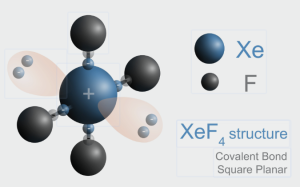
Usually, you see this geometry pop up when the central metal ion has a d8 electronic configuration. Think of ions like Ni2+ or Pd2+. But here is the catch: to get this specific shape, these metals usually need to pair up with strong-field ligands like CN– or CO.
A couple of classic textbook examples you will run into constantly are the [Ni(CN)4]2- ion and the [PdCl4]2- ion. These structures are incredibly stable because of the tight bonding between the metal and its ligands. If you are aiming to crack inorganic chemistry questions in the IIT JAM, memorizing this core setup is your first step.
Here is a quick checklist of the key features of Square planar complexes:
-
Square planar geometry
-
dsp2 hybridization
-
Four-coordinate complex (Coordination Number = 4)
-
Typically involves transition metals with a d8 configuration
Worked Example: Solved Question For CSIR NET
Let’s break down a classic problem you might encounter: figuring out the hybridization of the central metal ion in the [PtCl4]2- ion.
Here, we have a platinum (Pt) atom bonded to four chloride (Cl–) ligands. If you try to apply basic VSEPR theory blindly, you might assume that four electron pairs around a central atom always push apart into a 3D tetrahedral shape to minimize repulsion. But chemistry loves its exceptions. The actual shape of this complex is flat and square planar.
Why does this happen? Platinum is a 5d transition metal, and its Pt2+ state gives it a d8 configuration. Because it sits lower down in the periodic table, the crystal field splitting energy is incredibly high, even with a weak-field ligand like chloride. This forces the electrons to pair up, leaving a empty d orbital open for business.
The metal then uses a dsp2 hybridization scheme. This means it mixes one d orbital, one s orbital, and two p orbitals to create four identical hybrid orbitals. These orbitals point directly to the corners of a square, giving the complex its distinct square planar shape.

Misconception: Common Mistake in Identifying Square Planar Complexes For IIT JAM
Here is a trap that trips up a lot of students on exam day: mixing up square planar complexes with tetrahedral complexes. It is an easy mistake to make because both types have a coordination number of 4. The secret to avoiding this trap lies in looking at the hybridization and the strength of the ligands.
To make sense of this, imagine two different social settings. Let’s look at the [Ni(CN4]2– ion versus the [NiCl4]2- ion.
Think of the strong-field ligand, Cyanide (CN–), as a highly assertive tour guide entering a crowded room of d-electrons. The guide firmly orders everyone to double up and share seats, freeing up a specific inner d-orbital. This allows the metal to undergo dsp2 hybridization, flattening the structure out into a neat, organized square planar arrangement.
On the flip side, think of the weak-field ligand, Chloride (Cl–), as a very laid-back guide. It enters the same room but does not bother making anyone move or pair up. Since the inner d-orbitals stay packed, the incoming ligands have to use the outer s and p orbitals instead. This leads to sp3 hybridization, and the structure naturally branches out into a 3D tetrahedral shape.
-
[Ni(CN)4]2- ion: Square planar, dsp2 hybridization (Strong-field ligand forces pairing)
-
[NiCl4]2- ion: Tetrahedral, sp3 hybridization (Weak-field ligand leaves electrons alone)
Catching these subtle differences in ligand strength is what helps you spot the right geometry under pressure. We focus heavily on these conceptual pivots at VedPrep so you can spot these traps instantly.
Application: Square Planar Complexes in Catalysis
These flat complexes are not just pretty shapes on a whiteboard; they are workhorses in industrial chemistry. Because they are flat, the top and bottom of the metal atom are completely exposed. This open space makes them incredible catalysts for organic reactions. They offer high activity and selectivity while letting reactions happen under mild conditions.
A famous example is using palladium complexes in the Suzuki-Miyaura reaction. As per Square planar complexes, this reaction is a big deal in the chemical world for stitching carbon atoms together to create complex molecules.
The flat, square planar geometry of the palladium catalyst is perfect for this. It gives the reacting molecules plenty of room to dock onto the metal, get activated, and bond with each other. This specific reaction is widely used to manufacture modern pharmaceuticals and advanced materials, showing just how important these coordination shapes are outside the classroom.
Exam Strategy: Tips For IIT JAM
If you want to nail questions on this topic, you need to master how d-orbitals split under a square planar crystal field. It is a bit different from your standard octahedral splitting, and questions often test your knowledge on magnetic properties (whether a complex is diamagnetic or paramagnetic) and its color spectra.
To get comfortable with this, spend time practicing questions that connect CFT with molecular orbital theory. At VedPrep, we regularly build out practice sets designed around these exact conceptual intersections to help you build reliable problem-solving habits.
Make sure your study checklist covers these frequently tested areas:
-
Coordination compounds: Nomenclature, structural and stereoisomerism
-
Crystal field theory: Splitting patterns and calculating Crystal Field Stabilization Energy (CFSE)
-
Molecular orbital theory: Applying orbital overlaps to transition complexes
Real-World Examples: Square Planar Complexes in Coordination Chemistry
We already talked about industrial catalysts, but square planar complexes show up in medicine too. Think about the [PtCl4]2- ion. This specific complex serves as a critical building block for synthesizing Cisplatin—one of the most widely used anticancer drugs in medical history.
The flat shape of the molecule allows it to slide into biological systems and bind effectively with DNA, showcasing how structural inorganic chemistry plays a direct role in saving lives.
Whether you are studying the [PtCl4]2- ion, the [PtCl4]2- ion, or the [Ni(CN)4]2- ion, recognizing these real-world uses makes the theory much easier to remember.
Square planar complexes For IIT JAM: Key Concepts: dsp2 and sp2d Hybridization
To wrap things up, let’s look at the actual orbital mixing. The type of hybridization tells you exactly how a complex will behave.
When you hear dsp2 hybridization, think of the mixing of one inner d orbital, one s orbital, and two p orbitals. This specific combination is the signature of stable, flat square planar complexes.
Sometimes you might run into the phrase sp2d hybridization. This involves an outer d orbital mixing with s and p orbitals. You will generally see this variation in geometries like trigonal bipyramidal or square pyramidal shapes rather than the classic flat square layouts.
Getting a firm grip on how these orbitals combine lets you predict whether a complex will be stable, how it will react, and what its magnetic properties look like. Keeping these fundamentals straight is what makes the difference when you are aiming for a top rank.
Final Thoughts
Mastering square planar complexes isn’t about memorizing endless exceptions—it’s about recognizing the patterns behind how metals and ligands interact. Once you can picture the flat geometry, understand why a d8 configuration loves to pair up, and see how the d-orbitals split, these exam questions start feeling like puzzles you actually know how to solve. It is these foundational concepts that bridge the gap between a confusing question paper and a top rank.
To learn more in detail from our faculty, watch our YouTube video:
Frequently Asked Questions
What is the typical hybridization of a square planar complex?
The most common hybridization for these flat structures is dsp2. This happens when the central metal ion mixes one inner d orbital, one s orbital, and two $p$ orbitals to create four identical hybrid orbitals pointing toward the corners of a square.
Which metal ions commonly form square planar complexes?
You will see this geometry most frequently with transition metal ions that have a $d^8$ electronic configuration. Textbook examples include Ni²⁺, Pd²⁺, Pt²⁺, Rh⁺, and Au³⁺.
Can a weak-field ligand ever form a square planar complex?
Yes, but typically only with heavier 4d and 5d metals like Pd²⁺ or Pt²⁺. For these larger metal ions, the crystal field splitting energy (Δ) is inherently so large that it forces electron pairing regardless of how weak the ligand is. A classic example is [PtCl₄]²⁻.
Does geometrical isomerism occur in square planar complexes?
Absolutely, and it is a favorite topic for exam examiners! Because the structure is rigid and flat, complexes with the general formula [MA2B2] can form distinct cis (ligands next to each other) and trans (ligands opposite each other) geometric isomers.
Do square planar complexes show optical isomerism?
Generally, no. Because the molecule is entirely flat, the molecular plane itself acts as a internal plane of symmetry (POS). This internal symmetry usually prevents them from being chiral or optically active, unless they contain highly specialized, bulky asymmetric ligands.
What is the coordination number of a square planar complex?
The coordination number is always 4, meaning the central metal ion forms exactly four coordinate covalent bonds with the surrounding ligands.
Why are square planar complexes highly effective as industrial catalysts?
Their flat layout leaves the spaces directly above and below the central metal atom completely wide open. This steric availability lets reacting molecules easily attach to the metal, undergo chemical changes, and break away efficiently.
What role do square planar complexes play in medicine?
They are critical in oncology. The famous anticancer drug Cisplatin is a square planar platinum complex, cis-[Pt(NH3)2Cl2]. Its flat structure allows it to successfully bind to cancer cell DNA and inhibit tumor replication.
How does the choice of standard textbook help in mastering this topic?
Textbooks like Shriver & Atkins provide the strict mathematical and physical frameworks for orbital splitting. At VedPrep, we suggest using these reference books alongside targeted problem sets to build a practical, intuitive grasp of how to predict structure types instantly on exam day.
What is the value of the bond angle in a perfectly symmetric square planar complex?
Because the ligands occupy the four corners of a perfect square, the adjacent ligand-metal-ligand (L-M-L) bond angles are exactly 90°, while the opposite ligands sit at a clean 180° relative to each other.
How does the principal quantum number ($n$) of a metal affect square planar stability?
As you move down a group from 3d to 4d to 5d transition metals, the size of the d-orbitals increases. This allows for better orbital overlap with ligands, driving up the crystal field splitting energy (Δ). As a result, 4d and 5d metals form remarkably stable square planar complexes across the board.
Can a square planar complex undergo substitution reactions easily?
Yes, they are generally quite labile and undergo ligand substitution reactions relatively quickly. These reactions typically follow an associative pathway (Ia or A), because the open spaces above and below the molecular plane allow an incoming ligand to easily approach and form a temporary five-coordinate intermediate.