
Preparing for the RPSC Assistant Professor exam means diving deep into the core of coordination chemistry. At the heart of this section lies Crystal Field Theory (CFT), a framework that explains how ions interact with their surrounding environment in crystals. This interaction directly dictates their electronic properties and magnetic behavior.
If you look at your syllabus, topics from classic textbooks like Physical Chemistry by P. W. Atkins and Inorganic Chemistry by Greenwood and Earnshaw (often studied alongside standard physical chemistry texts) form the backbone of these concepts. Crystal Field Theory is the tool you need to decode the electronic structure and spectra of transition metal complexes. These reference books offer a deep look into the subject, but let us break it down into what you actually need to clear the exam.
The Basics of Crystal Field Theory
Crystal Field Theory is essentially a model that maps out the electronic structure of transition metal complexes. It looks at how a central metal ion behaves when ligands surround it, which causes the metal’s d orbitals to split up. If you want to predict the magnetic, optical, and thermodynamic properties of these complexes, you need a solid grip on this theory.
The model relies on a few straightforward, idealized assumptions:
- Ligands are point charges: They are treated simply as negative point charges or point dipoles.
- Purely electrostatic interactions: The bond between the metal and the ligand is assumed to be 100% ionic, ignoring any covalent sharing.
- Orbital splitting: The five degenerate d orbitals of the free metal ion split into different energy levels—specifically, the t₂g and eg sets in an octahedral environment.
Worked Example: Crystal Field Theory (CFT) For RPSC Assistant Professor
Let us look at a typical high-yield question you might encounter in competitive exams like RPSC :
Question: What is the electronic configuration of the Fe2+ ion in a high-spin octahedral complex, and how do we determine its crystal field splitting energy (Δo)?
The free Fe²⁺ ion has a d⁶ configuration. When ligands approach in an octahedral geometry, the five d orbitals split into two energy levels: the lower-energy t₂g set (dxy, dyz, dxz) and the higher-energy eg set (dx²-y², dz²}).
Imagine the d orbitals as a group of roommates sharing an apartment. Initially, they all have equal status. But when guests (the ligands) move in near specific rooms, some roommates have to deal with more noise and crowd than others, forcing them into a higher-stress, higher-energy state.
For a standard high-spin d⁶ complex like [Fe(H₂O)₆]²⁺, electrons fill the orbitals one by one before pairing up, following Hund’s rule. This gives us a configuration of t2g4 eg2. The energy gap between these two sets is Δo.
| Orbital | Energy Level | Electron Occupation |
| eg | +0.6 Δo (or +3/5 Δo) | 2 electrons |
| t2g | -0.4 Δo (or -2/5 Δo) | 4 electrons |
For a weak-field ligand setup with Fe²⁺, this Δo value typically hovers around 10,000 cm⁻¹..
Misconception: Common Mistakes in Understanding Crystal Field Theory (CFT) For RPSC Assistant Professor
A frequent slip-up among aspirants is thinking that the crystal field splitting energy (Δ) is a fixed property of the metal ion alone. That is not how it works. The value of Δ is a dynamic property born from the relationship between the metal ion and the incoming ligands.
If you ignore the ligands, you miss the whole point of the spectrochemical series. Ligands are ranked by their field strength—their ability to split the d orbitals. For example, if you swap out water molecules for cyanide ions, the splitting energy changes completely because cyanide pushes the orbitals much further apart. At VedPrep, we often tell students to focus heavily on these trends, as exam questions frequently test how changing a ligand alters a complex’s color or magnetic behavior.
Application of Crystal Field Theory (CFT) In Real-World Scenarios
To make sense of Crystal Field Stabilization Energy (CFSE), let us look at a quick, fictional scenario. Imagine an engineering team trying to develop a highly stable, heat-resistant dye for industrial use. They experiment with different transition metal complexes. By calculating the CFSE, they can predict which metal-ligand combination holds the lowest, most stable energy configuration. This calculation saves them months of trial-and-error in the lab.
In materials science, Crystal Field Theory helps researchers design specific tools, like the contrast agents used in MRI machines. The theory lets scientists tweak the magnetic properties of a compound by choosing the right metal ion and ligand pairing, ensuring the agent interacts correctly with magnetic fields.
While CFT uses a very simplified model—treating bonds as entirely electrostatic and ignoring covalent overlap—it remains an incredibly practical tool for predicting color and magnetism.
Exam Strategy: Study Tips for Crystal Field Theory (CFT) For RPSC Assistant Professor
Mastering Crystal Field Theory is non-negotiable if you want to score well in the inorganic and physical chemistry sections of the RPSC Assistant Professor exam. Here is a practical roadmap to tackle this topic:
- Nailed down the geometries: Make sure you can confidently draw and explain the splitting patterns for octahedral, tetrahedral, and square planar complexes.
- Create quick comparison charts: Keep a notebook where you map out how factors like metal oxidation state, principal quantum number (3d vs 4d vs 5d), and ligand strength alter the value of Δ
- Practice the math: Work through numerical problems involving CFSE calculations, magnetic moments, and spin-only formulas regularly.
If you want a structured breakdown of these topics, you can check out the free chemistry lectures and resources over at VedPrep. Mapping out connections between coordination chemistry and molecular orbital theory will help you handle those tricky, conceptual questions easily.
Crystal Field Theory (CFT) For RPSC Assistant Professor: Key Concepts and Formulas
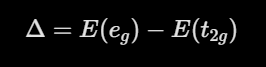
When you are reviewing this unit right before the exam, keep these core formulas handy:
- The Splitting Energy Gap:
- CFSE Calculation (Octahedral):

(where x is the number of electrons in t2g, y is the number of electrons in eg, P is the pairing energy, and n is the number of paired electrons)
While CFT provides a quick and dependable way to solve exam problems, remember that it is a stepping stone to more advanced models like Ligand Field Theory (LFT) and Molecular Orbital Theory (MOT), which account for covalent bonding.
Crystal Field Theory (CFT) For RPSC Assistant Professor: Advanced Topics
Once you have the basics down, the syllabus pushes into more advanced territory, including the Jahn-Teller Effect—where certain non-linear complexes distort to lower their symmetry and remove orbital degeneracy.
Modern research even links these transition metal properties to fields like spintronics and quantum computing, where molecules are studied as potential quantum bits (qubits). At VedPrep, we believe that understanding the structural roots of these electronic transitions keeps your preparation grounded, making it much easier to confidently approach any question the RPSC exam throws your way.
Final Thoughts
Wrapping your head around Crystal Field Theory isn’t just about memorizing formulas for exam day; it’s about building an intuitive sense of how atomic structure dictates real-world properties. When you can look at a complex and immediately see why it’s a vibrant blue or why it acts like a tiny magnet, you’ve crossed the line from rote learning to true mastery. The RPSC Assistant Professor exam heavily rewards this kind of conceptual clarity.
To know more in detail from our expert faculty, watch our YouTube video:
Frequently Asked Questions
What are the main assumptions of CFT?
The main assumptions of CFT are: (1) the ligands are treated as point charges or point dipoles, (2) the metal-ligand bonds are purely ionic, and (3) the d-orbitals of the metal ion are degenerate in the absence of ligands.
What is the significance of the crystal field splitting energy?
The crystal field splitting energy, denoted by Δ (delta), is a measure of the energy difference between the two sets of d-orbitals (t2g and eg) in a metal complex. It determines the stability and reactivity of the complex.
How does CFT explain the color of transition metal complexes?
CFT explains the color of transition metal complexes by attributing it to the excitation of electrons from the t2g to eg orbitals, which corresponds to the absorption of light in the visible region. The energy difference between these orbitals (Δ) determines the wavelength of light absorbed and hence the color of the complex.
What are the limitations of CFT?
The limitations of CFT are: (1) it does not account for the covalent character of metal-ligand bonds, (2) it does not explain the magnetic properties of complexes, and (3) it is not applicable to complexes with high-spin and low-spin configurations.
What are the key features of CFT?
The key features of CFT are: (1) the splitting of d-orbitals in metal ions due to the presence of ligands, (2) the concept of crystal field splitting energy (Δ), and (3) the prediction of complex geometries and properties.
What is the importance of CFT in inorganic chemistry?
CFT is important in inorganic chemistry because it provides a simple, intuitive model for understanding the electronic structure and properties of transition metal complexes. It has been widely used to predict the properties of complexes and to understand their reactivity.
How is CFT applied in the RPSC Assistant Professor exam?
CFT is a fundamental concept in inorganic chemistry, and its applications are frequently tested in the RPSC Assistant Professor exam. Questions may involve the calculation of crystal field splitting energy, prediction of complex geometries, and explanation of magnetic properties.
What types of questions can be expected on CFT in the RPSC Assistant Professor exam?
Questions on CFT in the RPSC Assistant Professor exam may include: (1) multiple-choice questions on the principles of CFT, (2) short-answer questions on the application of CFT to transition metal complexes, and (3) problem-solving questions involving the calculation of Δ and prediction of complex properties.
How can CFT be used to predict the magnetic properties of complexes?
CFT can be used to predict the magnetic properties of complexes by determining the number of unpaired electrons in the d-orbitals of the metal ion. This information can be used to predict the magnetic moment and other properties of the complex.
What are common mistakes made when applying CFT?
Common mistakes made when applying CFT include: (1) incorrect assignment of oxidation states to metal ions, (2) incorrect prediction of complex geometries, and (3) failure to account for the effects of ligand field strength on Δ.
How can one avoid mistakes when using CFT to predict complex properties?
To avoid mistakes when using CFT, one should: (1) carefully assign oxidation states to metal ions, (2) consider the effects of ligand field strength on Δ, and (3) use the correct formulas for calculating Δ and predicting complex properties.
What are the common misconceptions about CFT?
Common misconceptions about CFT include: (1) that CFT is only applicable to octahedral complexes, (2) that CFT is a quantitative theory, and (3) that CFT can be used to predict the reactivity of complexes.
What is the relationship between CFT and molecular orbital theory?
CFT and molecular orbital theory are related in that they both describe the electronic structure of transition metal complexes. However, molecular orbital theory provides a more comprehensive description of the metal-ligand bonds, while CFT provides a simpler, more intuitive model.
How does CFT relate to the spectrochemical series?
CFT relates to the spectrochemical series in that the series ranks ligands according to their ability to split the d-orbitals of a metal ion. The spectrochemical series is a useful tool for predicting the magnitude of Δ and the properties of transition metal complexes.