

The Nernst equation is a fundamental concept in electrochemistry that relates cell potential to standard cell potential, temperature, and reaction quotient. It’s crucial for RPSC Assistant Professor aspirants to grasp this concept to solve problems in competitive exams like CSIR NET, IIT JAM, and CUET PG.
Syllabus: Electrochemistry
Electrochemistry is a branch of chemistry that deals with the interaction between chemical energy and electrical energy. It is a crucial aspect of various scientific disciplines, including chemistry, physics, and materials science. This topic belongs to Unit 4: Electrochemistry of the official CSIR NET / NTA syllabus.
Thermodynamics and kinetics are essential components of electrochemistry. Thermodynamics helps understand the spontaneity and feasibility of electrochemical reactions, while kinetics deals with the rates of these reactions. Students preparing for CSIR NET, IIT JAM, and GATE exams need to have a solid grasp of these concepts.
For in-depth study, students can refer to standard textbooks such as Physical Chemistry by Peter Atkins and Electrochemistry by Allen J. Bard and Larry R. Faulkner. These textbooks provide comprehensive coverage of electrochemistry, including thermodynamics and kinetics.
Unit: Electrochemistry
Recommended textbooks:
- Atkins, P. (Physical Chemistry)
- Bard, A. J., & Faulkner, L. R. (Electrochemistry)
Nernst Equation For RPSC Assistant Professor: A Comprehensive Overview
Let’s face it: when you’re aiming for a position as prestigious as an RPSC Assistant Professor, you aren’t just memorizing formulas to pass a test. You need to understand how the universe balances its chemical checkbook. That’s where the Nernst equation comes into play. It is the ultimate tool for calculating cell potential when you step outside the perfect world of laboratory standard conditions.
Think of standard conditions like a brand-new smartphone straight out of the box—everything is tested at exactly 25°C, with 1 M concentrations. But what happens when you actually use the phone, the battery drains, and the chemical concentrations shift? The Nernst equation bridges that gap. It was introduced by Walther Hermann Nernst, a German chemist who figured out how to track these changes mathematically.
For the RPSC Assistant Professor exam, you’ll want this equation hardwired into your brain:
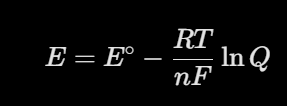
Here is the breakdown of what’s happening inside:
- E is the cell potential under your actual, real-time conditions.
- E° is the standard cell potential (the out-of-the-box value).
- R is the universal gas constant (8.314 J/mol · K).
- T is the temperature measured in Kelvin.
- n is the number of moles of electrons moving through the reaction.
- F is Faraday’s constant (96,485 \text{ C/mol).
- Q is the reaction quotient, which tells you the ratio of product concentrations to reactant concentrations at any given moment.
We deal with these concepts all the time at VedPrep, and we know that visualizing this helps. Imagine a fictional scenario where you are testing a custom battery in a high-temperature lab in Rajasthan during peak summer. If the temperature hits 45°C, your standard E° values won’t give you the right story anymore. You need this equation to predict exactly how that heat and the changing chemical concentrations alter your voltage. It is exactly why the equation shows up everywhere from everyday batteries to high-tech fuel cells and bio-sensors.
Expression of Nernst Equation: Derivation and Significance For RPSC Assistant Professor
To teach this at a college level, you have to appreciate where it comes from. The equation isn’t just pulled out of thin air; it is born directly from the marriage of thermodynamics and electrochemistry.
We know from basic thermodynamics that the change in free energy (ΔG) dictates whether a reaction happens on its own. In a moving electrochemical cell, that relationship looks like this:
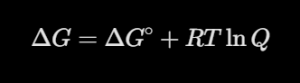
Since chemical energy converts directly to electrical work, we can swap out ΔG for -nFE. When you substitute those values in and clean up the math by dividing everything by -nF, you get the classic Nernst equation.
The real beauty of this equation is its sensitivity. It accounts for temperature swings and ion concentrations simultaneously. If you are preparing for exams like CSIR NET, IIT JAM, or the RPSC interview, understanding this derivation gives you the confidence to explain why a battery’s voltage drops as it dies. The products build up, the reactants disappear, Q gets larger, and that subtractive term drags your total cell potential (E) down.
Worked Example: Nernst Equation For RPSC Assistant Professor
Let’s walk through a classic problem style that frequently trips people up under exam pressure.
The Problem: A copper-copper ion cell has a standard reduction potential of Cu²⁺/Cu = +0.34 V. The concentration of Cu²⁺ is 0.1 M, and the temperature is 25°C. The cell reaction is Cu²⁺ + 2e- → Cu. Calculate the cell potential.
Here is how we tackle this step-by-step:
- Get your temperature into Kelvin:
T = 25 + 273 = 298 K - Identify the electrons transferred (n):
The reaction clearly shows 2 electrons are doing the heavy lifting, so n = 2. - Set up your reaction quotient (Q):
Since pure solids like copper metal have an activity of 1, your Q focuses purely on the ions in solution:
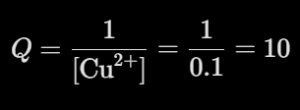
- Plug everything into the equation:
At 298 K, the term RT/F × 2.303 simplifies beautifully to 0.0591. This lets us convert the natural log (ln) to a base-10 log (log10) for quicker calculations:
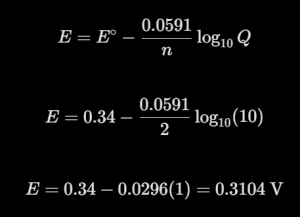
So, your final cell potential under these non-standard conditions is 0.3104 V.
Common Misconceptions About Nernst Equation For RPSC Assistant Professor
One big trap that students fall into is thinking the Nernst equation is only meant for rare, complex situations. In reality, it is the standard E° that is the exception. Standard conditions are a human construct for easy baseline comparisons. The Nernst equation is the actual working law for the real world because almost no chemical system stays at exactly 1 M concentration for long.
Another common slip-up is forgetting to change the sign of the reaction quotient if you accidentally flip the cell reaction. At VedPrep, we always remind our students to write down the full, balanced net cell reaction before touching the math. If you get the products and reactants mixed up in your Q ratio, your log value goes upside down, and your final voltage calculation will be completely off.
Real-World Applications of Nernst Equation For RPSC Assistant Professor
This equation isn’t just academic theory; it runs the modern world. Here is where it shows up outside the textbook:
| Application | How the Nernst Equation Fits In |
| Battery Design | Engineers use it to model how a lithium-ion battery behaves as it discharges from 100% down to zero. |
| Corrosion Protection | It helps predict if a metal pipe buried in wet soil will rust over time by calculating the exact potential shift caused by soil pH and moisture. |
| Medical Sensors | Blood gas analyzers use tiny electrochemical probes to read ion concentrations in a patient’s blood stream based on voltage changes. |
To make this completely clear, let’s create a quick, fictional scenario. Imagine an environmental chemist trying to measure river pollution near an industrial area. By using an ion-selective electrode that relies entirely on the Nernst equation, they can submerge a probe into the river water, read the electrical potential, and immediately calculate the exact parts-per-million concentration of heavy metal pollutants.
Exam Strategy: Tips and Tricks for Solving Nernst Equation Problems
When you are sitting in the exam hall, time is your scarcest resource. Here are a few tricks to help you glide through these problems:
- Watch the Temperature: If the question states the temperature is 25°C (298 K), save time and skip the long multiplication. Use the pre-calculated shortcut value of 0.0591 V for the base-10 log version of the equation.
- Check Your Units: Make sure your gas constant R (8.314 J/mol · K) matches your energy units throughout the rest of your thermodynamic data.
- Log Shortcut Rules: Remember that log1010 = 1, log10(1) = 0, and log10(0.1) = -1. Examiners love using concentrations that resolve into clean powers of 10 to test your conceptual clarity rather than your ability to do long-form long division.
We focus heavily on these speed-running tactics in our sessions at VedPrep because mastering the math shortcuts frees up your mental energy for the trickier conceptual questions on the exam paper.
Practice Problems: A Comprehensive Collection
Let’s test your understanding with a standard exam-style scenario involving a complete galvanic cell.
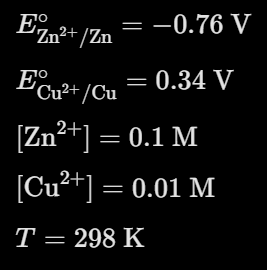
Consider a cell made of a zinc anode and a copper cathode under the following conditions:
The net reaction is:

Here is the path to the solution:
First, calculate your standard cell potential (E°cell):

Next, set up the reaction quotient (Q):
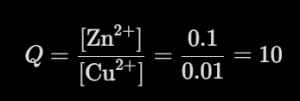
Since two electrons are being transferred (n = 2) at 298 K, drop the values into our shortcut formula:
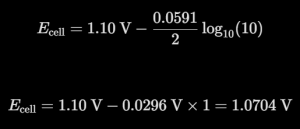
Your final cell potential comes out to approximately 1.07 V. Notice how the lower copper concentration dragged the overall voltage down from its ideal 1.10 V standard value.
Final Thoughts
Mastering the Nernst equation is more than just ticks on a marking scheme—it is about building the deep, intuitive chemistry knowledge you will pass on to the next generation of students as an assistant professor. At VedPrep, we know the journey through competitive exams like RPSC can feel intense, but breaking down these core physical chemistry principles makes the path much smoother. Keep practicing the shortcuts, watch your units, and remember that every formula represents how chemistry works in the real world.
To know more in detail from our faculty, watch our YouTube video:
Frequently Asked Questions
What are the components of the Nernst equation?
The Nernst equation consists of the standard electrode potential, gas constant, temperature, number of electrons transferred, and concentrations of the chemical species involved.
What is the significance of the Nernst equation in electrochemistry?
The Nernst equation is crucial in understanding the behavior of electrochemical cells, predicting the spontaneity of reactions, and determining the equilibrium constant.
How does temperature affect the Nernst equation?
Temperature affects the Nernst equation through the gas constant and temperature term, influencing the electrode potential and reaction spontaneity.
What are the units of the Nernst equation?
The units of the Nernst equation typically involve volts (V) for electrode potential, joules (J) for energy, and moles (mol) for concentrations.
How does the Nernst equation relate to the equilibrium constant?
The Nernst equation can be used to determine the equilibrium constant of a reaction by relating the electrode potential to the concentrations of reactants and products.
What is the role of the Nernst equation in Physical and Organic chemistry?
The Nernst equation plays a significant role in Physical and Organic chemistry, particularly in understanding electrochemical reactions, synthesis, and characterization of compounds.
What is the relationship between the Nernst equation and electrochemistry?
The Nernst equation is a fundamental concept in electrochemistry, describing the electrode potential of a cell under non-standard conditions and predicting reaction spontaneity.
How is the Nernst equation applied in RPSC Assistant Professor exams?
The Nernst equation is a key concept in RPSC Assistant Professor exams, often tested through problem-solving and theoretical questions, requiring a deep understanding of electrochemistry.
What types of questions are commonly asked about the Nernst equation in RPSC Assistant Professor exams?
Common questions include deriving the Nernst equation, applying it to different electrochemical cells, and solving problems related to electrode potential and reaction spontaneity.
How can I practice Nernst equation problems for RPSC Assistant Professor exams?
Practice problems can be found in textbooks, online resources, and VedPrep study materials, focusing on varying concentrations, temperatures, and electrode potentials.
What are common mistakes when applying the Nernst equation?
Common mistakes include incorrect units, sign errors, and neglecting temperature and concentration effects, highlighting the need for careful calculation and attention to detail.
How does the Nernst equation relate to other electrochemical concepts?
The Nernst equation is connected to other electrochemical concepts, such as the Butler-Volmer equation, electrochemical kinetics, and mass transport, illustrating its broader relevance.
What are the limitations of the Nernst equation?
The Nernst equation assumes ideal behavior, neglecting non-ideal effects, such as activity coefficients, and is limited to equilibrium conditions, highlighting the need for complementary approaches.
How can the Nernst equation be extended or modified?
The Nernst equation can be extended or modified to account for non-ideal behavior, kinetic effects, and multi-component systems, demonstrating its adaptability and ongoing development.