




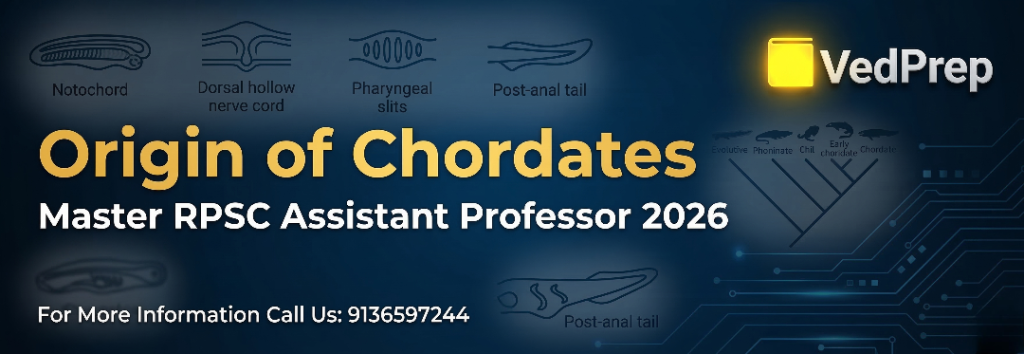

The Origin of Chordates marks the evolutionary shift from invertebrate deuterostomes of ancient lineage to the initial life forms characterized by a notochord, a dorsal hollow nerve cord, and pharyngeal clefts. Contemporary phylogenetic analysis pinpoints the Early Cambrian epoch as the key timeframe for this separation, which set the foundational structure evident in all vertebrates presently.
Scientific Theories and the Evolutionary Origin of Chordates
The Origin of Chordates persists as a key focus within the RPSC Assistant Professor Zoology syllabus since it illuminates the movement from rudimentary to intricate life structures. Scientists propose several hypotheses to explain how a mobile, bilateral organism developed the unique chordate hallmarks. The Echinoderm theory suggests that chordates and echinoderms share a common dipleurula like ancestor due to similarities in embryonic development. You must understand that both groups are deuterostomes, meaning the anus develops from the blastopore during early growth.
The Hemichordate theory focuses on organisms like Balanoglossus in Origin of Chordates . While Balanoglossus possesses pharyngeal gill slits, it lacks a true notochord. Researchers now view hemichordates as a sister group rather than a direct ancestor. Another significant perspective is the Urochordate or Ascidian larva theory. This theory posits that the free swimming larvae of tunicates like Herdmania failed to metamorphose into sedentary adults. Instead, these larvae developed functional reproductive organs while retaining larval features like the notochord. This process, known as neoteny or paedomorphosis, likely led to the first chordate lineage.
Mathematical simulation of these developmental alterations frequently employs transition likelihood formulas. Such frameworks assist scholars in gauging the duration needed for genomic architecture modifications. The subsequent table outlines primary conceptual structures pertaining to the Origin of Chordates.
| Theory Name | Proponent/Basis | Core Expression or Principle |
|---|---|---|
| Echinoderm Theory | Garstang / Bather | Da = De (Deuterostome Ancestry Equality) |
| Auricularia Hypothesis | Muller | Lchordate ≈ Lechino (Larval Morphological Similarity) |
| Neoteny Model | Garstang | Rm > Sm (Reproductive Maturity rate exceeds Somatic Maturity) |
Comparative Anatomy in the RPSC Assistant Professor Zoology Syllabus
Exploring the RPSC Assistant Professor Zoology syllabus necessitates close examination of vertebrate comparative anatomy within paper I. The progression from protochordates such as Branchiostoma to more intricate vertebrates entails substantial alterations in both the outer covering and the supporting framework. The external covering transformed from a simple cellular layer in protochordates into a structure with multiple strata in mammals. This development offered enhanced shielding and temperature control. The supporting structure moved away from a pliable notochord toward a firm spinal column made of bone or cartilage.
Digestive and respiratory systems show a trend toward increased surface area and efficiency in Origin of Chordates . In the initial chordates, the throat area handled both taking in food and breathing. In more advanced vertebrates, these roles split. Gills specialized in fish, while air sacs developed in land vertebrates to aid living on ground. The blood movement system changed from an open or basic closed loop to a heart with four sections in birds and warm-blooded creatures. This change allows for quicker energy use. The waste removal and reproductive systems also improved, as did the nervous system, with the mind forming separate areas for interpreting signals and managing movement.
Adaptation Strategies Across Vertebrate Classes
The Origin of Chordates set the stage for diverse environmental adaptations. Fishes developed streamlined bodies and lateral line systems for aquatic navigation. Amphibians bridged the gap between water and land by developing moist skin for respiration and limbs for locomotion. These dual adaptations are critical for survival in fluctuating environments. You will find that reptilian evolution introduced the amniotic egg, which removed the dependence on water for reproduction.
Regarding the Origin of Chordates, avian species and mammals stand as the apex of vertebrate refinement. Birds developed plumage and pneumatic bones to facilitate aerial locomotion. Their rapid metabolism necessitates an effective breathing apparatus featuring air sacs. Mammals possess mammary glands and fur. Such characteristics aid in maintaining a warm-blooded state and providing extensive care for offspring. Comprehending these modifications is crucial for thoroughly covering the RPSC Assistant Professor Zoology syllabus.
Economic Importance of Chordates in Modern Society
The economic importance of chordates extends through several sectors such as farming, healthcare, and travel. Fish represent a main source of protein for countless individuals globally. The commercial fishing sector adds billions to the world’s finances via commerce and refinement. Aside from sustenance, creatures such as reptiles and amphibians offer toxins and dermal outputs utilized in drug investigation. These materials aid in creating remedies for cardiac issues and persistent discomfort.
Farm animals like cows, sheep, and fowl are central to worldwide farming activities. They supply meat, dairy, fleece, and hides. In numerous societies, equines and dromedaries still serve vital roles in moving goods and doing work. The financial value of chordates also covers environmental benefits. Avian species and Chiroptera serve as organic methods to manage pests and aid in pollination. Safeguarding the variety within chordates guarantees the steadiness of environments that sustain human existence. VedPrep offers thorough units to assist in examining these financial effects for your tests.
Classification and Characteristics of Protochordates
Protochordates mark the early developmental phases in the Origin of Chordates. This collection encompasses the subphyla Urochordata and Cephalochordata. Creatures such as *Herdmania* display a distinct life cycle where the mature form is fixed in place and is missing the majority of chordate traits. In contrast, the larval form possesses a tail, a notochord, and a nerve cord. This difference underscores the significance of these juvenile stages when exploring evolutionary lineage. *Branchiostoma*, or lancelets, offer a better representation of the progenitor chordate structure because they maintain all four defining chordate characteristics throughout their existence.
Balanoglossus, part of the Hemichordata, functions as an anatomical bridge. Its form is segmented into a proboscis, a collar, and a trunk. Although it lacks a genuine notochord, the presence of pharyngeal openings hints at a close connection to the Origin of Chordates. Examining these creatures aids learners in comprehending the gradual alterations that transpired during the emergence of Chordates. The RPSC Assistant Professor Zoology curriculum highlights these structures to establish a groundwork for vertebrate studies.
The Notochord Transition and Evolutionary Constraints
The shift from a pliable notochord to a rigid bony vertebral column marks a key point in the Origin of Chordates. This alteration facilitated greater body dimensions and stronger muscle moorings. Nevertheless, this development introduced limitations. A stiff framework necessitates greater calcium and energy consumption for upkeep. In settings where minerals are limited, certain lineages returned to skeletons made of cartilage. This illustrates that evolution does not invariably advance toward intricacy but rather toward the most effective solution for persistence.
It’s important to grasp that the Origin of Chordates wasn’t just one moment, but rather a succession of genetic and ecological interplay. Certain scholars contend that the conventional understanding of a straight-line development is inaccurate. They propose that various chordate characteristics might have developed on their own in distinct lines before converging in one common forebear. This viewpoint casts doubt on the notion of a straightforward transitional form. It prompts one to examine the evidence from genomes instead of solely relying on fossil findings.
Practical Application of Chordate Studies in Research
Researching the Origin of Chordates has practical applications in developmental biology and genetics. Researchers employ Branchiostoma as a subject for investigating how genes are controlled. Its genetic makeup, lacking the wide-scale duplication present in vertebrates, offers a more straightforward layout of the initial chordate functional set. Grasping these hereditary arrangements assists experts in pinpointing origins of birth anomalies in people. Examining the bone and nerve structures in early chordates guides current advancements in healing technologies.
Final Thoughts
The Origin of Chordates is still among the most fascinating parts of evolutionary science, connecting the simpler sea-dwelling invertebrates with the sophisticated vertebrates prevalent on our planet now. Inspecting the structural shifts from the notochord in creatures such as *Branchiostoma* to the developed bony structures in mammals offers a complete picture of biological change and ancestry. Grasping these ideas is crucial for any academic engaging with the RPSC Assistant Professor Zoology curriculum or advanced competitive assessments. VedPrep provides focused instruction and resources led by specialists to aid you in securing leading positions in these respected academic endeavors. Comprehending this evolutionary leap not only illuminates history but also supplies the genetic basis for contemporary medical and growth studies.
To know more in detail from our faculty, follow our YouTube video:
Frequently Asked Questions (FAQs)
What is the Origin of Chordates?
The Origin of Chordates marks the evolutionary emergence of animals possessing a notochord, dorsal hollow nerve cord, and pharyngeal slits. Scientific consensus points to the Early Cambrian period for this transition. Researchers analyze ancestral deuterostomes to trace how these specialized anatomical features first appeared in the fossil record.
Which period marks the Origin of Chordates?
The Origin of Chordates occurred during the Cambrian explosion approximately 530 million years ago. Fossil evidence from the Chengjiang and Burgess Shale formations confirms the presence of early chordate ancestors. This period saw a rapid diversification of bilateral body plans that led to modern vertebrate lineages.
What are the primary theories regarding the Origin of Chordates?
Key theories include the Echinoderm theory, the Hemichordate theory, and the Urochordate or Ascidian larva theory. The Ascidian larva theory suggests chordates evolved through neoteny. This means larval stages of primitive organisms developed reproductive capabilities while retaining swimming features like the notochord.
How do you study the Origin of Chordates for competitive exams?
Focus on comparative anatomy between protochordates and vertebrates. Map the structural changes in the integument, skeletal, and circulatory systems. Use the RPSC Assistant Professor Zoology syllabus as a guide to prioritize topics like Branchiostoma anatomy and chordate adaptations.
What are the diagnostic features of the Phylum Chordata?
You must identify four primary characteristics: a longitudinal notochord, a dorsal hollow nerve cord, pharyngeal gill slits, and a post anal tail. These features appear at some stage of development in all chordates. Recognizing these traits is fundamental for biological classification and evolutionary mapping.
How is comparative anatomy used to track chordate evolution?
Comparative anatomy examines the similarities and differences in organ systems across vertebrate classes. By comparing the heart of a fish to a mammal, you can track the move toward high pressure circulation. This method provides physical evidence for the sequential complexity described in evolutionary models.
What defines the economic importance of chordates?
The economic importance of chordates stems from their roles in food production, medicine, and ecosystem services. Fisheries provide global protein, while livestock drive the agricultural economy. Pharmaceutical researchers study chordate venoms to develop new medications for cardiovascular and neurological conditions.
Why is the Hemichordate theory sometimes criticized?
Critics argue that the stomochord in hemichordates is not homologous to the chordate notochord. Modern genetic sequencing shows that hemichordates are more closely related to echinoderms. This discrepancy requires a careful distinction between analogous and homologous structures during your exam preparation.
What limits the fossil record for the Origin of Chordates?
Early chordates were soft bodied organisms that did not fossilize easily. This lack of hard parts creates gaps in the chronological record. Researchers rely on exceptional preservation sites like the Burgess Shale to find impressions of fragile structures like the notochord.
How do you distinguish between neoteny and paedomorphosis?
Neoteny is the slowing of physiological development, while paedomorphosis is the retention of juvenile traits in the adult. In the context of chordate origins, these terms describe how larval swimming forms became the blueprint for the vertebrate body plan.
What is the transition probability model in chordate evolution?
The transition probability model uses mathematical expressions to estimate the likelihood of genomic changes. It calculates the rate of mutation required to develop complex structures like the four chambered heart. These models help quantify the timeframes discussed in evolutionary theory.
What is the significance of the endostyle in early chordates?
The endostyle is a ciliated groove in the pharynx used for filter feeding. It is the evolutionary precursor to the vertebrate thyroid gland. This homology demonstrates how a feeding structure adapted to become a vital endocrine organ.
How do chordate adaptations differ between birds and mammals?
Birds adapted for flight through feathers and pneumatic bones. Mammals adapted through hair, mammary glands, and specialized dentition. Both groups independently developed endothermy to maintain high metabolic activity in diverse climates.
What is the role of the RPSC Assistant Professor Zoology syllabus in career planning?
The syllabus defines the technical standards for academic positions in Rajasthan. Mastering sections on chordate evolution and economic importance prepares you for high level teaching and research roles. It ensures a deep understanding of biodiversity and evolutionary mechanics.